
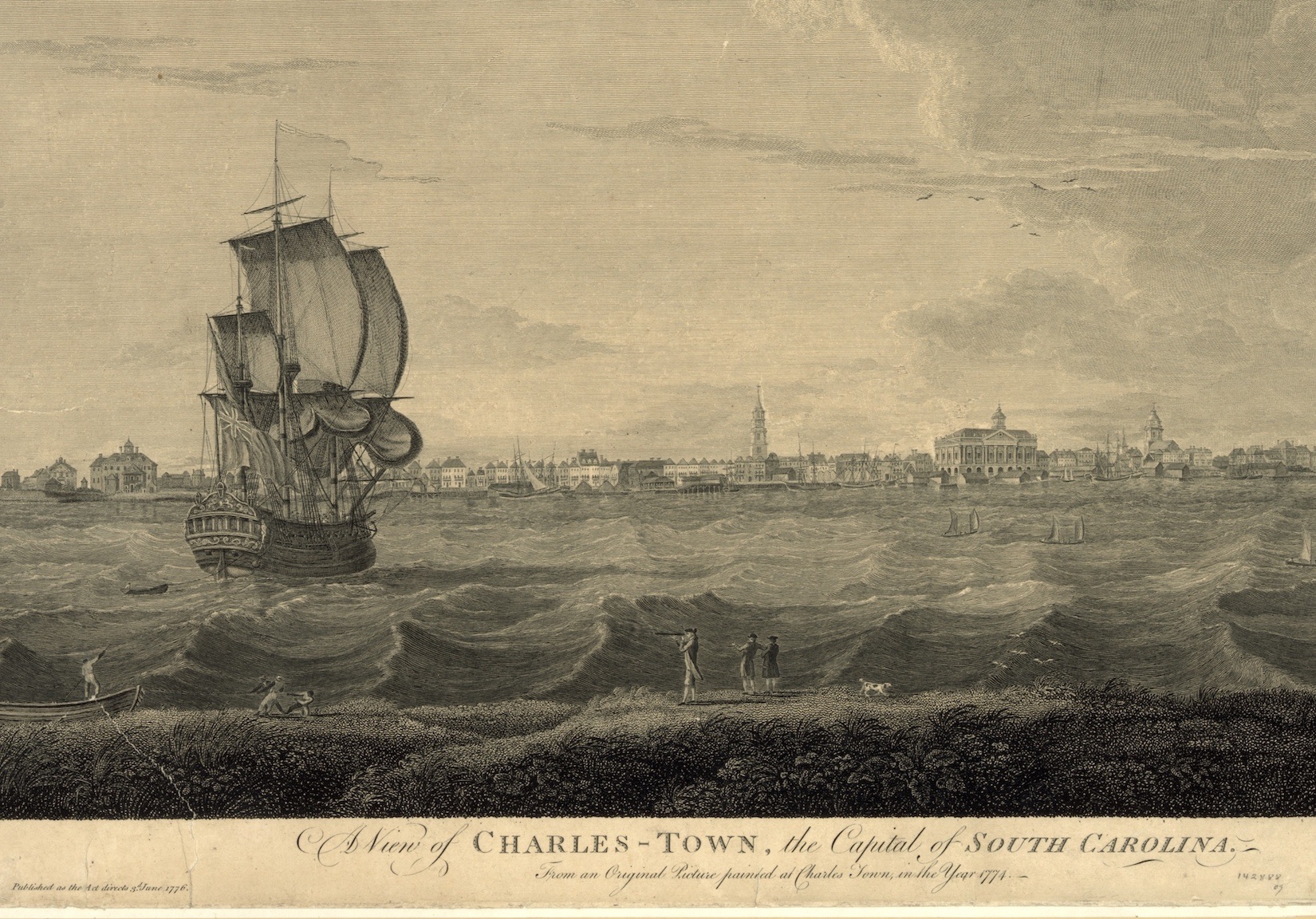
One hundred and five years after the founding of modern South Carolina, the king’s royal governor dissolved the provincial government and fled the capital in mid-September 1775. Lord William Campbell’s famous nocturnal flight to the warship Tamar followed a sustained summer campaign of rebel intimidation, and triggered an autumnal stand-off between hostile American colonists and British officials desperate to preserve control of Charleston Harbor.
In letters and speeches written after his arrival in late June 1775, Governor Campbell repeatedly acknowledged that the metastasizing shadow-government erected by rebel South Carolinians—including the Provincial Congress, the General Committee of Charleston, and the executive Council of Safety—had effectively seized the reins of power. Civilian agents of the rebel faction now openly threatened and assaulted their neighbors who expressed loyalty the British Crown, while the rebel congress printed a profusion of fiat paper money to fill the ranks of an illegal standing army.
On the last day of August, as I mentioned in the previous episode, Lord William informed the Earl of Dartmouth, British Secretary of State for the American Colonies, that South Carolina’s increasingly volatile political climate might soon oblige him “to withdraw from Charleston to avoid fresh indignities.” Campbell’s candid statement was not an admission of failure or cowardice, but a pragmatic prediction echoing the well-reported movements of his colleagues to the north. Josiah Martin, Governor of North Carolina, had fled from his official residence in early June 1775 and taken refuge aboard His Majesty’s sloop-of-war Cruizer, stationed at the mouth of the Cape Fear River. Days later, Virginia’s last Royal Governor, John Murray, 4th Earl of Dunmore, fled from Williamsburg and took up residence aboard the British frigate Fowey in the York River.

Campbell’s exit strategy stemmed in part from a desire to shield his family from threats of physical violence against the king’s chief agent in South Carolina. At some point during the months of July or August, Lord William, his wife Sarah Izard, their three children, and the family’s domestic servants removed from their temporary residence in Miles Brewton’s King Street mansion to the house now identified as 34 Meeting Street. The three-story brick structure in question was built during the 1760s as a luxurious townhouse for a Lowcountry planter named John Bull. Two of Bull’s granddaughters, first cousins to Lady William Campbell, inherited the house in 1771, and Miles Brewton managed the property during the tenure of South Carolina’s last royal governor. The house was not ready for Campbell’s occupation when he stepped ashore on 18 June 1775, but he and his family transitioned to the Meeting Street mansion shortly afterwards.[1]
During the first week of September, the rebel General Committee ordered all of the king’s civil officers—Lord William Campbell excepted—to surrender their personal arms and confine their movements within the limits of urban Charleston. Agents of the Committee then visited the governor’s residence on the evening of September 3rd to order Alexander Innes, Campbell’s private secretary, to depart from South Carolina within twenty-four hours. The rude encounter rattled Lord William’s confidence in his family’s safety and compelled Secretary Innes to move his belongings from the governor’s house to the sloop-of-war Tamar in Rebellion Road on September 6th.
Under clear skies the following morning at 8 a.m., the king’s mariners aboard the Tamar heard the familiar boom of a signal gun beyond the bar of Charleston Harbor, fired by a ship seeking a pilot. Spyglasses pointed towards the bright eastern horizon observed the long, swallowed-tailed pennant of red, white, and blue flying at atop the ship’s main topgallant mast, indicating a vessel of the Royal Navy. At ten, an unidentified harbor pilot sailed out to greet the new arrival and offer his professional services. The ship weighed anchor at noon, and the crew trimmed its canvas to traverse the principal channel through the treacherous sandy shoals. Two hours later, the helpful pilot gave the signal to anchor in Rebellion Road, near the worm-eaten Tamar, and then departed into obscurity.[2]
His Majesty’s armed vessel Cherokee was a recent, unconventional addition to the king’s fleet. Built in Massachusetts two years earlier for trans-Atlantic commerce, the ship-rigged vessel was sold to the Royal Navy in 1774 specifically for the use of His Majesty’s Surveyor General for the Southern District of North America, who was responsible for updating coastal maps of the southern colonies. Three masts extended high above the ship’s main deck, which measured seventy-six feet in length from stem to stern. Six wooden carriages arrayed between the fore- and mainmasts supported small cannons firing three-pound shot, while iron brackets along the outboard railing supported eight smaller swivel guns firing half-pound shot. Below deck, the Cherokee afforded space for 177 tons of cargo and passengers, a burthen comparable to an average merchant ship of that era. Like the larger Tamar and other warships of similar size, the survey vessel carried two boats, described as a pinnace (for passengers) and a longboat or cutter (for materiel).[3]

The Cherokee’s assigned complement included just one lieutenant, John Fergusson (his spelling, circa 1731–1818), one sailing master, William Pickard, and twenty-seven seamen. Earlier in the year, the Lords of the Admiralty directed Fergusson to receive on board Surveyor General William De Brahm and his entourage, transport them to Charleston, and then to sail “to such other parts” of the North American coastline, between the rivers Potomac and Mississippi, “as the said Mr. De Brahm shall from time to time, desire.”[4] To accomplish this mission, the Cherokee carried seven civilian supernumeraries, including Mr. Brahm, four deputy surveyors, one apprentice, and one servant. After a series of delays in England, the Cherokee departed from Plymouth on July 1st, took on wine and water at the Island of Madeira, and crossed the Atlantic to Charleston.[5]
Shortly after his arrival in Rebellion Road, Lieutenant Fergusson went aboard the Tamar to converse with Captain Edward Thornbrough. The elder, bed-ridden captain, plagued by chronic gout, informed his junior colleague that local rebels had recently outfitted at least two schooners with guns, contrary to the king’s suppression of American arms. Days earlier, sailors retrieving provisions from the town’s marketplace reported rumors that the rebel vessels were planning to attack and board the king’s warship. Fergusson carried this information back to the Cherokee, where crewmen “loaded the guns for action” at dawn on September 8th. The following morning, the crew hoisted an additional pair of carriage guns from the ship’s hold and mounted them on deck for their better defense.
Lord William did not personally visit the Cherokee to welcome its British crew to Charleston, but, with the aid of a telescoping spyglass, he observed the ship’s arrival from his residence, three miles west of Rebellion Road. In a letter to the Earl of Dartmouth later that month, Campbell said that “the very sight of the pennant, which made some little addition to our force, gave me great pleasure.”[6] While the appearance of the survey vessel bolstered the king’s diminishing authority in the harbor, the men aboard the Cherokee did not intend to remain long before proceeding on their assigned mission. Their departure was delayed, however, by the sudden collapse of British authority in the capital of South Carolina.
After a simmering, months-long struggle for political supremacy within urban Charleston, the countdown to a revolutionary rupture commenced with a knock at the governor’s door. Campbell’s unexpected guest was a backcountry planter named Moses Kirkland, who in June 1775 had accepted an officer’s commission in one of the new regiments authorized by the South Carolina Provincial Congress. He later renounced his affiliation with the illegal army, organized a counter-insurgency, and faced the scorn of his disaffected neighbors. To escape punishment as a traitor to the rebel cause, Kirkland fled to Charleston in disguise, accompanied by a small entourage of like-minded supporters. The wanted men galloped into town on the evening of September 11th and immediately sought protection under the governor’s roof. At dawn the following morning, after a late-night discussion of backcountry politics, Campbell quietly sent Kirkland in a boat across the rain-swept harbor to the Tamar for his protection.[7]

Hours after Moses Kirkland’s sunrise journey to the king’s warship, rebel agents in town apprehended one Bailey Cheney (spelled variously), a young backcounty citizen who had accompanied the fugitive to Charleston. Cheney was forcibly detained and, on the afternoon of September 13th, interrogated by members of the General Committee, chaired by Henry Laurens. Under intense scrutiny from the rebel leaders, Cheney confessed that Governor Campbell had, since his arrival in South Carolina, secretly communicated with backcountry loyalists to encourage their armed resistance, contrary to assurances of neutrality that Lord William had given repeatedly to rebel leaders in the capital.[8]
Word of the governor’s duplicity enraged the Committee, some of whom proposed a radical plan to confirm the true nature of Campbell’s western correspondence. Adam McDonald, a captain in the nascent provincial army, offered to disguise himself as a “back country woodsman,” armed with a pair of pocket pistols, and accompany Bailey Cheney to the governor’s house. There, Cheney would introduce McDonald as fictional companion named Dick Williams, and initiate a conversation with Campbell about Moses Kirkland and loyalist activity on the western frontier. Cheney’s participation in the ruse was his sole path to freedom, said the rebel Committee. If he refused to comply, or sabotaged the gambit while in the governor’s presence, Captain McDonald vowed “he would immediately blow out his brains.” The backcountry youth grudgingly agreed to the scheme, but its execution was delayed by the governor’s sudden maritime excursion across the harbor.
At 4 p.m. on the squally afternoon of September 13th, the British packet boat Swallow anchored in Rebellion Road with a cargo of July mail from England.[9] Crewmen dispatched from the Tamar immediately transferred bags of letters from the packet to the warship, as they had done with similar deliveries since early July, when a rebel party burglarized the town’s Post Office on Bay Street. Governor Campbell, eager to read news that might strengthen his diminishing authority, boarded a small boat in the Cooper River and climbed aboard the Tamar amidst showers of heavy rain. Captain Thornbrough, roused from his bed by the commotion, ordered his men to fire a fifteen-gun salute to the visiting governor, while apprehensive rebels in town considered new strategies to pilfer the latest British intelligence.[10]
Foremost among the government dispatches addressed to Campbell was a letter from the Earl of Dartmouth, dated 5 July 1775, that assuaged the governor’s mounting anxiety. The Board of Admiralty, following the king’s instructions, was preparing to dispatch a number of warships and troop transports to North America, including a small squadron assigned to South Carolina with instructions to remain “within the bar of Charles-Town.”[11] Furthermore, the out-bound vessels were to carry orders for all British commanders in American waters “to receive on board His Majesty’s ships and to afford every reasonable accommodation to the governors, or other officers of the colonies within their respective stations, who may be compelled by the violence of the people to seek such an asylum,” and to oppose with force all American attempts to construct new defensive fortifications.[12]

Excited by the assurance of imminent reinforcement, Governor Campbell returned to his residence in Meeting Street after dark on the stormy evening of September 13th. At 10 p.m., another knock at the door announced the arrival of Bailey Cheney and his hayseed companion called Dick Williams, who introduced himself as a humble sergeant loyal to Moses Kirkland. Campbell fell headlong into their deceptive trap and chatted freely with his country guests, readily confirming both his support for armed resistance to the rebel menace and news of British warships coming to batter the rebellious Americans into submission. “I have a letter from the King,” said the governor, referring to the latest mail from England, “and he is resolved to carry his [military] scheme into execution, from one end of the continent to the other.” “Will he send any soldiers here, between this [time] and the fall?” asked the curious Dick Williams. “Yes, he will,” replied Campbell, “and this will be a place of settled soldiers; and a seat of war shortly.”[13]
The loquacious governor also peppered their conversation with disparaging remarks about the various rebel committees, while Bailey Cheney and Adam McDonald played their covert roles with convincing acumen. Immediately after thanking Lord William for his late-night hospitality, Captain McDonald shed his disguise and hastened back to a candlelight debriefing with the General Committee. The rebel leaders, insulted by the governor’s deception and disrespect, now understood clearly that British reinforcements would soon arrive. The king’s superior firepower might then force the rebels of Charleston to disarm, and perhaps occupy Fort Johnson on James Island to solidify their tenuous control over the flow of ship traffic in and out of the harbor. Although the Committee rejected a proposal to arrest and detain Campbell, they authorized a delegation to confront the governor in person to force a blunt reckoning of his duplicitous behavior.
Early on the rainy morning of September 14th, a gang of nine rebel leaders—including Adam McDonald—interrupted Governor Campbell as he strolled to the Cooper River waterfront, on his way to continue reading mail aboard the Tamar. The impatient Americans confronted Lord William with the “most insolent and audacious demand,” as he described it, to see his latest letters from England and copies of his correspondence with backcountry loyalists. Campbell steadfastly refused to comply with their hostile request, but “in the course of conversation, acknowledged that ships and troops were to be sent from England to all the colonies, and might be shortly expected.” After their rude encounter in public view, the governor proceeded by boat to the Tamar, where he remained for some hours.[14]
Both Campbell and his rebel adversaries now realized that a serious rupture was imminent, and both parties took immediate action to protect their interests. The delegates who had confronted the governor reported directly to the larger General Committee, who, after a brief discussion, “deemed it high time to take possession of Fort Johnson,” a minor fortress completed in 1709 and expanded during the late 1750s. Although its garrison in 1775 consisted of just a handful of soldiers in the king’s pay, mariners from the nearby Tamar might have visited the fort regularly and thereby created the illusion of a stronger resident force. The General Committee forwarded its recommendation to the members of the executive Council of Safety, who, during the morning of September 14th, ordered Colonel William Moultrie of the South Carolina Provincial Army to scramble three companies of infantry for a secret expedition to seize the island fort.[15]
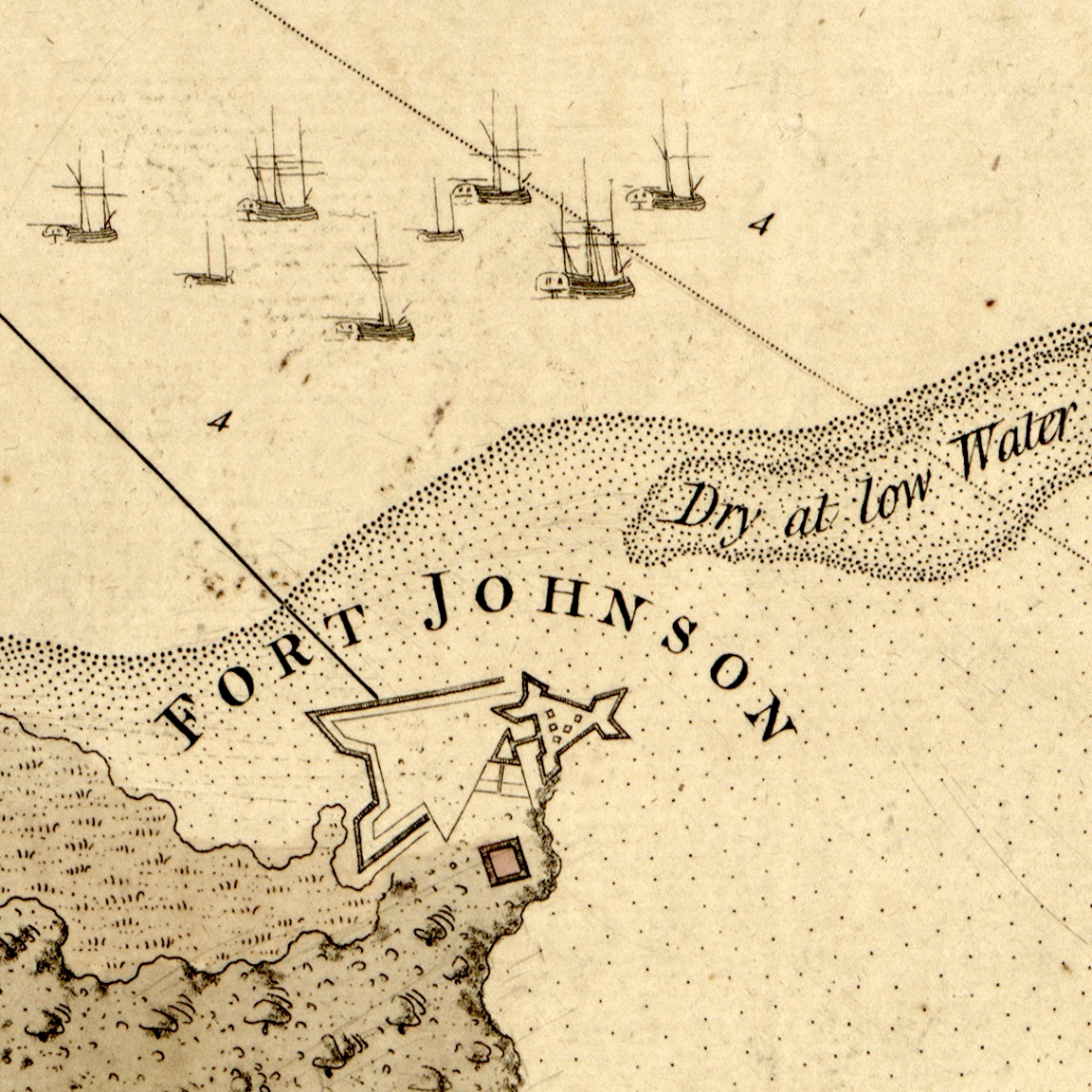
While menacing storm clouds gathered above the Tamar in Charleston Harbor that same afternoon, Governor Campbell flexed his executive authority over the king’s forces in South Carolina. To Captain Thornbrough, the Royal Navy’s senior officer in the colony, Lord William recommended “in the strongest manner” that he detain the Cherokee until further notice, and take care “that she is kept in constant readiness for service.” Because the survey vessel’s modest crew was “not sufficient for the defence of the ship, and to assist in protecting His Majesty’s servants and faithfull subjects in this Province,” Campbell ordered the naval officers to increase the Cherokee’s complement to fifty effective men “as soon as possible.”[16] Their conversation aroused the indignation of Surveyor General William De Brahm, who objected to the interruption of his cartographic mission. Governor Campbell “cut him very short,” however, noting that it was “a fine time to talk of his surveys of a country that we are in a doubt to whom it may belong.”[17]
Before returning to his residence in town on the cloudy afternoon of September 14th, Campbell paid a brief visit to James Island, perhaps in company with his secretary, Alexander Innes. The purpose of the excursion was likely to inspect the crumbling state of Fort Johnson and assess its strategic value. Gunner George Walker, chief officer-in-residence and recent victim of a brutal tar-and-feathering, evidently conversed with the governor about the vintage and value of the fort’s motley collection of twenty-one iron cannons. In a subsequent conversation with Captain Thornbrough or Secretary Innes, Campbell directed his subordinates to dispatch a party of men that evening to dismount all of the heavy guns at Fort Johnson, in case the American rebels should attempt to seize the works and turn them against the king’s forces in the harbor.[18]
Captain Thornbrough shared the governor’s latest instructions with his junior colleague aboard the survey vessel, and both ships organized shore parties at sunset. Their nocturnal assignment coincided with the peak of the annual hurricane season, and the day’s gloomy weather worsened as darkness spread across the starless sky. At 8 p.m., a party of perhaps a dozen armed seamen under the command of Lieutenant John Fergusson departed from the Cherokee in the ship’s pinnace, likely rowing first to the larger warship nearby to coordinate a plan of action. At 9 p.m., Captain Thornbrough detached Lieutenant Joseph Peyton and “about 30” armed men from the Tamar, filling both the ship’s pinnace and longboat. Alexander Innes accompanied the mariners and, as a former army captain, might have assumed command of the covert operation.[19]
Through bands of driving rain, the king’s boats rowed a mile and a half to the southwest, battling choppy waters and strong gales to reach the northern shore of James Island before midnight.[20] The armed sailors then tread quietly through the gate of the old fort and dispersed across its rambling landscape of turfed ramparts and tabby walls. Captain Innes, perhaps accompanied by a few musketeers, marched into the fortified barracks to detain gunner George Walker and his feeble crew of three or four soldiers.[21] Under the stormy, moonless sky, the waterlogged mariners worked in teams to muscle each of the fort’s twenty-one cannons from their respective platforms and push them over the high parapets facing the harbor, destroying in the process some of the heavy wooden carriages. They did not, however, hammer spikes into the cannons’ touch holes, nor did they remove any of their mounting trunnions, both standard methods for rendering cannon unusable. Governor Campbell later took responsibility for this military decision, explaining that he was “loath to order [the cannons] to be spiked up and the trunnions knocked off, as they are good guns and were brought from England at a great expense to government.”[22]
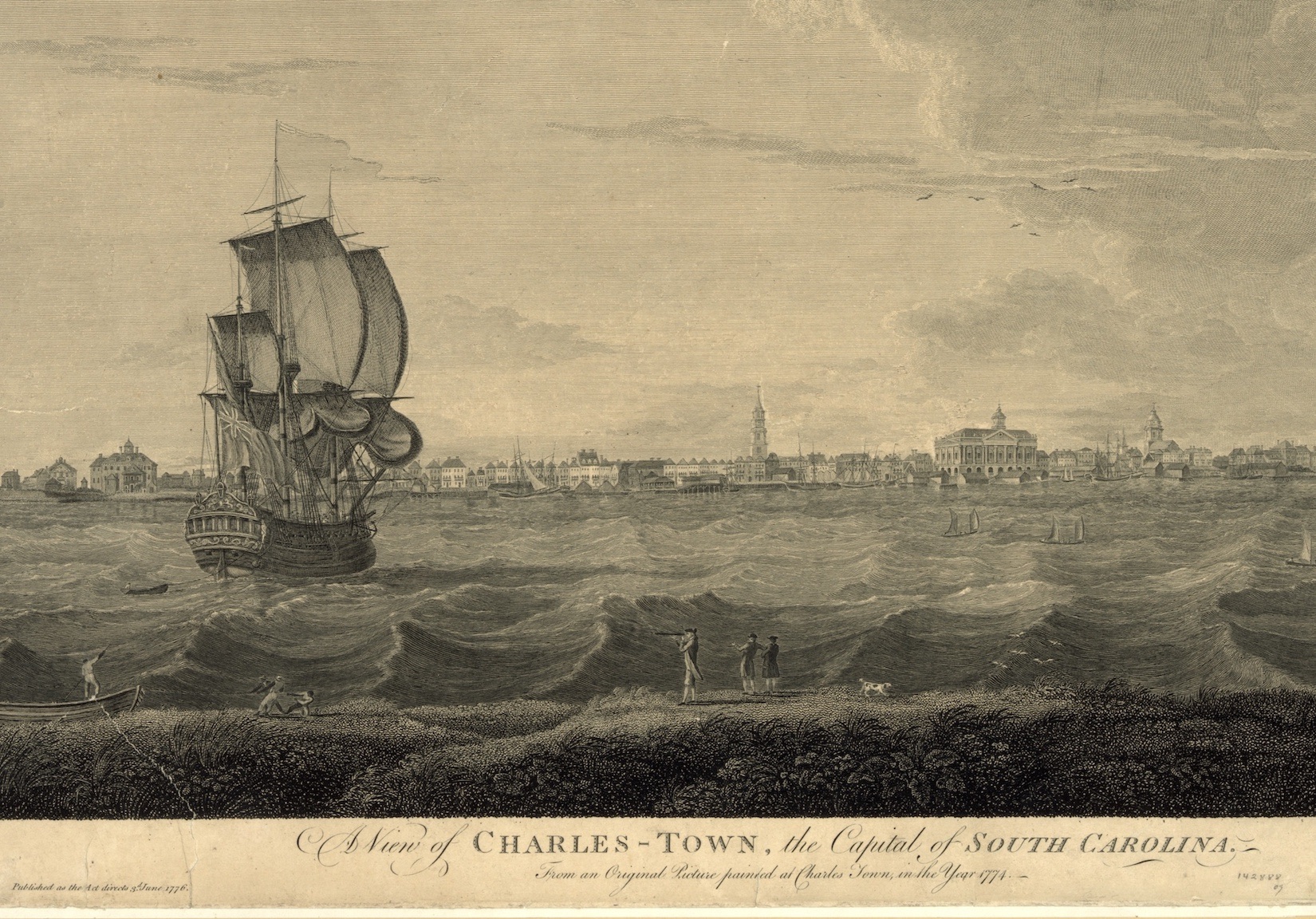
Having accomplished their nocturnal mission, the king’s mariners and Secretary Innes returned to their beached boats and rowed through showers of rain to Rebellion Road, reaching the Tamar and Cherokee some “three or four hours before day-light.” The exhausted seamen “had hardly got on board,” said Governor Campbell, when they saw a number of small boats landing scores of rebel soldiers on the north shore of James Island. After they took possession of Fort Johnson without resistance, the resident gunner, George Walker, informed the provincial officers that Alexander Innes and the king’s men had “left the fort two hours ago.”[23]
News of the rebel seizure of Fort Johnson spread quickly across Charleston at the dawn of September 15th as citizens commenced their daily routines and procured fresh provisions from the town’s waterfront markets. Governor Campbell and his wife, Sarah, had likely slept little, no doubt conversing through the stormy night about their fading futures in South Carolina. As the king’s chief representative in the hostile province, Lord William was a lightning rod for American resentment of British colonial policy, and his continued presence in the capital compromised the safety of his family. The two cramped warships in the harbor could not possibly accommodate the entire Campbell household, or so they believed. That circumstance, combined with the rising tide of political violence across the American colonies, obliged the governor to embrace the reality of a temporary separation.
In his final executive act in Charleston, Governor Campbell summoned the few remaining members of his advisory Council for a daybreak meeting of an extraordinary nature. Their brief conversation soon concluded that the time had arrived for the king’s representative to withdraw from his government. With the consent of His Majesty’s Council for South Carolina, Campbell issued a brief proclamation dissolving the provincial General Assembly, which a local newspaper published the same morning.[24] Lord William then returned to his residence in Meeting Street to assemble trunks of necessary clothing and papers. On the evening of September 15th, he bid farewell to his wife and children, boarded a small boat along the waterfront, and retreated to the relative safety of His Majesty’s sloop-of-war Tamar.
Campbell explained his decision to abandon his government in a frank letter to the Earl of Dartmouth, written a few days later: “The king’s dignity and the honour of his government would not permit me to remain any longer in Charleston, and I have at last been under the necessity of retiring on board His Majesty’s ship in this harbour.” After describing his hostile confrontation with rebel leaders on September 14th, and the rebel seizure of Fort Johnson the following morning, Campbell summarized his exodus: “I could no longer think of remaining in Charleston, and after holding a Council, shutting up the offices, and dissolving the Assembly, I retired on board the King’s ship, where I am crowded up in a little cabin without the least possibility of procuring any accommodation for Lady William, who must remain on shore with my children and servants unless I can procure a ship.”[25]
Aboard the Tamar in Rebellion Road on the evening of September 15th, Captain Thornbrough noted in his log that the governor had taken refuge aboard the warship “for the safety of his person.” This maritime asylum was not the ignominious end of Campbell’s brief career in South Carolina, however. Lord William still held a royal commission, and he was determined to persevere against the rebel usurpation of his government until the arrival of the reinforcements promised in his recent letters from England. Tune in next time, when we’ll follow the continuing saga of the Royal Navy’s floating resistance within Charleston Harbor, and witness the first shots of the nascent revolution in the colonial capital.
[1] John Bull (died 1768), of Prince William Parish, and his wife, Mary Bull (died 1771), purchased the site of the present No. 34 Meeting Street in 1759 (see George Eveleigh to John Bull, lease and release, Charleston County Register of Deeds, volume C6: 133–39). Mary Bull inherited her husband’s property within urban Charleston, then bequeathed that property to granddaughters Mary Izard Brewton and Elizabeth Izard Blake (see the 1771 will of Mary Bull, Charleston County WPA transcript volume 14: 127–31). Through the legal doctrine of coverture, their husbands, Miles Brewton and Daniel Blake, respectively, controlled the property, but the Blakes resided in England in 1775. The Brewtons perished at sea in late August 1775, leaving the absent Daniel and Elizabeth Blake in full legal possession of the house now known as 34 Meeting Street. Documentation confirming the residence of Campbell’s family at that address does not survive from the eighteenth century. Rather, that information exists as an oral tradition passed down through the successive owners of the property over the past two and a half centuries.
[2] Throughout this essay, I have extracted descriptions of Cherokee- and Tamar-related activities, movements, weather conditions, and quotations from four manuscript sources at the National Archives, Kew: Captain’s log (Edward Thornbrough), Tamar, 1775–76, ADM 51/968; Muster books, Tamar, 1775–77, ADM 36/7697; Master’s log (William Pickard), Cherokee, 1775–76, ADM 52/1662; and Muster books, Cherokee, 1775–76, ADM 36/8049; and from two manuscript sources held at the Caird Library and Archives, National Maritime Museum, Greenwich: Lieutenant’s log (John Fergusson), Cherokee, 1775–76, ADM/L/C/284; and Lieutenant’s log (Joseph Peyton), Tamar, 1775–76, ADM/L/T/6.
[3] For information about the Cherokee and De Brahm’s surveying mission, see Louis De Vorsey Jr., De Brahm’s Report of the General Survey in the Southern District of North America (Columbia: University of South Carolina Press, 1971); Winfield, British Warships in the Age of Sail, 1714–1792, page 555 of the e-book edition.
[4] Admiralty instructions to Lieutenant John Fergusson, 16 January and 6 April 1775, in ADM 2/99, pages 242–43, 317–19, at the National Archives, Kew. According to the Muster books, Cherokee, 1775–76, ADM 36/8049, the ship’s assigned complement was thirty men, one of whom was a fictive “widow’s man.”
[5] Besides William De Brahm, the supernumeraries named in the Cherokee muster books included deputy surveyors Seton Wedderburn Row (De Brahm’s son-in-law), Moriz [sic] De Brahm (William’s nephew), Joseph Purcell, and John Williams; apprentice Philip Wesner; and servant Edward Herbert. Archival sources in South Carolina demonstrate, however, that Joseph Purcell was already in Charleston in 1775. The Cherokee muster books do not mention the presence of Mrs. De Brahm, but the died aboard the ship on 8 September 1775 and was buried at an unknown location two days later; see Charles L. Mowat, “That ‘Odd Being’ De Brahm,” Florida Historical Quarterly, volume 20, No. 4 (1941): 336.
[6] Lord William Campbell to the Earl of Dartmouth, 19 September 1775, in K. G. Davies, ed., Documents of the American Revolution, volume 11 (Dublin: Irish Academic Press, 1976), 116. In this quote and throughout this essay, I have reproduced the spelling found in the original source, but added punctuation to clarify the syntax.
[7] John Drayton, Memoirs of the American Revolution, volume 2 (Charleston, S.C.: A. E. Miller, 1821), 29–30; Keith Krawczynski, William Henry Drayton: South Carolina Revolutionary Patriot (Baton Rouge: Louisiana State University Press, 2001), 157–59, 166, 179–85. Note that Kirkland does not appear as a supernumerary in the muster books of the Tamar.
[8] Drayton, Memoirs, 2: 29–30; Henry Laurens to William Henry Drayton, 15 September 1775, in David R. Chesnutt, The Papers of Henry Laurens, volume 10 (Columbia: University of South Carolina Press, 1985), 386–88.
[9] Details related to the arrival of the Swallow appear in the aforementioned logbooks, and in South Carolina and American General Gazette, 8–15 September 1775, page 3.
[10] Lord William Campbell to the Earl of Dartmouth, 19 September 1775, in Davies, Documents of the American Revolution, 11: 117.
[11] The Earl of Dartmouth’s letter to Lord William Campbell, dated 5 July 1775, is abstracted in K. G. Davies, ed., Documents of the American Revolution, 1770–1783, volume 10 (Dublin: Irish Academic Press, 1976), page 24 (item No. 26); the full text is found among the Correspondence of the Secretary of State, 1773–1777, CO 5/396, folios 147–50, at the National Archives, Kew.
[12] Earl of Dartmouth to the Board of Admiralty, 1 July 1775, in William Bell Clark, ed., Naval Documents of the American Revolution, volume 1 (Washington, D.C.: U.S. Government Printing Office, 1964), 1307–8.
[13] Drayton, Memoirs, 2: 31–32.
[14] Drayton, Memoirs, 2: 34–36; Henry Laurens to William Henry Drayton, 15 September 1775, and to South Carolina Delegates to the Continental Congress, 18 September 1775, in Chesnutt, Papers of Henry Laurens, 10: 386–88, 397–400; Lord William Campbell to the Earl of Dartmouth, 19 September 1775, in Davies, Documents of the American Revolution, 11: 117.
[15] Drayton, Memoirs, 2: 35. Note that the Council of Safety’s order to Moultrie is dated 13 September 1775 in various sources, including William Moultrie, Memoirs of the American Revolution, volume 1 (New York: D. Longworth, 1802), 86–87; Drayton, Memoirs, 2: 44–45; Chesnutt, Papers of Henry Laurens, 10: 380–81, but the direction “to embark this night,” contained within the said order, demonstrates that the Council drafted it during the early morning hours of the 14th.
[16] Thornbrough summarized Governor Campbell’s “recommendation” of September 14th in a letter to Lieutenant John Fergusson, dated on board the Tamar in Rebellion Road, 15 September 1775, a copy of which he enclosed within a separate letter to Admiralty Secretary Philip Stephens, dated 23 October 1775, in ADM 1/2591, at the National Archives, Kew. Campbell also described his “request” to Captain Thornbrough in a letter to the Earl of Dartmouth, 19 September 1775, in Davies, Documents of the American Revolution, 11: 116–17.
[17] Alexander Innes, aboard the Cherokee in Rebellion Road, to Patrick Tonyn, Governor of East Florida, 15 October 1775, in William Bell Clark, ed., Naval Documents of the American Revolution, volume 2 (Washington, D.C.: U.S. Government Printing Office, 1966), 465–66.
[18] Campbell’s visit to Fort Johnson on September 14th was observed by Lieutenant-Colonel Isaac Motte, who reported the same to Henry Laurens; see Laurens to William Henry Drayton, 15 September 1775, in Chesnutt, Papers of Henry Laurens, 10: 387.
[19] Governor Campbell mentioned the participation of Lieutenants Fergusson and Peyton in his letter to the Earl of Dartmouth, dated 19 September 1775, in Davies, Documents of the American Revolution, 11: 117.
[20] Captain Thornbrough recorded the ship’s latest coordinates in Rebellion Road under the heading of 12 September 1775 in his aforementioned logbook: Sullivan’s Island, East ½ South; the “high steeple in Charles Town” (i.e., St. Michael’s Church), West by North; and Fort Johnson, Southwest 1 ½ miles.
[21] The participation of Alexander Innes is mentioned in Drayton, Memoirs, 2: 36, and in the manuscript order book of Captain Barnard Elliott, who commanded one of the companies that captured Fort Johnson on 15 September 1775; see “Diary of Barnard Elliott,” in Charleston Year Book, 1889, 161. Various contemporary sources disagree on the number of men present at Fort Johnson on 14–15 September 1775, counting between three and six in total.
[22] Lord William Campbell to the Earl of Dartmouth, 19 September 1775, in Davies, Documents of the American Revolution, 11: 117.
[23] Drayton, Memoirs, 2: 36; Lord William Campbell to the Earl of Dartmouth, 19 September 1775, in Davies, Documents of the American Revolution, 11: 118; “Diary of Barnard Elliott,” 161; Moultrie, Memoirs, 1: 87–88.
[24] The text of Campbell’s proclamation appears in SCAGG, 8–15 September 1775, page 3; and in Drayton, Memoirs, 2: 39.
[25] Lord William Campbell to the Earl of Dartmouth, 19 September 1775, in Davies, Documents of the American Revolution, 11: 116–17. Note that this same letter, after describing the rebel seizure of Fort Johnson on the morning of September 15th, confirms that Campbell fled to the Tamar “that evening.” The logbook entries of both Captain Thornbrough and Lieutenant Peyton of the Tamar record Campbell’s arrival under the heading of September 15th, though curiously indicating “AM” and “PM,” respectively. The ship’s muster books also record Campbell’s arrival as a supernumerary on 15 September 1775.
NEXT: Posturing in Charleston Harbor, September 1775: Prelude to a Firefight
PREVIOUSLY: The Tamar in Rebellion Road: Asylum for Loyalists in 1775
See more from Charleston Time Machine