
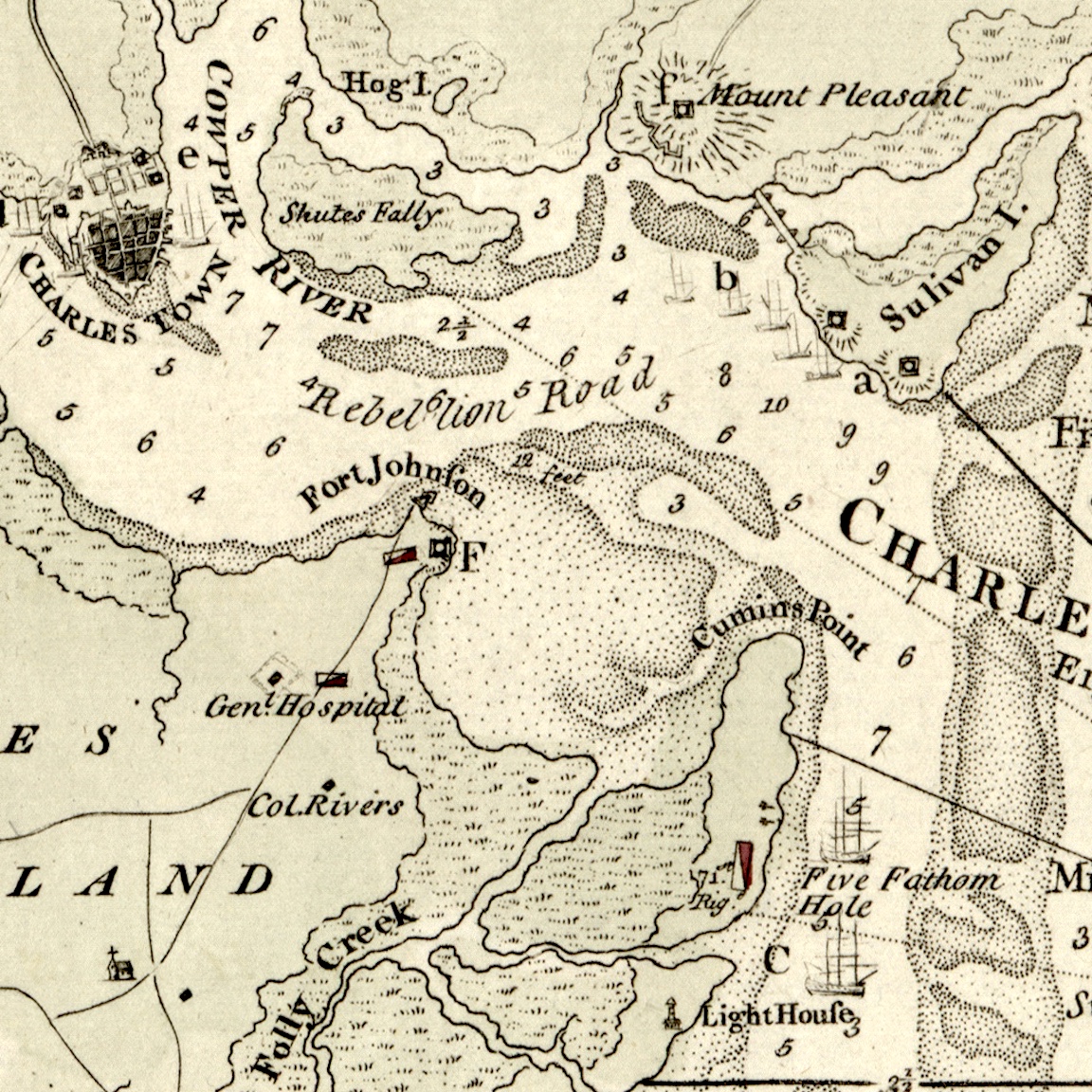
In late September 1775, elements of the Royal Navy and South Carolina’s provincial army exchanged threats and postured aggressively within Charleston Harbor, but neither side possessed sufficient martial confidence to initiate the use of lethal force. Amidst the cracking veneer of polite détente within the provincial capital, possession of Sullivan’s Island quickly emerged as the principal objective of their competing military agendas.
As I mentioned in the previous episode, Governor Lord William Campbell on 15 September 1775 dissolved the provincial government, quit his rented house in the capital, and retired to the safety of the sloop-of-war Tamar. That same day, soldiers recruited by South Carolina’s shadow government quietly took possession of Fort Johnson on James Island. These events marked the collapse of British rule in the colony and the beginning of a new chapter in the maturing rebellion. Eight months after the creation of the South Carolina Provincial Congress, and five months after the bloodshed at Lexington and Concord in Massachusetts, agents of the rebel faction now wielded uncontested power within Charleston and across the surrounding Lowcountry. Lord William Campbell was still nominally the governor of the British colony, however, and he was determined to exercise his authority from a new floating base within the harbor anchorage known since the 1690s as Rebellion Road.
Although the governor did not possess the military resources to suppress the insurrection, nor the diplomatic leverage to negotiate a reconciliation with disaffected colonists, he was convinced that British ships and troops were then streaming across the Atlantic to his aid. To facilitate their imminent deployment within Charleston, the epicenter of rebellion in the Southern colonies, Campbell asserted command over two small warships, the Tamar and Cherokee, manned with fewer than 150 of the king’s mariners, to maintain control over the waters and the bar of Charleston Harbor until reinforcements arrived.[1]
The dramatic events unfolding within the harbor in mid-September 1775 also coincided with the apex of the annual hurricane season, and those participating in the upheaval endured a succession of tropical storms. Later the same week, a local newspaper reported that “the excessive and almost continual rains for some time past, have not only retarded the harvest, but done great injury to the corn, rice, and indico” (sic; indigo) across the Lowcountry. “So wet a season was scarce ever known in this province.”[2]
Inclement weather frustrated the labors of men on both sides of the political divide, including the waterlogged rebels who took possession of Fort Johnson during the morning of September 15th. Hours before their arrival, Governor Campbell had ordered mariners from the British warships to dislodge all of the cannons from their elevated platforms, a task that destroyed several of the heavy wooden carriages but did not damage the guns. The provincial infantrymen now making camp within the fort feared that the warships might soon attack their position, but they possessed neither the tools nor the expertise to resurrect the fallen cannons. During the stormy evening of the 15th, a detachment of artillery militiamen carrying specialized equipment sailed from Charleston to James Island and commenced the hard labor of hoisting the heavy guns back to the platforms facing the harbor to the north. “Notwithstanding an incessant rain,” recalled eye-witness David Ramsay, “they had three guns ready for action before the dawning of day.”[3]
Before sunrise on September 16th, Governor Campbell presided over a tense conference with his subordinates aboard the Tamar. He had, since his arrival in June, repeatedly declared his desire to follow a neutral political path, but Lord Williams’ demeanor turned militant after the rebel seizure of Fort Johnson. “I imagined no terms were to be kept,” he said, urging Captain Edward Thornbrough, senior naval officer in the colony, to prepare both warships to attack the fort at dawn. The captain hesitated, however, and offered a more passive alternative. Because the smallest of the fort’s twenty-one heavy cannons were more powerful than any of the twenty-four light carriage guns aboard the Tamar and Cherokee, Thornbrough opined that “it would not be advisable at present to risk our little force” against the fort. When the reinforcements arrive from England, he told the governor, “the first frigate of any force that comes in to the harbour may drive them from it.”
Campbell respected the grey-haired, gouty captain, but grew increasingly frustrated with the “poor man” he described as being “wore down with age and infirmities.” William Copeland, master of the recently-arrived packet boat Swallow, sided with Thornbrough and likewise urged restraint. The governor sneered at their caution, remarking that Captain Copeland “seems more anxious to avoid giving offence to the people of Charleston than promoting the king’s service.” Campbell found a more willing ally in Lieutenant John Fergusson, commander of the Cherokee, whom he regarded as “a most spirited, active, good officer with the warmest zeal for the service.”[4] According to one crewman who witnessed the scene, Fergusson “took Capt. Copeland by the nose & wrung it, calling he [sic] a Bouger because he wou’d not consent to come to attack the fort.” With Fergusson’s support and that of Alexander Innes, Lord William’s private secretary, Campbell insisted on proceeding with the attack before the rebels had time to prepare a stronger defense.[5]
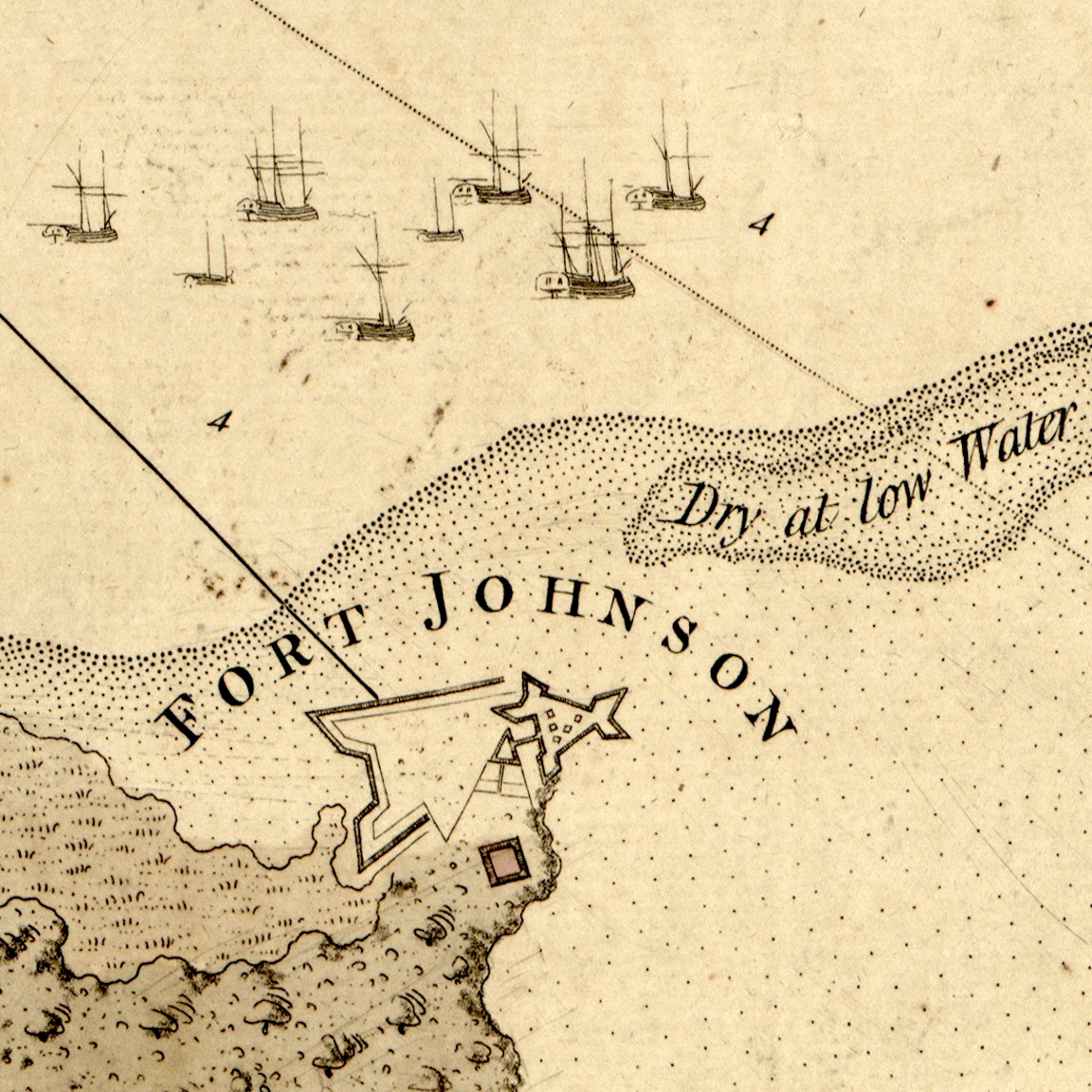
At 7 a.m. on the dim, squally morning of September 16th, the Tamar and Cherokee weighed anchor and made sail in tandem, carefully approaching the broad tidal mudflat fronting the northern ramparts of Fort Johnson. As Lieutenant Joseph Peyton of the Tamar noted succinctly in his logbook, the warships “endeavourd [sic] to get nearer to the fort in order to drive the rebels out of it.” Provincial soldiers perched within the fort, alerted by the ships’ movements, stood ready at their three mounted cannons, while musketeers below prepared to greet a landing party potentially dispatched from the approaching vessels. The prevailing wind and tide did not favor the attackers, however. “Unfortunately it fell calm,” noted Campbell, and “the tide of ebb running strong,” observed Captain Thornbrough, “obliged us to bring up as before.” The disappointed warships quietly turned about and resumed their anchorage in Rebellion Road later the same morning.[6]
While boatloads of provincial troops sailed from Charleston to reinforce Fort Johnson on the afternoon of September 16th, Lieutenant Fergusson gathered a party of armed men to complete a task assigned by his superior officer. Captain Thornbrough, acting on the advice of Governor Campbell, had directed Fergusson to increase the Cherokee’s crew from thirty to fifty men “as soon as possible,” to better defend the ship and protect persons still loyal to the British Crown.[7] Fergusson and his cohort then visited several merchant vessels riding at anchor in the harbor to forcibly impress men into the king’s service. They also ensnared several local mariners from smaller vessels traversing the harbor, including an enslaved man called Shadwell or William Shadwell, and a veteran white pilot named William Farrow.[8] Joined by Captain Clarke of the visiting Pensacola Packet, the recruiting party then boarded the Swallow packet and impressed ten British mariners, while verbally abusing others who refused to serve their monarch aboard the Cherokee.[9]
The increased number of mouths aboard the Cherokee required a larger volume of daily provisions, but the augmentation of the ship’s company coincided with the beginning of a protracted dietary conundrum. Since the establishment of a naval post at Charleston more than fifty years earlier, a succession of local agents under contract to the Royal Navy had supplied robust quantities of beef, pork, bread, peas, rice, butter, and beer to the king’s mariners serving on the Carolina Station. During the political meltdown of 1775, a contractor named William Price purchased the various species of provisions in bulk from local suppliers and delivered them periodically to the Tamar, and now the Cherokee. Immediately after the rebel seizure of Fort Johnson, however, the executive Council of Safety ordered Mr. Price “not to supply the king’s ships with provisions until farther order.” News of that food stoppage did not reach the British mariners before the rebel General Committee countermanded the order with a less drastic alternative. On September 16th, the Committee ordered Price to continue supplying the warships as customary, but henceforth in quantities sufficient “only for daily consumption.”[10]
The decision to restrict the flow of food to the British mariners in Rebellion Road was a curious solution to an awkward situation. Although rebel leaders sought to encourage the royal governor and his loyal forces to sail away from South Carolina, they did not wish to appear so inhumane as to starve gentlemen whom they still regarded as fellow subjects of a misguided monarch. Rather than cut off the supply of food altogether, the General Committee proposed to sustain their frenemies in a state of constant need. Their revised order of September 16th tempered a not-so-subtle hint with a modicum of polite hospitality, a passive-aggressive policy that inflamed tensions during subsequent weeks.
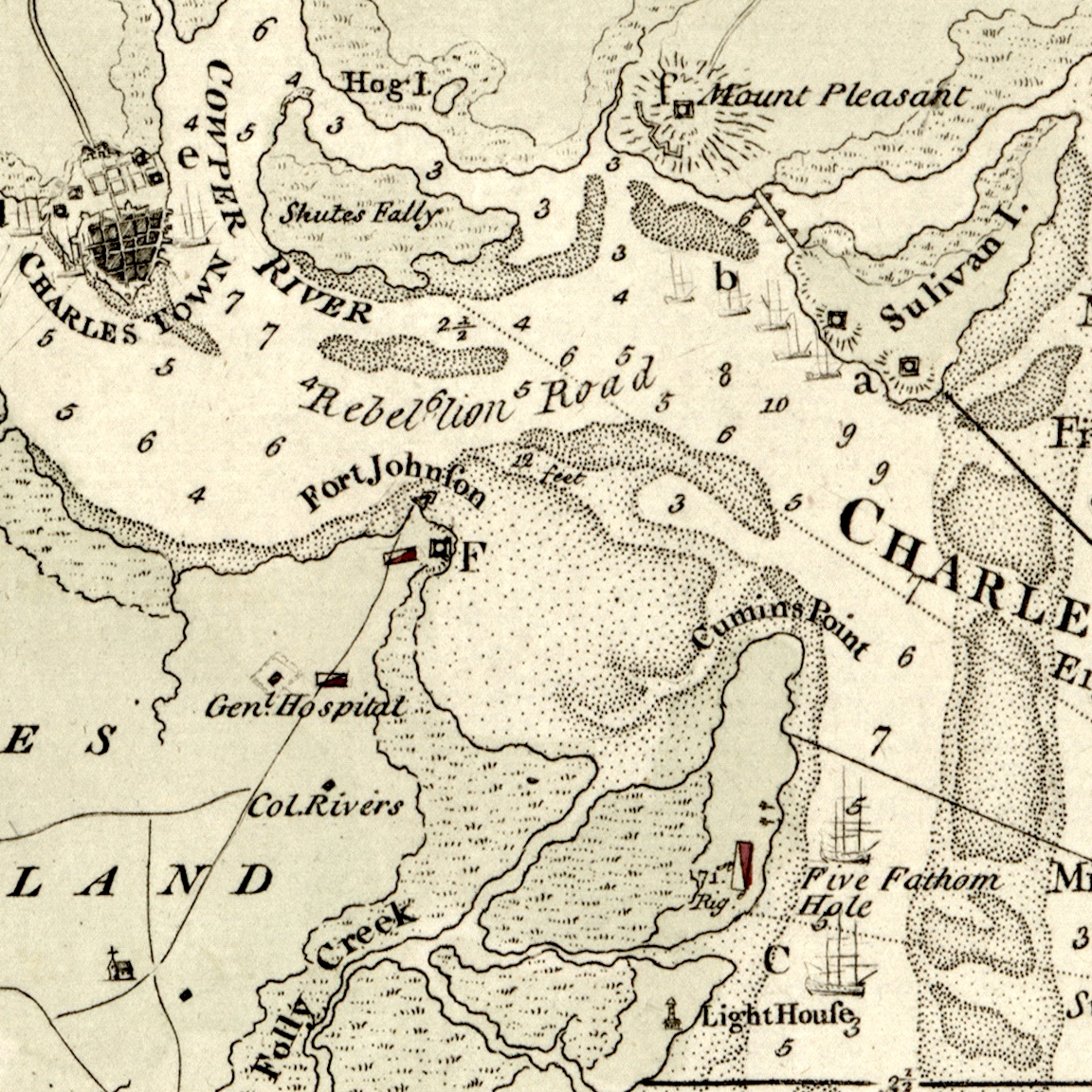
Although the British mariners in Rebellion Road did not interfere with the boats ferrying soldiers and supplies from Charleston to Fort Johnson, on the south side of the harbor, they expressed great alarm at similar developments along the opposite shore to the north. On September 17th, rebel leaders in town sent a detachment of provincial soldiers to Haddrell’s Point, an established ferry landing near the mouth of Shem Creek. The infantrymen then marched a short distance to the east and planted a temporary military hospital within a bucolic tract of private property known as Mount Pleasant. The nascent provincial army had recently recruited “about 700 men” from South Carolina and other colonies, most of whom now resided in barracks erected within the capital decades earlier. As mosquito-borne fevers and other distempers spread through their crowded ranks, the provincial government sought to transfer the sick to a more salubrious location.[11] The loyalists floating in Rebellion Road did not know the purpose of the men and supplies suddenly flowing across the harbor from Charleston to Mount Pleasant, but they perceived a threat to their safety and reacted accordingly.
At 4 p.m. on the seventeenth, both the Tamar and Cherokee weighed anchor and “dropt down” a short distance to the east, away from the new rebel camp, anchoring abreast the southwestern shore of Sullivan’s Island. The ships’ senior officers all noted in their respective logbooks that their new anchorage was just one quarter of a mile from the beach, due south of the Pest House, the sole building then standing on the verdant barrier island. The provincial government had erected this sizeable brick and timber structure for quarantine purposes in the mid-1750s, replacing a smaller lazaretto destroyed by a hurricane in September 1752. The rebels of September 1775 might have considered using the existing Pest House as a ready-made hospital, staffed with a resident caretaker salaried by the now-defunct General Assembly, but its proximity to the main shipping channel, as demonstrated by the position of the newly-anchored warships, likely convinced them to establish a new facility at Mount Pleasant, two miles northwest of the isolated Pest House.
Captain Thornbrough and Lieutenant Fergusson’s decision to shift their anchorage likely followed a conversation with Governor Campbell earlier the same day. The king’s officers might have observed a few of the rebel soldiers marching eastward from their new camp at Mount Pleasant towards Sullivan’s Island, reconnoitering the littoral landscape to assess its potential military value. Such movements fueled suspicions that the rebels sought to take possession of the unpopulated barrier island reserved to the British Crown since the 1670s. There the rebels might erect a waterfront battery capable of raking fire across the principal sea route into the harbor. Lord William expressed this fear in a letter to the Secretary of State in London, Lord Dartmouth, noting that the two warships “fell down to Sullivan’s Island to prevent [the rebels] erecting a battery there, which would have greatly annoyed any ships coming into the road.”[12]
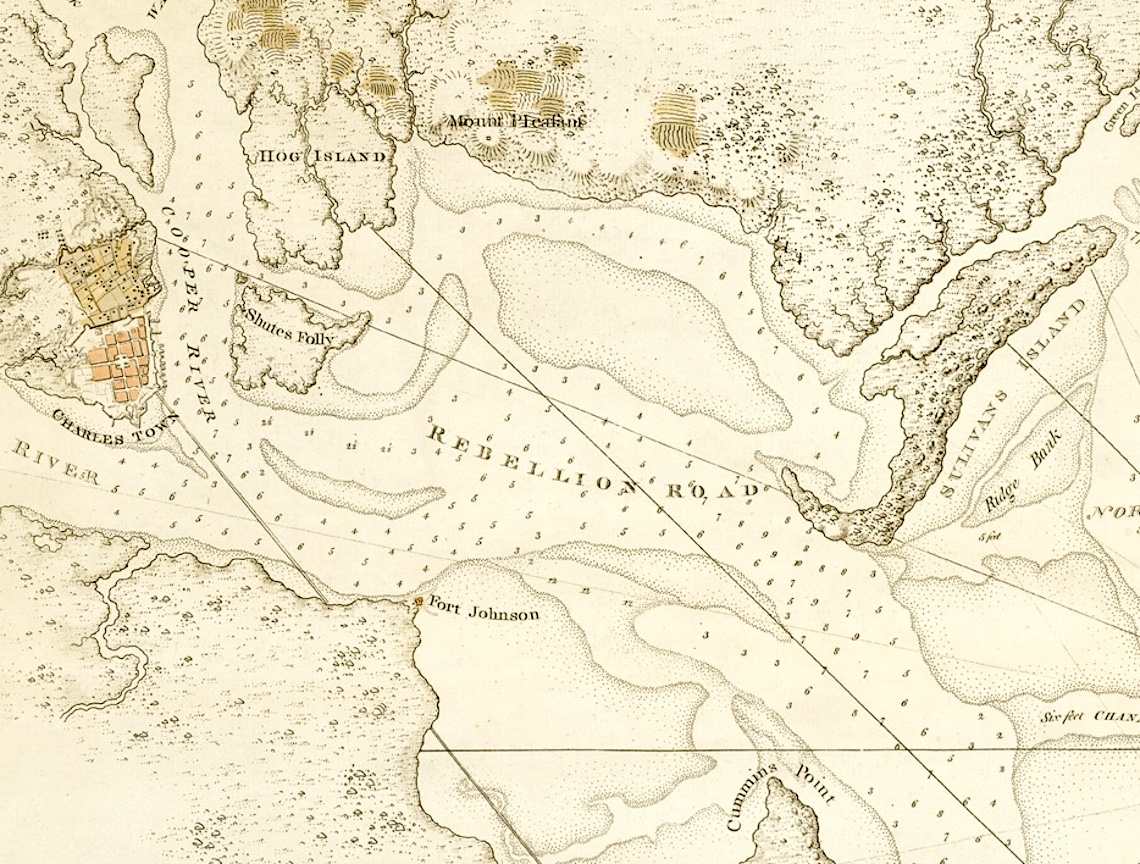
The governor’s sudden concern for the future of Sullivan’s Island, no doubt shared with his naval colleagues, inspired immediate action. At sunrise on the rainy morning of September 18th, Captain Thornbrough ordered a detachment from the Tamar to row ashore to Sullivan’s Island, probably landing on the beach in front of the Pest House. The armed men also carried axes and saws, with which they began felling trees around the southwestern end of the island. In his logbook, Thornbrough explained that he had sent a party to Sullivan’s Island “to cut down the wood to prevent the Provincials from raising a battery on it.” The king’s mariners laboring onshore in the rain evidently aroused the curiosity of some unidentified persons on the adjacent mainland, either civilians from the neighboring village of Greenwich or soldiers affiliated with the hospital at Mount Pleasant, gathering intelligence for their superiors. During the first day of forest clearing on Sullivan’s Island, Captain Thornbrough noted that gunners aboard the Tamar “fired to cover our men one six pounder shotted and seven swivels with round and grape [shot].”
Reports of the king’s mariners clearing the woods from Sullivan’s Island quickly travelled from Mount Pleasant to the State House in Charleston, where members of the rebel General Committee immediately considered the long-term strategic value of the largely undisturbed barrier island. On the afternoon of September 18th, the Committee composed a memo to the Council of Safety, recommending that elements of the provincial army should take possession of Sullivan’s Island as soon as possible, to prevent British forces from asserting control over the entrance to South Carolina’s principal port.[13] This brief suggestion marked the beginning of an important objective that shaped provincial policy during the remainder of 1775 and culminated with the creation of Fort Sullivan in the spring of 1776.
In the meantime, the two hungry British warships anchored in Charleston Harbor still posed a serious threat to the expanding rebellion. The new policy restricting the delivery of provisions to the Tamar and Cherokee reached the ears of Captain Thornbrough on September 18th, coincidentally, while his men fired rounds at nosy provincials near the western end of Sullivan’s Island. The old seaman evidently heard a garbled version of the contradictory orders recently issued by the Council of Safety and General Committee, believing that the rebels had terminated the supply of provisions and ordered their agents to prevent the king’s boats from fetching fresh water from the customary sources. He shared this flawed news with the governor, who was then composing a letter to the Earl of Dartmouth. “Captain Thornbrough has just acquainted me,” wrote Campbell, that “the [General] Committee have stopped his provisions, which will lay us under a necessity of helping ourselves.”[14]
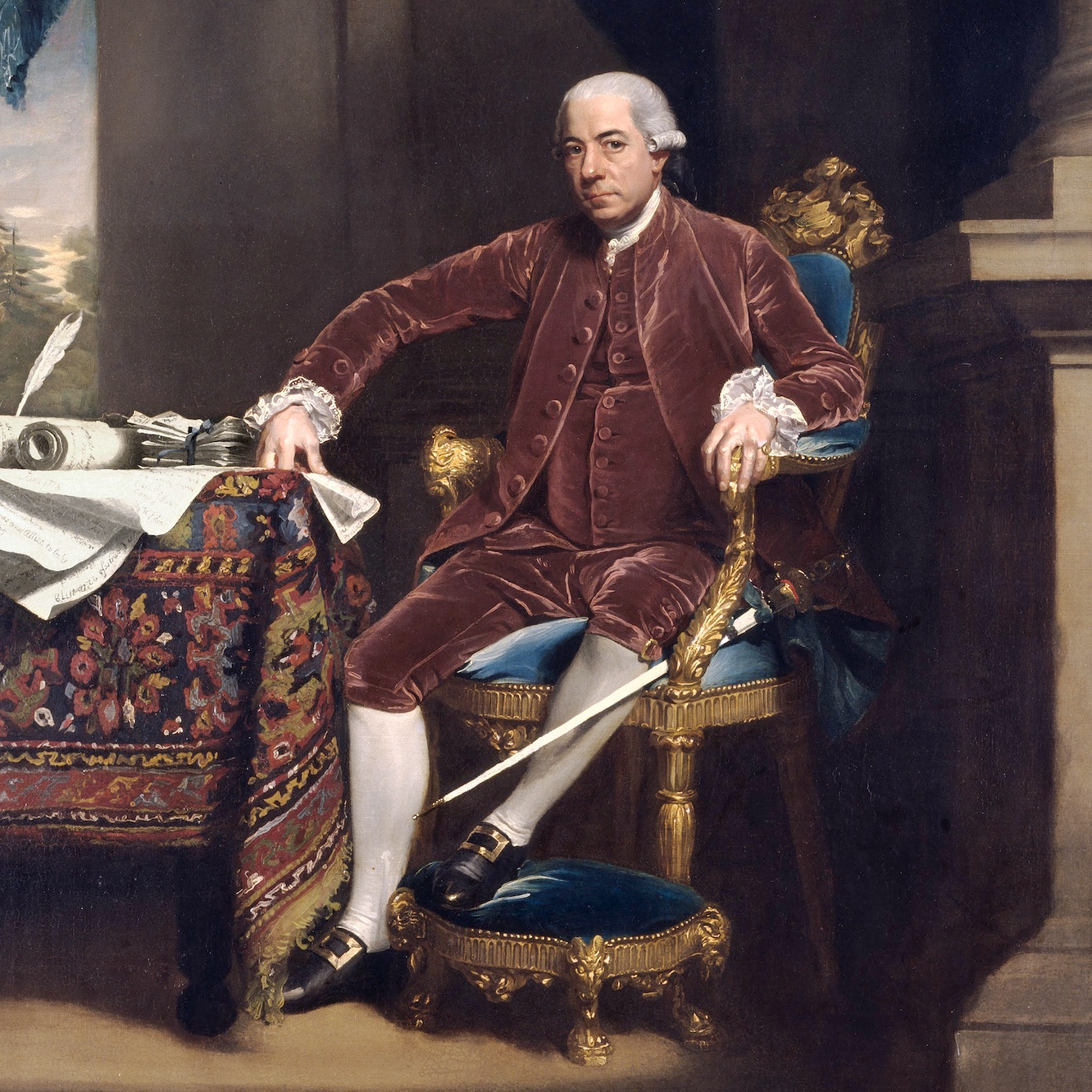
Thornbrough then wrote or dictated an angry letter to Henry Laurens, Chairman of both the General Committee and Council of Safety, objecting to their inhospitable treatment of the king’s ships and asserting his resolve to defend the station assigned to him by the Royal Navy.[15] Laurens replied the following day, informing Thornbrough that the Committee had “not refused a supply of provisions to the king’s ships in this harbour, nor have they taken one step to prevent their watering.” The rebel chairman then commenced a rapid-fire critique of the captain’s recent exploits, addressing him dismissively in the third person:
“The hostile dispositions which the commander of those ships has for some time past shewn towards this colony, by imprisoning its pilots, affording sanctuary to a traitor, seizing its seamen, dismantling its principal fortification, stopping private property, and firing upon the persons of its inhabitants who were not only peaceable but unarmed, and driven from the shore, do make it necessary, in [the Committee’s] opinion, to alter the mode of supply. And as you have declared, that you do not mean to leave the station, it can be no disadvantage to His Majesty’s ships to receive their provisions from day to day in this warm climate.”[16]
Thornbrough sent a brief response to Laurens on the 19th to express a polite but not-so-subtle threat: “I have only to say, that I would not offer such an affront to your judgment, as to give reasons for my conduct, which I think must be obvious to you; and you may be assured, that whilst I have the honour of commanding one of his Majesty’s ships, I am determined to have the assistance of a pilot, and every necessary supply, by force, if I cannot obtain them in an amicable way.”[17]
Captain Thornbrough’s stern objection to the limits imposed on his food supply, echoed perhaps by other voices in the capital, induced the General Committee to reconsider its instructions to contractor William Price. Following conversations not recorded for posterity, the provincial leaders revised their policy at some point in late September 1775 and permitted Mr. Price to supply the warships with the usual provisions in quantities sufficient for two weeks’ rather than daily consumption.[18] This curious compromise prolonged the military stand-off in Charleston Harbor for nearly three months, until the widening chasm between the opposing factions dissolved the façade of hospitality.
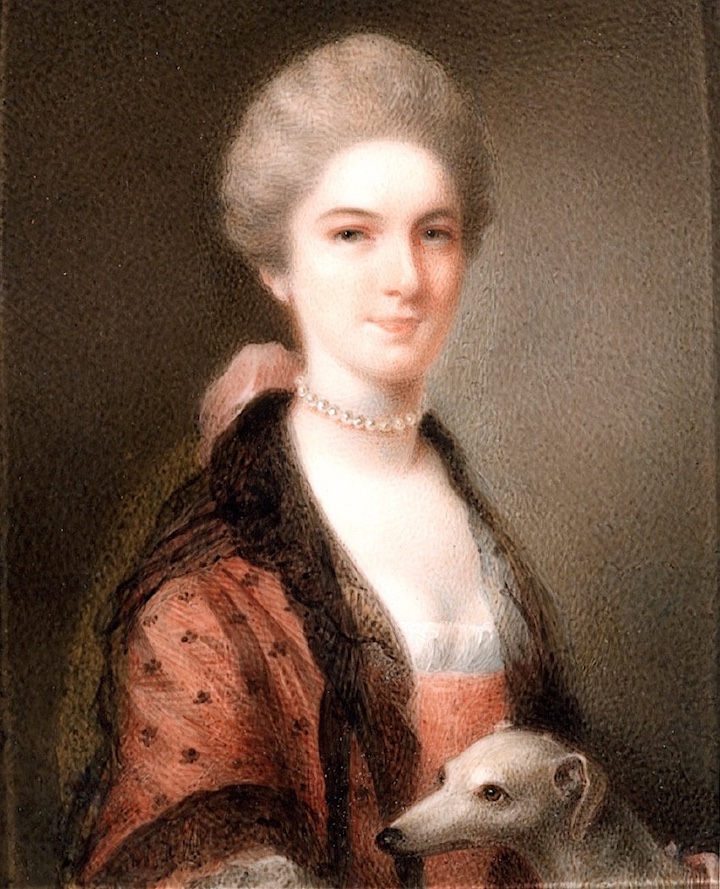
Governor Campbell and the king’s mariners anchored near Sullivan’s Island did not suffer any want of food or drink during his first week of residence aboard the Tamar, but the stress of his recent retreat, combined with the crowded, damp conditions aboard the worm-eaten warship, quickly eroded Lord William’s health. Word of his illness soon reached the ears of Doctor Alexander Garden, a long-time denizen of Charleston and loyal British subject, who obtained permission from rebel chairman Henry Laurens to see the governor and assess his condition. The doctor then called at the house rented for the governor’s family (now 34 Meeting Street), where he invited Lady William (Sarah Izard Campbell) to join his errand and visit her husband. They departed from the Cooper River waterfront on the hazy afternoon of September 19th, no doubt accompanied by a coterie of servants who rowed or sailed the pair more than three miles across the harbor to the Tamar. Warning shots fired from Fort Johnson briefly halted the boat’s progress, but the journey resumed after Doctor Garden displayed his pass from Henry Laurens. Lady William’s visit with her ailing husband continued for several hours or several days—the details are now lost—after which she and the doctor returned to their more comfortable lodgings in the capital.[19]
Later in the evening of September 19th, rebel soldiers fired shots at another boat crossing before the re-mounted guns of Fort Johnson, detaining three inebriated British sailors affiliated with the packet boat Swallow. Lieutenant Colonel Isaac Motte, commandant of the fort, interrogated the seamen and reported their testimony in a letter delivered to Henry Laurens at midnight. Although the trio had suffered the wrath of Lieutenant Fergusson for refusing to join the crew of the Cherokee, the sailors overheard British officers discussing their potential strategies for combating the expanding rebellion. Colonel Motte informed Laurens that the king’s mariners “are clearing away the woods [on Sullivan’s Island] that we may not be sheltered from their shot, if we sho[ul]d attack them from that quarter. That they intend to throw up an entrenchment on the point of the Island (Sullivants [sic] Island), as they are much afraid we sho[ul]d get possession of it.” The sailors told Motte that the British officers initiated the ongoing tree-cutting campaign after witnessing “the [rebel] encampment on the other shore” (i.e., at Mount Pleasant), which “alarmed them very much, thinking the troops from thence will attack them from the island.” After securing a foothold on the strategically-important island, alleged the sailors, “they are first to attack the fort [i.e., Fort Johnson] & then to proceed to burn the town.”[20]
Henry Laurens carried Colonel Motte’s late-night letter to a meeting of the Council of Safety the following morning and shared it with their rebel colleagues. The intelligence extracted from the crewmen of the Swallow prompted a mature consideration of the proposal issued two days earlier by the General Committee, recommending the seizure of Sullivan’s Island. Members of the executive Council then resolved to formulate a plan to take possession of the island before Governor Campbell and his naval colleagues gained the upper hand, and to solidify rebel control over Charleston Harbor by erecting a battery thereon. Various distractions and logistical challenges intervened to delay the execution of this ambitious plan during the autumn of 1775, but rebel leaders never abandoned the goal of securing control of Sullivan’s Island.[21]
As I mentioned at the beginning of this program, the rebel seizure of Fort Johnson and Governor Campbell’s retreat to the Tamar, both of which occurred on the fifteenth of September, marked the beginning of a new phase in the maturing revolution in South Carolina. The opposing factions continued to pursue their separate goals with caution and a modicum of civility, but now they brandished weapons at each other and postured defiantly, drawing lines in the sand to mark the limits of their tolerance. Control over the flow of maritime traffic across the harbor quickly emerged as the general theme of their pantomime war, with a particular emphasis on the possession of Sullivan’s Island, now recognized by both sides as an essential feature of their future success.
Join me next time for the continuation of this historical narrative, when the aggressive posturing of British and American forces within Charleston Harbor finally provokes the exchange of lethal force.
[1] Throughout this essay, I have extracted descriptions of Cherokee- and Tamar-related activities, movements, weather conditions, and quotations from four manuscript sources at the National Archives, Kew: Captain’s log (Edward Thornbrough), Tamar, 1775–76, ADM 51/968; Muster books, Tamar, 1775–77, ADM 36/7697; Master’s log (William Pickard), Cherokee, 1775–76, ADM 52/1662; and Muster books, Cherokee, 1775–76, ADM 36/8049; and from two manuscript sources held at the Caird Library and Archives, National Maritime Museum, Greenwich: Lieutenant’s log (John Fergusson), Cherokee, 1775–76, ADM/L/C/284; and Lieutenant’s log (Joseph Peyton), Tamar, 1775–76, ADM/L/T/6.
[2] South Carolina Gazette, 19 September 1775, page 2.
[3] David Ramsay, The History of the Revolution of South Carolina, from a British Province to an Independent State (Trenton, N.J.: Isaac Collins, 1785), 1: 45.
[4] Lord William Campbell to the Earl of Dartmouth, 19 October 1775, in K. G. Davies, ed., Documents of the American Revolution, volume 11 (Dublin: Irish Academic Press, 1976), 155.
[5] Isaac Motte to Henry Laurens, 19 September 1775, in David R. Chesnutt, The Papers of Henry Laurens, volume 10 (Columbia: University of South Carolina Press, 1985), 409.
[6] Lord William Campbell to the Earl of Dartmouth, 19 September 1775, in Davies, Documents of the American Revolution, 11: 117–18; Isaac Motte to Henry Laurens, 19 September 1775, in Chesnutt, Papers of Henry Laurens, 10: 410. Although John Drayton, Memoirs of the American Revolution, volume 2 (Charleston, S.C.: A. E. Miller, 1821), 51, and “Diary of Barnard Elliott,” in Charleston Year Book, 1889, 161–62, both state that the two warships nearly attacked Fort Johnson on the morning of 17 September 1775, the extant logbooks of the Tamar and Cherokee, as well as William Moultrie, Memoirs of the American Revolution, volume 1 (New York: D. Longworth, 1802), 88–90, and Ramsay, History of the Revolution of South Carolina, 1: 45, indicate that this event occurred on the morning of the 16th.
[7] Thornbrough summarized Governor Campbell’s “recommendation” of 14 September 1775 in a letter to Lieutenant John Fergusson, dated on board the Tamar in Rebellion Road, 15 September 1775, a copy of which he enclosed within a separate letter to Admiralty Secretary Philip Stephens, dated 23 October 1775, in ADM 1/2591, at the National Archives, Kew.
[8] See the aforementioned muster books of the Cherokee for the names of the several “Supernumeraries borne for wages & victuals per order from Edward Thornbrough Esqr. Commander of His Majesty’s Sloop Tamer.” Farrow, a longtime resident of Charleston, piloted the ship Port Henderson, bounded from Jamaica to London, and spent nearly two years in the British naval service, as described in South Carolina and American General Gazette (hereafter SCAGG), 15–22 September 1775, page 3; and SCAGG, 17 July 1777, page 3. Note that Lord William Campbell, in his letter to the Earl of Dartmouth, 19 September 1775, stated that Captain Thornbrough lent seven men from the Tamar to the smaller warship until Fergusson could find enough men to increase its modest complement; see Davies, Documents of the American Revolution, 11: 117.
[9] Isaac Motte to Henry Laurens, 19 September 1775, in Chesnutt, Papers of Henry Laurens, 10: 409–10.
[10] Drayton, Memoirs, 2: 53. In a footnote on this page, John Drayton mis-identified the “Agent Victualler” as Fenwick Bull, a notary public in Charleston who acted as an intermediary between Governor Campbell and the rebel Council of Safety in late 1775. Subsequent historians have generally repeated this error. William Price was identified as the “contractor for victualling the king’s ships” in a meeting of the Council of Safety on 8 December 1775, in “Journal of the Second Council of Safety, appointed by the Provisional Congress, November 1775,” in Collections of the South Carolina Historical Society, volume 3 (Charleston: South Carolina Historical Society, 1859), 66; and in a memorandum written by Lieutenant John Fergusson on 23 October 1775, in Naval Documents of the American Revolution, 2: 584. Owing to the loss of the manuscript journals of the General Committee and Council of Safety for this period, the full text of the orders concerning provisions does not survive.
[11] For references to this hospital, see Moultrie, Memoirs, 1: 91–92; SCAGG, 15–22 September 1775, page 3; “Diary of Barnard Elliott,” 172–73.
[12] Lord William Campbell to the Earl of Dartmouth, 19 September 1775, in Davies, Documents of the American Revolution, 11: 117–18.
[13] Drayton, Memoirs, 2: 54; Henry Laurens to James Laurens, 22 September 1775, in Chesnutt, Papers of Henry Laurens, 10: 414.
[14] Campbell to Dartmouth, 19 September 1775, in Davies, Documents of the American Revolution, 11: 118.
[15] The text presented in Drayton, Memoirs, 2: 53, purporting to be an extract from Thornbrough’s letter of 18 September 1775 to the Chairman of the General Committee, actually represents an extract from Thornbrough’s letter of 1 November 1775 to Henry Laurens, which will be discussed in a subsequent episode.
[16] Henry Laurens to Edward Thornbrough, [19 September 1775], in Chesnutt, Papers of Henry Laurens, 10: 405–6. Note that this same text appears in Clark, ed., Naval Documents of the American Revolution, volume 2: 261, under the conjectural but less probable date 30 September 1775.
[17] Edward Thornbrough Henry Laurens, 19 September 1775, in Chesnutt, Papers of Henry Laurens, 10: 406; Drayton, Memoirs, 2: 53–54, 91–92 (emphasis original).
[18] See Joseph Peyton’s entry for 17 October 1775 in Lieutenant’s log, Tamar, 1775–76, ADM/L/T/6.
[19] Alexander Garden to Henry Laurens, 17 September 1775, and Isaac Motte to Henry Laurens, 19 September 1775, in Chesnutt, Papers of Henry Laurens, 10: 395, 407–8.
[20] Isaac Motte to Henry Laurens, 19 September 1775, in Chesnutt, Papers of Henry Laurens, 10: 409.
[21] Drayton, Memoirs, 2: 54.
NEXT: Sullivan's Island, October 1775: An Emergent Loyalist Sanctuary
PREVIOUSLY: The Collapse of British Rule in South Carolina, September 1775
See more from Charleston Time Machine