
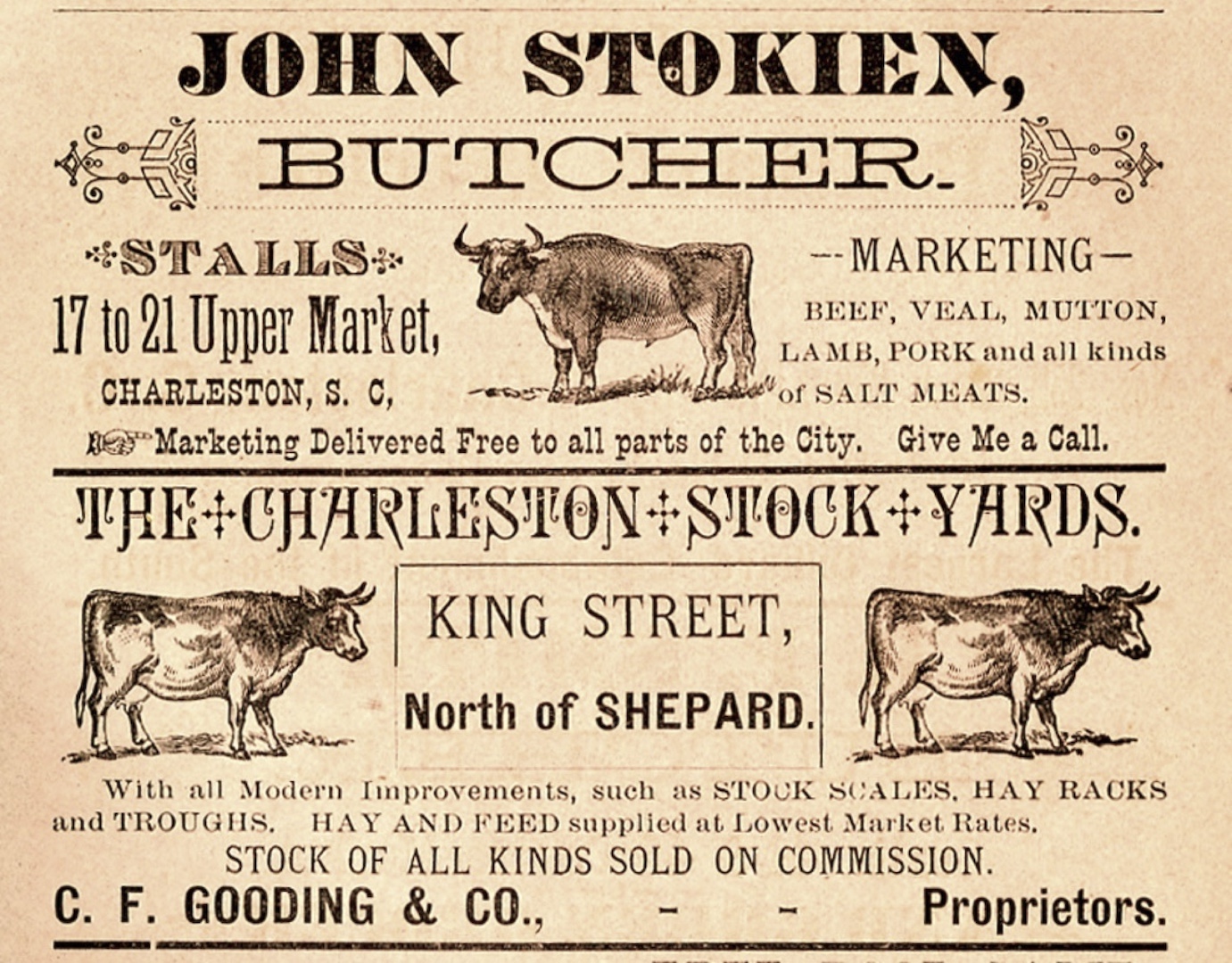
The enclave known as Butcher Town flourished around Cannon’s millpond until 1850, when the expansion of Charleston’s city limits propelled the slaughtering business northward. The migration of butchers’ pens across the Neck then triggered a decades-long battle between private enterprise and public efforts to regulate the industry. Following a suite of political and technological developments in the early twentieth century, a modern municipal abattoir ultimately scrubbed the ancient blood-soaked industry from the local landscape.
As I mentioned in the previous episode, the rise and fall of Butcher Town is a story about Charleston’s earliest and most enduring zoning issue—the slaughtering of animals for human consumption. Local leaders initiated efforts to dictate the location of slaughterhouses and allied trades in the 1690s, and their messaging evolved as the town expanded during the colonial era. In the years following the American Revolution and the 1783 incorporation of Charleston, the nascent City Council began pressuring butchers to move their slaughterhouses beyond Boundary Street (now Calhoun Street), the northern limit of the city’s early jurisdiction. The Medical Society of South Carolina aided this municipal campaign in 1795 by suggesting butchers should be required to locate their noisome slaughterhouses “in such places as are daily washed by the ebbing and flowing of the tide.”

Such pressure inspired a number of butchers to acquire property within the emerging suburb of Cannonborough. Butcher Town, as their slaughtering enclave became known, lacked clearly-defined boundaries, but records from the late 1790s and the early 1800s point to a number of slaughter houses, soap boilers, and tallow chandlers clustered around the tidal millpond at the northeastern terminus of Coming’s Creek (aka Cannon’s Creek), a site now bounded by Rutledge, Cannon, and Coming Streets, extending southward nearly to Warren Street. By the summer of 1807, when City Council formally prohibited the slaughtering of market animals within its municipal boundaries, most of that business had already moved to Butcher Town, where the daily tides could ostensibly flush blood, entrails, and other animal waste to the Ashley River.
Butcher Town flourished at the northeast corner of Cannonborough for half a century, during which time residents of the sparsely-populated neighborhood occasionally complained. In 1824, for example, a local grand jury drew attention to “the effects produced by the butcher pens at the head of Mr. Bennett’s [formerly Mr. Cannon’s] mill-pond. The blood and offal float away and lodge in the cove, and other places partly within the limits of the city [i.e., south of Boundary Street], and in times of neap tides, and during the whole of the summer season, become a serious and important cause of ill health in the neighborhood of such places.” The grand jury did not ask the state legislature or City Council to force the butchers to relocate, but instead suggested “that the butchers whose pens occasion said evil, may be compelled to bury the offal of the pens, and dispose of it in such a manner, that the winds and tides may not convey it where it will be injurious to the inhabitants.” The city government was powerless to enforce its ordinances beyond its corporate limits, however, and the state General Assembly refused to address the subject.[1]
The demise, or rather, the relocation of Butcher Town commenced in 1850, after the City of Charleston annexed all of the land extending from Calhoun Street to a new northern boundary defined by Mount Pleasant Street. That previously-unincorporated landscape included Butcher Town around Cannon’s millpond and a few other slaughter pens scattered along the eastern and western fringes of Charleston Neck. All of these facilities were now subject to the 1807 prohibition of animal slaughtering within the corporate limits, but the city government offered a temporary reprieve. In a sweeping ordinance to consolidate territories new and old, ratified in October 1850, the city suspended enforcement of the 1807 law for those places on the Neck “heretofore and now used as places for the slaughter of cattle, and known as slaughter-pens . . . until further action by Council.”[2]
Seventeen months later, in March 1852, City Council appointed a committee “to report on the expediency of removing all the slaughter pens” from within the corporate limits.[3] Their findings noted that Cannon’s millpond—the epicenter of Butcher Town since the late 1790s—was nearly filled by the accretion of animal waste, and the volume of tidewater flowing across the site was no longer sufficient to carry away the offal deposited daily by the neighboring slaughterhouses. The committee recommended abolishing the butchers’ pens around the west end of both Radcliffe and Vanderhorst Streets and along the south side of Cannon Street, and thereafter enforcing the 1807 ordinance prohibiting such activity within the city limits. Council adopted their recommendations in early May 1852, but did not immediately pursue action against the denizens of Butcher Town.[4]

While some butchers saw the handwriting on the wall and voluntarily moved northward into the sparsely-populated upper wards during the early 1850s, City Council continued to hear complaints from citizens about noisome slaughterhouses operating within the rapidly-gentrifying middle wards. Finally, in early May 1853, City Council “resolved, that the mayor be instructed to notify all butchers and occupants of slaughter pens within the city, that the [1807] ordinance in relation to the same will be strictly enforced, on or after the 1st August 1853.”[5] Days later, however, a large contingent of butchers and men employed in allied trades submitted a stern memorial to City Council expressing their frustration. Their strongest objection to the proposed relocation, besides the expense, invoked the ancient fear of miasma, or foul air arising from decaying organic matter. If the slaughtering business was to move northward into the unincorporated wilderness of Charleston Neck, impure air arising from the undeveloped landscape would endanger the butchers’ health and that of their enslaved laborers.
As a compromise, the butchers asked City Council for permission to retain their slaughterhouses within the city limits for a while longer, concentrated at two relatively remote and sparsely-populated tidewater locations—Gadsden’s Creek, connected to the Ashley River, and Vardell’s Creek, connected to the Cooper River (now Grace Bridge Street).[6] Council thereafter appointed a committee to investigate the locations in question, and in July 1853 heard two sharply contrasting opinions. The committee’s majority report stated that most of the slaughter pens were not offensive and recommended that they be allowed to continue, while a damning minority report alleged that every slaughter pen had received advance notice of the inspections and had quickly scrubbed their premises for the occasion. The latter report also concluded that the location of the pens was inherently objectionable. Rather than removing the offal, the daily ebb and flow of Gadsden’s Creek spread blood and entrails across the marshy landscape, where the sun’s warming rays transformed the offal into a noxious miasma. Despite earnest warnings about the site’s threat to public health, City Council adopted the positive majority report and left the butchers to slaughter in peace.[7]
Less than a year later, however, in April 1854, a number of residents in the upper wards complained to City Council about various nuisances created by the numerous “butcher pens which now occupy the position of the former fortifications in Line Street.” A committee sent to investigate the matter not only confirmed the veracity of the complaints, but pointed especially to the offensive presence of trash-eating hogs. Although Council had in 1837 prohibited the keeping of hogs within city limits, the investigating committee of 1854 noted that “every slaughter house [on the Neck] is flanked with an appendage of ten, twenty or more hogs ostensibly to consume to offal, but really to convert the offal into something, if possible, more offensive. This more offensive matter remains in situ, undergoes the usual fermentation, vitiates the atmosphere of the neighborhood, and woe be unto him or them who dwell to the leeward of such a manufactory of corruption.”
To remedy the various nuisances emanating from the scattered butchering sites on the Neck, the committee report of April 1854 recommended “a concentration of all the slaughter houses in one locality, and that locality should be on Gadsden’s Creek, which would receive and convey away all the filth incident to the business, while it would furnish a supply of water sufficient to wash the floors” of the slaughter pens. At that site, the committee recommended the construction a large municipal abattoir (introducing the European term), or perhaps a cluster of publicly-owned slaughterhouses, built on land owned by the city and rented to private parties like the butchers’ stalls in the Centre Market. Although the sitting mayor and aldermen concurred with committee’s advice, they quietly swept the matter under the proverbial rug for the action of a later administration.[8]
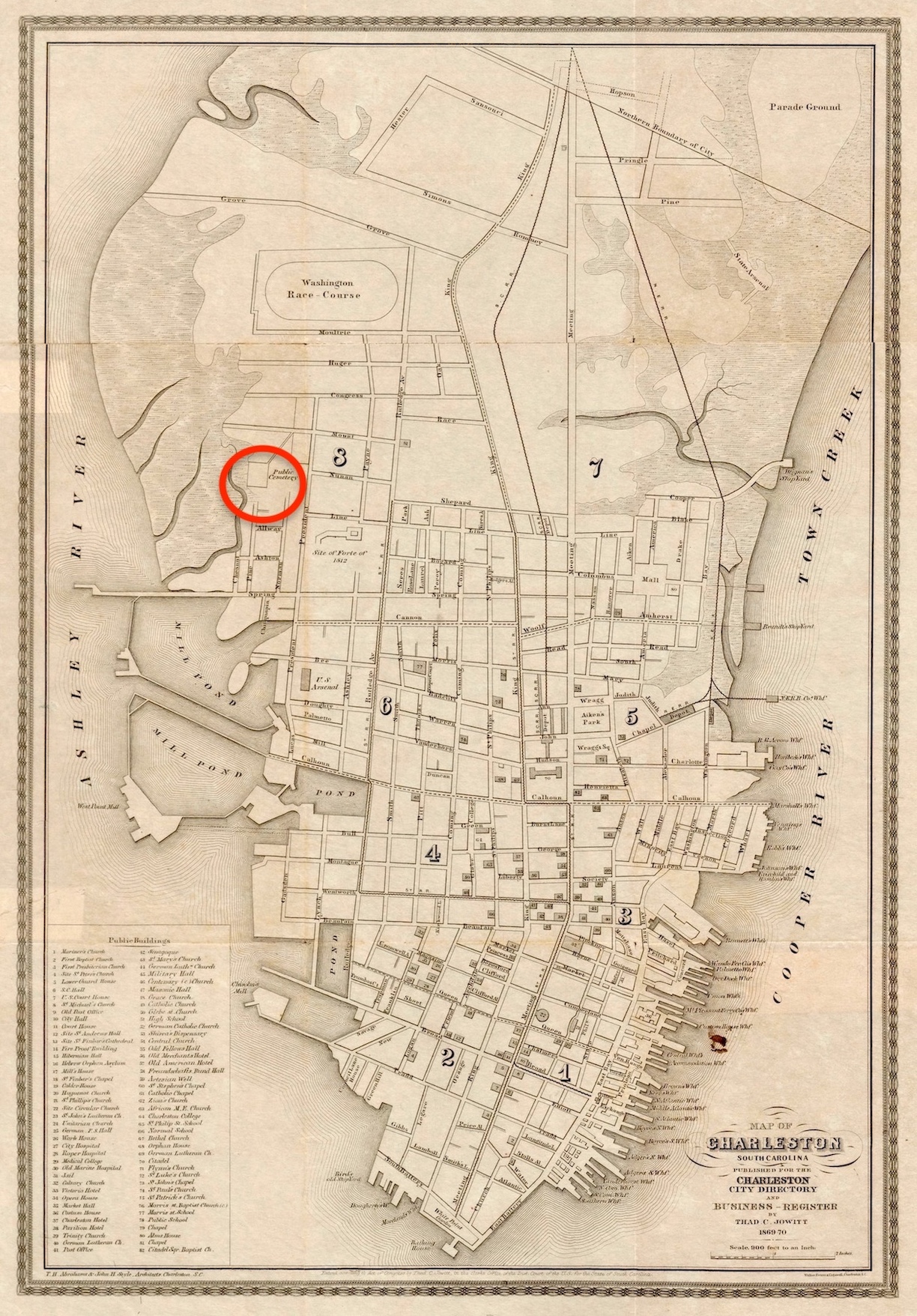
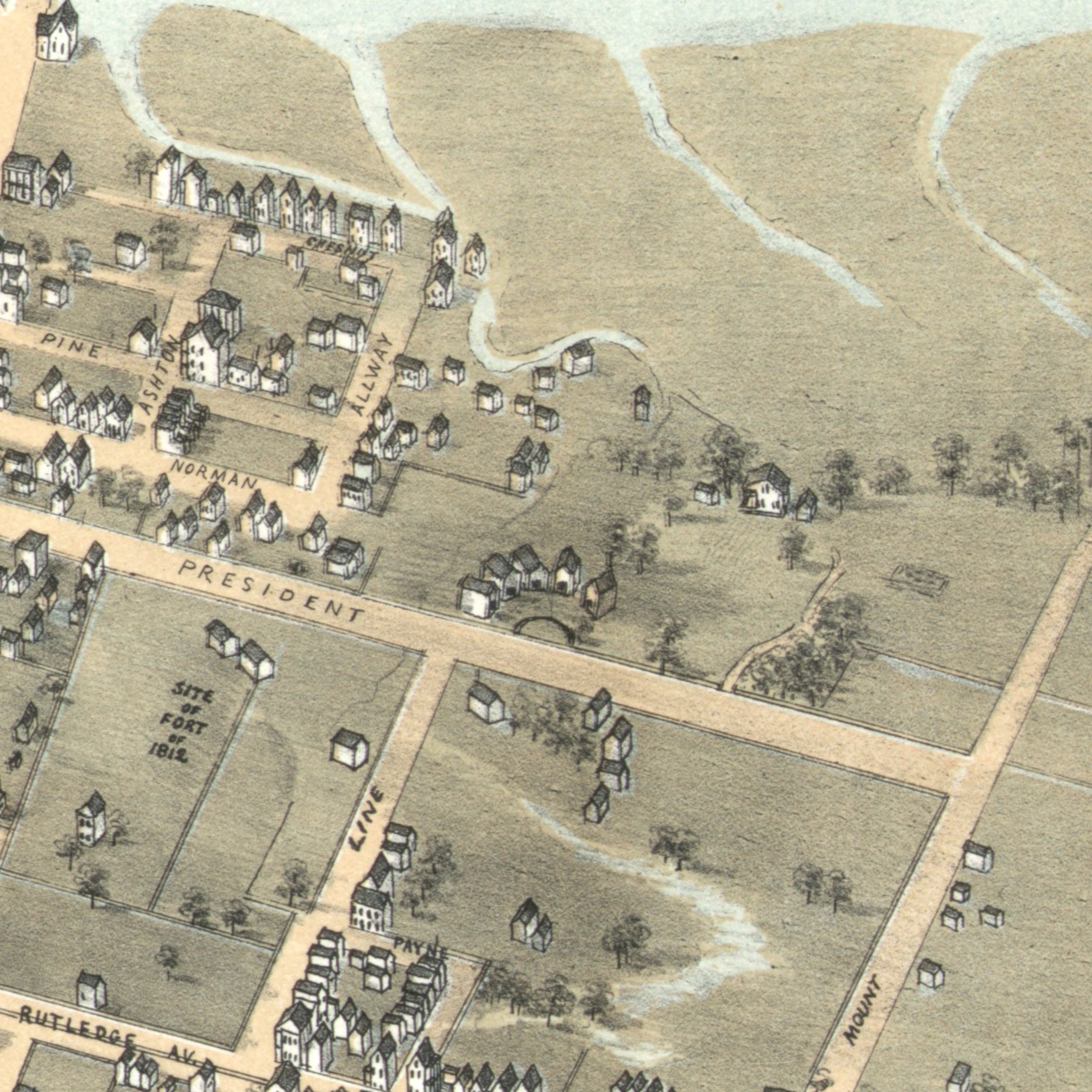
Two years later, in April 1856, another committee appointed to investigate ongoing complaints about the butchering business on Charleston Neck resurrected the idea of a consolidated public facility on the margins of Gadsden’s Creek. They recommended the city build a series of publicly-owned slaughterhouses at the northwest corner of Line and President Streets, encompassing approximately two acres of a larger tract that the city had purchased years earlier for use as a public cemetery. The site in question within the largely undeveloped eighth ward was both sparsely populated and “almost entirely separated from the main land by marshes intersected by creeks of considerable size.” The members of City Council now embraced the proposal to create, in effect, a new iteration of Butcher Town, and spent several months debating the size, number, and arrangement of the wooden slaughterhouses to be constructed at the west end of Line Street.[9]
While City Council refined the text of an ordinance to regulate the new abattoir complex during the summer of 1856, contractors began erecting twelve sizeable wooden slaughterhouses arranged in a semi-circular fashion on the public land in question. The proprietors of thirteen privately-owned butcher pens scattered along the length of Line Street then submitted to Council a long list of grievances against the project they believed undermined their free enterprise. The obligatory committee dispatched to investigate their claims submitted that August a bold report that swept aside the butchers’ complaints. “The advance of population necessitates the retreat of the butcher pens,” said the committee, noting that similar social forces at the close of the eighteenth century had inspired the creation of Butcher Town at Cannon’s millpond. While the committee conceded that the new campus of municipal slaughterhouses would produce the same nuisances the city sought to eradicate, they opined that “the annoyances will then be limited to one position, and not proceed from thirteen distinct and separate points, scattered over the length of Line street, from river to river.” In short, City Council acknowledged that there were but two options—“either to drive the butchers beyond the limits of the city, or to set apart a certain portion of land, and establish a permanent location within the city.” In the summer of 1856, the city adopted the latter alternative “as most beneficial to all parties.”[10]
Public and private debate of the plan continued into the following spring, but Council finally ratified the ordinance establishing a municipal slaughtering campus in June 1857. The law formally dedicated the new, city-owned slaughterhouses standing at the west end of Line Street “for the slaughter and dressing of neat cattle, calves, sheep, swine and goats, intended for sale.” Rather than require butchers to abandon their private slaughter pens immediately, the ordinance contained two clauses representing significant compromises between public and private interests. The fifth section required all remaining butcher pens located within the city limits, but not on tidal waters, to move to a tidewater location by the first of January 1858, while the sixth section stated that no privately-owned slaughter pens would be tolerated within city limits after the first of January 1860.[11]
The protracted genesis of the new Butcher Town at the head of Gadsden’s Creek in 1856–57 seemed to alleviate, or at least ameliorate longstanding complaints about the suburban slaughtering business, but the city’s victory was short-lived. Butchers required to abandon their private facilities within the prescribed timeframe grew more resentful of the law as the deadlines drew near. By flexing their economic and political influence, the butchers of Charleston badgered City Council to repeal the fifth and sixth clauses of the 1857 ordinance. Revised versions of the law, ratified in 1858 and 1859, eliminated the aforementioned deadlines and undermined the city’s ability to enforce its proposed slaughterhouse monopoly.[12]
Traditional cattle-driving routes leading from neighboring states to Charleston atrophied during the American Civil War as the competing armies siphoned livestock away from civilian markets. Meat shortages and inflated prices continued for several years after the war, while livestock populations across the South slowly rebounded.[13] In the spring of 1868, during the tense period of Federal Reconstruction, one of Charleston’s temporary, military mayors insisted that local butchers ought to be required to remove their slaughter pens northward, beyond the city limits, in accordance with the ordinance of 1807. A number of citizens, mostly butchers, thereafter petitioned City Council to maintain the status quo, pleading poverty, and warned that that high price of meat would increase beyond the means of most citizens if they were required to construct new slaughtering facilities farther up the Neck. The city’s health department investigated the matter and, as usual, concluded in favor of the politically-savvy butchers. Environmental conditions within the butchers’ pens were not conducive to the preservation of local health, but improvements would have to wait until some future era of peace and prosperity.[14]
More than twelve years later, in January 1881, Mayor William Courtenay reframed the long-standing debate about local slaughtering practices by introducing a bold new plan. Rather than pressure butchers to move their pens beyond the city limits, Courtenay proposed to construct a state-of-the-art municipal abattoir that would supersede all private slaughterhouses and subject Charleston’s meat industry to more rigorous oversight. The proposition was inspired, said the mayor, by a recent visit to a “modern abattoir in a distant city,” complete with separate “slaughtering and cooling rooms, ice boxes and storage capacity, with convenient scales for weighing hides and tallow, with cisterns for securing the blood and offal, apartments for saving the hoofs and horns; in fact an establishment in which not an ounce of waste is permitted from one or a thousand cattle, not only insuring a considerable additional profit on the business of butchering, but forbidding the objections which follow the ordinary butcher pen system.” Such a consolidated facility, managed by skilled agents employed by City Council, would be cleaner, healthier, more efficient, and less cruel to the animals than the “primitive” slaughterhouses clustered around “a small creek in the eighth ward, in the midst of low grounds.” In addition, said the mayor, the mandatory inspection of all animal flesh at the proposed abattoir, both before and after slaughter, would eradicate the sale of low-quality meat that, in other communities, was “condemned as unfit for human consumption.” Reforming and modernizing this industry was an important matter for all Charlestonians, Courtenay concluded, “for we are in happy ignorance of the quantity [of unsound meat] we have heretofore consumed.”[15]
Inspired by the mayor’s proposal, City Council appointed a committee to visit modern abattoirs in several Northern cities and investigate their conditions. The committee’s lengthy report, published in September 1881, heaped praise on the clean and efficient abattoirs they had toured in Baltimore, Philadelphia, New York, and Boston. They endorsed Mayor Courtenay’s proposal to construct a similar municipal abattoir and stockyard on the northern Neck of the peninsula, fronting the Cooper River. With a nod to emerging scientific theories about the true source of human illness, the committee concluded that they sought to eradicate the sale of unsound meat tainted with “the germs and seeds of serious disease.”[16]

City Council, in turn, embraced the plan for a modern public abattoir and stockyard, which they opined might operate under the management of a new municipal commission. To gain the necessary legal authority to establish such a body, Charleston’s corporate counsel submitted a bill for that purpose to the state legislature in November 1881. The city’s abattoir proposal upset the maverick members of Charleston’s butchering community, however, who immediately dispatched lobbyists to Columbia, and in January 1882 formed a “Butchers Association” to consolidate their opposition. Details of their political maneuvers at the state house do not survive, but the independent butchers again succeeded in quietly sinking the city’s dream of a municipal abattoir.[17]
Despite the failure of the abattoir project of the early 1880s, and continuing opposition from members of the livestock and butchering industries, the successive directors of Charleston’s Health Department spent the next three decades campaigning for the concentration of all local animal slaughtering within a single publicly-owned modern facility.[18] The business of fresh meat formed a significant part of the local market economy, converting more than 40,000 animals into nearly $600,000 during the year 1897, for example.[19] By that time, the advent of artificial refrigeration had thoroughly revolutionized the food and beverage industry across the United States. Local production of artificial ice commenced in the spring of 1888 (see Episode No. 238), and the subsequent appearance of refrigerated rail cars extended the viability of freshly-killed meat, which could be transported to customers far removed from the place of slaughter.
The city’s lengthy campaign to modernize the butcher’s business began to gain traction around the turn of the twentieth century, when the “germ theory” of disease and infection gained mainstream acceptance and supplanted the ancient “miasma theory” that had shaped the geography of the local meat industry since colonial times. The drive for slaughterhouse reforms also intensified during the early years of the new century following newspaper reports of barbaric conditions within the large meatpacking plants of the American Midwest. That journalistic wave crested in 1906 with the publication of Upton Sinclair’s scandalous novel, The Jungle. In April of the same year, Charleston’s City Council created the office of municipal inspector of meat and milk, whose regular visits to the city’s numerous slaughterhouses and dairies quickly reduced the trade in unsound products. Two months later, in June 1906, the U.S. Congress ratified the Food Inspection Act, which mandated minimum hygienic standards within the food industry across the nation. Charleston’s municipal government adopted new regulations for meat inspection that autumn, while the city’s health department continued to beat the drum for the creation of a consolidated public abattoir.[20]
To fill the needs created by overlapping layers of new public regulations, a group of investors chartered the Charleston Abattoir Company in the summer of 1911. That August, the company purchased a vacant site encompassing nearly six acres at the northeastern-most corner of the city, on the east side of Meeting Street, south of Mount Pleasant Street, stretching eastwardly to the railroad tracks.[21] City Council applauded this public-spirited private enterprise and, in October 1911, ratified “An Ordinance prescribing the manner in which animals to be used for food shall be slaughtered in the City of Charleston.” The law, which went into effect in 1912, did not explicitly mandate the closure of older slaughterhouses remaining within city limits, but it ensured a virtual monopoly for the new Abattoir Company by dictating a slate of minimum standards that were beyond the reach of the older, more primitive facilities.[22]

Construction delays postponed the opening of Charleston’s state-of-the-art abattoir to mid-August 1912. The privately-owned brick-and-concrete facility included cattle pens abutting the railroad tracks, allowing workers to funnel livestock arriving by rail directly into a fenced paddock adjacent to a large, two-story slaughterhouse. A mechanical conveyor moved suspended carcasses into the hands of skilled butchers working within a separate cold-storage building. To maximize profits and reduce waste, the business also included facilities to render tallow, dress hides, and to grind the remaining blood, organs, and bones into steam-dried fertilizer packed in burlap bags for sale. The city’s health officer warned local slaughterhouses during the summer of 1912 that he would prosecute anyone butchering animals outside of the newly-opened abattoir. All of the old-fashioned businesses closed their respective doors that August, after which many of the city’s veteran butchers found employment within the new facility.[23]
The opening of Charleston’s first modern abattoir represented a significant milestone in local market history, but the business struggled to keep pace with the rapidly-evolving industry. The first sign of declining fortunes appeared in August 1918, when the city Food Inspector declared that the Charleston Abattoir was not up to the latest sanitary standards and ordered its closure. The shut-down, though brief, inspired the city to become more actively involved the livestock business. At a joint meeting between the mayor, the Chamber of Commerce, and the proprietor of the abattoir, they planned the creation of a municipal stockyard, adjacent to the slaughterhouse, on private property leased to the city for a nominal rent. The city stockyard opened in the spring of 1919 and was managed by board of commissioners appointed by City Council.[24] This public-private partnership persisted for two years until the operator of the slaughterhouse refused to upgrade the facility to ensure proper sanitary conditions. In response, City Council voted in October 1921 to purchase the entirety of the abattoir and stockyard property. Council thereafter created a new municipal Abattoir Commission, took possession of the slaughtering facility in 1922, and passed an even more stringent ordinance mandating the highest level of hygienic standards for that era.[25]
The municipal abattoir and stockyard at the upper end of Meeting Street persevered through the Jazz Age and the Great Depression, but its productivity waned during World War II as the volume of locally-raised livestock and imported beeves steadily declined. A report submitted to City Council in May 1949 revealed that the concern had been losing money every year since 1943, while increasing volumes of butchered meat arrived in refrigerated railcars from the distant west.[26] In response, Council voted to shutter the abattoir at the end of June 1949, but then immediately leased the facilities to a private concern. The new proprietors also failed to turn a profit, however, and quit the business when their lease expired at the end of July 1950.[27]
Coincidentally, the closure of the Charleston Abattoir facilitated a contemporary plan to extend East Bay Street northward from Cooper Street to the city boundary at Mount Pleasant Street. The proposed route traversed the central portion of the abattoir campus, the rest of which was subdivided and sold to private parties. Completed in 1952 and renamed Morrison Drive in 1958, the new street bisected the old municipal stockyard, while the site of Charleston’s last slaughterhouse is now occupied by the 1980s building identified as 1142 Morrison Drive.
Thanks to artificial refrigeration, inter-modal transport, and the industrialization of the food business, most of the animal flesh consumed in twenty-first century Charleston originated far from the Lowcountry of South Carolina. My goal in narrating this brief overview of more than three centuries of local slaughtering history was not to spoil your appetite for burgers, steaks, and chops, but to draw attention to once-familiar sights, sounds, and smells that have become extinct here and in most modern cities. Noisy stockyards and dismal slaughterhouses disappeared from the Charleston landscape more than a century ago, but let us never forget that such institutions once formed an essential part of the community’s social and economic fabric.
[1] Charleston Mercury, 21 May 1824, page 3.
[2] See section 18 of “An Ordinance to enlarge certain Boards and Departments, and to extend and adapt certain Laws and Regulations to that part of the Parish of St. Philip which has been recently incorporated with the City of Charleston, and for other purposes,” ratified on 19 October 1850, in H. Pinckney Walker, comp., Ordinances of the City of Charleston, from the 19th of August 1844, to the 14th of September 1854 (Charleston, S.C.: A. E. Miller, 1854), 95–98.
[3] City Council proceedings of 16 March 1852, in Charleston Courier, 19 March 1852, page 1.
[4] City Council proceedings of 14 April 1852, in Courier, 17 April 1852, page 2; City Council proceedings of 4 May 1852, in Courier, 7 May 1852, page 1.
[5] City Council proceedings of 7 September 1852 in Courier, 9 September 1852, page 2; City Council proceedings of 26 April 1853 in Mercury, 29 April 1853, page 1; City Council proceedings of 10 May 1853 in Mercury, 13 May 1853, page 2.
[6] City Council proceedings of 26 May 1853 in Mercury, 30 May 1853, page 1.
[7] City Council proceedings of 5 July 1853 in Mercury, 8 July 1853, page 2.
[8] City Council proceedings of 4 April 1854, in Courier, 7 April 1854, page 1.
[9] City Council proceedings of 15 April 1856, in Courier, 17 April 1856, page 4; City Council proceedings of 30 April 1856, in Courier, 2 May 1856, page 1; City Council proceedings of 8 July 1856, in Courier, 10 July 1856, page 2.
[10] City Council proceedings of 22 July 1856, in Courier, 24 July 1856, page 2; City Council proceedings of 5 August 1856, in Courier, 7 August 1856, page 2; City Council proceedings of 26 August 1856, in Courier, 28 August 1856, page 2; Courier, 29 August 1856, page 2, “Report of Prof. Hume to Council from Committee on Butcher Pens.”
[11] “An ordinance to establish public slaughter houses, public weighing of stock, and a public market for the sale of neat cattle, hogs, sheep, calves, &c.,” ratified on 23 June 1857, in John R. Horsey, comp., Ordinances of the City of Charleston from the 14th September 1854, to the 1st December 1859 (Charleston, S.C.: Walker, Evans & Co., 1859), 49–51.
[12] City Council proceedings of 22 December 1857, in Courier, 24 December 1857, page 1; City Council proceedings of 5 January 1858, in Courier, 7 January 1858, page 1; City Council proceedings of 19 January 1858, in Courier, 21 January 1858, page 4; “An Ordinance to repeal the fifth section of ‘An Ordinance to establish public slaughter houses, public weighing of stock, and a public market for the sale of neat cattle, hogs, sheep, calves, &c.’ ratified June 16th [sic], A.D. 1857,” ratified on 30 March 1858, in Horsey, Ordinances, 1859, 71; City Council proceedings of 26 April 1859, in Courier, 29 April 1859, page 1; City Council proceedings of 21 June 1859, in Courier, 23 June 1859, page 1; “An Ordinance to alter and amend the Ordinance of 23 June, 1857, in relation to Slaughter Houses and Stock,” ratified on 2 August 1859, in Horsey, Ordinances, 1859, 101.
[13] Charleston Daily News, 4 May 1867, page 3, “The Cattle Trade.”
[14] City Council proceedings of 9 April 1868 in Courier, 18 April 1868, page 1; City Council proceedings of 21 April 1868 in Courier, 25 April 1868, page 4; City Council proceedings of 5 May 1868 in Courier, 9 May 1868, page 4.
[15] Charleston Year Book, 1880, 100–1.
[16] The full text of this report, dated 13 September 1881, appears in News and Courier, 17 November 1881, page 6; and in Charleston Year Book, 1881, pages 72–85.
[17] News and Courier, 28 September 1881, page 1, “Affairs in the City”; City Council proceedings of 22 November 1881, in News and Courier, 24 November 1881, page 3; News and Courier, 24 November 1881, page 1, “Legislative Proceedings”; News and Courier, 1 December 1881, page 1, “The Fight About Fences”; Charleston city directory of 1885–86, page 676; News and Courier, 21 January 1882, page 1, “A Move in the Right Direction.”
[18] See, for example, Charleston Year Book, 1881, 72; Year Book, 1899, 57; Year Book, 1900, 61; Year Book, 1902, 29; Year Book, 1903, 68–69; Year Book, 1904, 120; Year Book, 1905, 113–15; Year Book, 1906, 152; Year Book, 1907, 160; Year Book, 1908, 181–82; Year Book, 1909, 188; Year Book, 1910, 196–97.
[19] Anonymous, Charleston, S.C.: Its Advantages, Its Conditions, Its Prospects, A Brief History of the “City by the Sea” (s.l.: s.n.], ca. 1898), 27–28.
[20] Charleston Year Book, 1906, 152, 321–43, 350–53.
[21] News and Courier, 29 July 1911, page 2, “Charleston Abattoir Co.”; News and Courier, 6 August 1911, page 3, “Abattoir Site Secured”; William J. Storen to the Charleston Abattoir Company, deed of conveyance, 4 August 1911, CCRD D26: 303.
[22] Charleston Year Book, 1911, pages 293, 494–95.
[23] Charleston Evening Post, 14 August 1912, page 8, “Abattoir Ready; Splendid Plant”; News and Courier, 15 August 1912, page 10, “Abattoir Starts Work To-Day.”
[24] Evening Post, 9 August 1918, page 9, “Abattoir Closed By Food Inspector”; News and Courier, 10 August 1918, page 8, “Food Inspector Closes Abattoir”; News and Courier, 3 December 1918, page 10, “Making Ready For Stockyards Here”; Evening Post, 1 February 1919, page 7, “Contract Let for City Stockyards”; News and Courier, 5 March 1919, page 10, “Local Stock Yards Ready By March 15”; Charleston Year Book, 1919, page 593.
[25] City Council proceedings of 11 October 1921, in News and Courier, 20 October 1921, page 6; Charleston Year Book, 1921, pages 592–93; Charleston Year Book, 1922, pages 692–94;
[26] News and Courier, 9 May 1949, page 14, “Council Committee Sharpens Axe for Slaughter House.”
[27] City Council proceedings of 21 June 1949, in Evening Post, 4 July 1949, page 6-B; News and Courier, 1 July 1949, page 15, “City Abattoir Doors Locked”; City Council proceedings of 19 July 1949, in Evening Post, 23 July 1949, page 12; Evening Post, 2 August 1950 (Wednesday), page 2-A, “Old City Abattoir Closed for Keeps.”
NEXT: The 1775 Debut of the South Carolina Flag
PREVIOUSLY: The Path to Butcher Town, Charleston's Slaughtering Suburb
See more from Charleston Time Machine