

In the autumn of 1775, rebellious South Carolinians raised a distinctive new flag over a waterfront fort just seized from British hands. Their commanding officer later described the creation of the state’s enduring banner in his memoir, but did not recall the date of its unveiling. Across Charleston Harbor, however, two British naval officers witnessed the flag’s debut and recorded a surprising detail regarding its appearance.
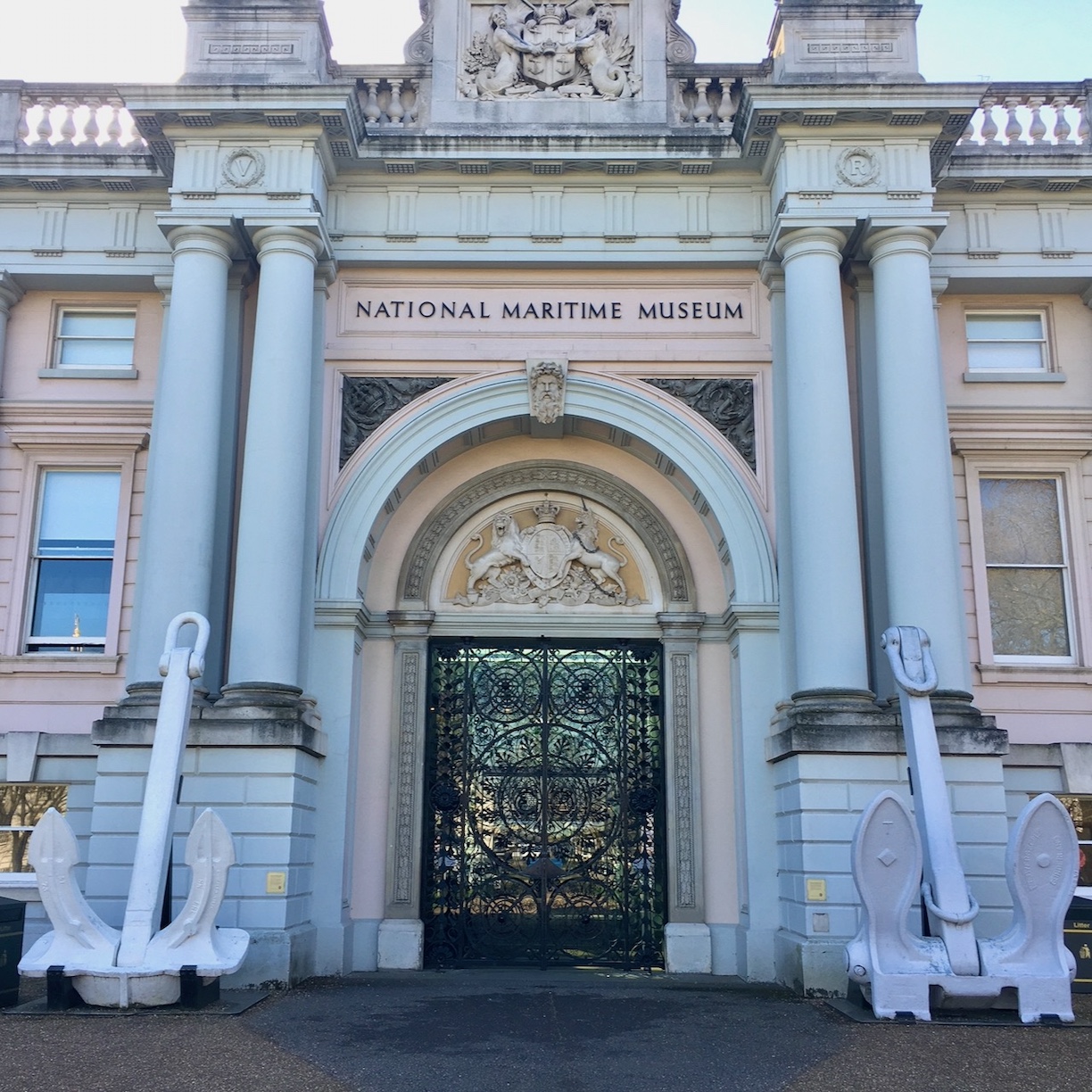
Avid followers of Charleston Time Machine will recall that I produced a program about the origins of the state flag back in 2021 (see Episode No. 188). Since that time, I’ve made a number of trips to England (financed by yours truly) to scour various archives in search of forgotten details of South Carolina’s early history. I’ve included some of my discoveries in a smattering of podcasts (see Episode No. 241, and No. 292, for example), and I’ve collected a sizeable trove of material for future programs. Most of the “new” material I’m finding revolves around the activities of the Royal Navy in Charleston Harbor and along the neighboring coastline during the five decades preceding the American Revolution. The well-preserved paper records of this long naval presence are both incredibly voluminous and accessible free-of-charge when you visit the spectacular National Archives in suburban Kew, or the amazing National Maritime Museum in historic Greenwich. Today’s program, focusing on a relatively small discovery relating to the early history of the South Carolina flag, constitutes a sort of teaser for an upcoming series of programs shedding new light on familiar local stories of the American rebellion that commenced in 1775.
Let’s begin with a brief summary of the most salient events leading up to the creation of the historic flag in question. South Carolina’s first steps towards armed rebellion against Britain commenced with acts of civil disobedience in the early months of 1775. Elected representatives from across the colony created a shadowy Provincial Congress that January, and a General Committee of like-minded Charlestonians orchestrated the seizure of state arms and gunpowder in late April (see Episode No. 64). In June, members of the Provincial Congress authorized the creation of a new provincial army, appointing Christopher Gadsden and William Moultrie commanders of the 1st and 2nd Regiments, respectively. Their subordinate officers recruited men from across the Lowcountry during the summer as the last vestiges of British authority disintegrated within thirteen of King George’s American colonies. Because Colonel Gadsden was in Philadelphia representing South Carolina in the Continental Congress, Colonel Moultrie supervised both of the provincial regiments then coalescing in Charleston.
Local fears of British retaliation for such overt acts of sedition percolated during the turbulent summer of 1775, stoked by intelligence of mixed veracity streaming into Charleston from sources near and far. South Carolina’s last royal governor, Lord William Campbell, fled to the safety of a British warship in the harbor, his executive authority usurped by a clutch of rebel leaders known as the Council of Safety. By the time of Campbell’s exodus in mid-September, the motley ranks of the 1st and 2nd Regiments were sufficiently filled and drilled to participate in a nocturnal expedition to seize control of a small, fortified outpost standing at the northeast corner James Island. Fort Johnson, erected in 1708 and named for the governor of that era, was defended by a tiny garrison of half-hearted British soldiers who quickly surrendered to rebel grenadiers on the morning of 15 September 1775. Robust details of that operation can be found is numerous published sources, so we’ll move along with our story about state flag. In his Memoirs of the American Revolution, published in 1802, William Moultrie recalled the flag’s origin in the following words:
“A little time after we were in possession of Fort Johnson, it was thought necessary to have a flag for the purpose of signals: (as there was no national or state flag at that time) I was desired by the Council of Safety to have one made, upon which, as the state troops were clothed in blue, and the fort was garrisoned by the first and second regiments, who wore a silver crescent on the front of their caps; I had a large blue flag made with a crescent in the dexter corner, to be in uniform with the troops: This was the first American flag which was displayed in South Carolina.”[1]

Moultrie’s brief text constitutes the most authoritative historical record concerning the origins of the state’s venerable flag, but it does not provide a date for the unveiling of the blue-and-white banner of his creation. For more than two centuries, historians and South Carolinians in general have followed Moultrie’s narrative and surmised that the earliest form of the state’s distinctive banner appeared at some unknowable point in the autumn of 1775 or the early months of 1776. I counted myself among that group until recently, when perusing the manuscript logbooks created by the British naval officers posted in Charleston Harbor during the entirety of the aforementioned chain of events. Within their recorded observations, we find both an answer and a new mystery.
The star witnesses to the first appearance of the South Carolina flag included a group of British mariners representing the Royal Navy, divided between two vessels of unequal size. The sloop-of-war Tamar was the final post ship assigned to the Carolina Station, a naval designation created by the Lords of the Admiralty in 1719 when South Carolina began to transition from a semi-autonomous proprietary colony to a crown possession. Under the command of Captain Edward Thornbrough, the Tamar arrived in Charleston Harbor in September 1774 to protect British shipping interests, as customary. Its crew, including Lieutenant Joseph Peyton and sailing master Walter Langford, observed the community’s gradual progress towards revolution until the ship’s departure in January 1776. The armed ship Cherokee, which came to Charleston in early September 1775, was a smaller commercial vessel purchased by the Royal Navy in 1774 to facilitate a surveying expedition along the southeastern coast of North America. Not intended to serve any combat or offensive role, the Cherokee carried a light armament and a small crew, commanded by a veteran lieutenant named John Fergusson (his spelling), who later ascended to the rank of admiral in the king’s navy. Lieutenant Fergusson’s second-in-command was the chief warrant officer aboard the Cherokee, sailing master William Pickard (his spelling).
Using quill and ink, the captain, lieutenants, and sailing masters of both the Tamar and Cherokee recorded daily entries in their respective logbooks. Naval regulations compounded this labor by requiring the aforementioned officers to send manuscript duplicates of their several logbooks to the Secretary of the Admiralty in London at least once a year. Like many naval officers serving during the age of sail, the king’s mariners aboard the various warships in Charleston Harbor occasionally copied each other’s text, and perhaps shared a common table and a bottle of rum while compiling their daily entries by candlelight. Their collective logbooks, archived by the thousands in London, reveal a life at sea filled with tedium and hardship, interspersed with moments of both leisure and terror, and often contain historical details not recorded in other sources.
Regarding the debut of the South Carolina flag, none of His Majesty’s officers aboard the Tamar recorded any mention of a distinctive new banner fluttering above Fort Johnson in the autumn of 1775 or the early days of 1776. They must have seen it day after day during their final weeks in the colony, but evidently considered the flag unworthy of their official notice. While perusing the Cherokee logbooks of Lieutenant John Fergusson and Master William Pickard, however, I found nearly identical descriptions of a novel sight inscribed under the heading of Wednesday, 22 November 1775: “Light breezes and fair wea[the]r. AM the Rebels at Fort Johnson hoisted their Provincial Colours[,] a White Cresent [sic] in a Green field.”[2]

As you can imagine, I was quite pleased to discover this brief text, the earliest-known eyewitness description of our familiar South Carolina flag, but I was also deeply troubled by Lieutenant Fergusson’s and Master Pickard’s quite legible, unmistakable inclusion of the words “green field.” Surely, they were mistaken, I thought, because Colonel Moultrie’s Memoirs clearly state that he had overseen the creation of “a large blue flag” shortly after the seizure of Fort Johnson. Perhaps, I speculated, some form of color blindness impaired the vision of Mr. Fergusson, or Mr. Pickard, or both. Perhaps the morning sunlight, rising above the horizon of the Atlantic Ocean, somehow imparted a greenish cast to an otherwise bluish flag. Perhaps the fabric of the new provincial flag had been dyed with an inferior grade of locally-produced indigo, creating an unintended greenish tint?
For days and weeks, my mind continued to search for rational explanations for the inclusion of the “wrong” color in the description recorded on 22 November 1775. Then I considered a sobering thought: Lieutenant Fergusson and Master Pickard, like their colleagues aboard the Tamar, likely witnessed the daily raising and lowering of the new provincial flag until they all crossed the bar and sailed away from Charleston on 6 January 1776. They had ample opportunity to revise their description of the flag, therefore, if further observation had altered their perception. That point inspired a new question that sent me back to the logbooks: How far away from Fort Johnson was the Cherokee during the days and weeks in question?
Neither Lieutenant Fergusson nor Master Pickard noted the precise coordinates of the Cherokee on or around the date in question. Rather, their logbooks both indicate simply that the ship was riding “at single anchor,” along the northern edge of the traditional anchorage known as Rebellion Road, “near Sullivan’s Island,” in water fourteen fathoms (84 feet) deep. The larger warship Tamar was nearby, also riding at single anchor, and their collective logbooks indicate that both ships had veered to half a cable; that is to say, they had each extended approximately 300 feet of rope between the anchor and the ship’s bow. Fortunately for us, both the captain and sailing master of the Tamar described their anchorage in greater detail on 19 November 1775, three days before the flag’s debut, by sighting two local landmarks on a thirty-two point compass rose: From their vantage point, Coming’s Point, the northernmost end of Morris Island, stood south-by-east, while the Pest House on Sullivan’s Island (slightly west of the present Fort Moultrie) stood east-by-south, one mile distant from the ship. Those coordinates place the Tamar approximately one-half of a mile west-by-south from the westernmost point of Sullivan’s Island. With some confidence, therefore, we can surmise that the warships Tamar and Cherokee were approximately one-and-a-half miles (or nearly 2.5 kilometers) to the northeast of Fort Johnson when South Carolina provincial soldiers raised their new flag, and the warships crept no closer to the fort’s guns during the remainder of their tenure in the harbor.
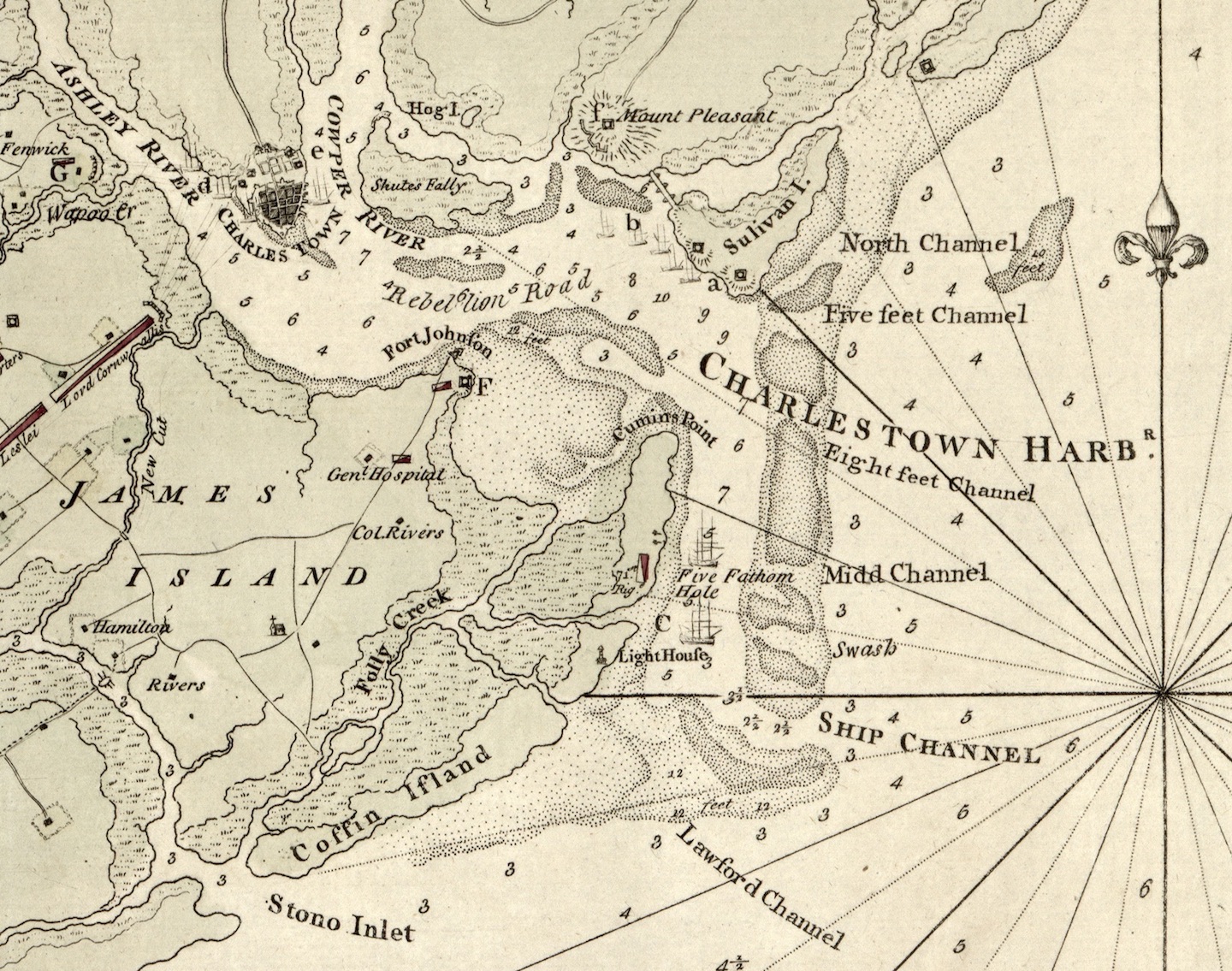
From that distance, it seems unlikely that the officers aboard the Cherokee could have discerned the flag’s white crescent without the aid of a telescoping spyglass, an instrument routinely carried by commissioned naval officers and sailing masters of all nations during the late eighteenth century. Is it possible, I wondered, still grasping for rationalizations, that a hand-ground lens of that era might have included some flaw in the glass that distorted the wavelength of the light and produced a false color? At this point, I recognized that my methodology was all wrong. I was simply searching for theories to discredit the plainly-written testimony of an eye witness. So I adopted a new tack: What if Lieutenant Fergusson and Master Pickard recorded an accurate description of the flag raised above Fort Johnson on 22 November 1775? Why would Colonel Moultrie have used a green field at that moment, but later reported the creation of a provincial flag with a blue field?
Turning back to primary sources on this side of the Atlantic, I immediately spied a clue in the aforementioned quotation from Moultrie’s Memoirs of the American Revolution. The flag in question was created, as the old general recalled, “for the purpose of signals.” At that moment in the autumn of 1775, the flag was not intended to serve as the representative banner of an independent state that did not yet exist. Military personal of that era, especially those serving in coastal harbors, were familiar with a variety of auditory and visual signals deployed to communicate vital information across large distances. Moultrie’s flag, whatever its color, entered the local semiotic lexicon in late November 1775, at the zenith of tension between the opposing forces in Charleston Harbor. Immediately after the departure of the British warships Tamar and Cherokee in early January 1776, the leaders of South Carolina’s rebel forces launched a rapid series of military projects to fortify and defend the harbor before the return of a larger force of enemy warships. Among their endeavors was the creation of a visual signal chain that provincial leaders delegated to the reliable Colonel Moultrie.
On 22 January 1776, the South Carolina Council of Safety asked William Moultrie to consult with other regimental commanders to devise a system of signals “for giving notice of the appearance of vessels on the coast.” Their goal was to facilitate the relaying of distinct signals, identifying the approach of various types of vessels, from the Light House on the south side of the harbor’s entrance, and from Sullivan’s Island on the north side of the harbor’s entrance, to Fort Johnson on James Island, and ultimately to officers in urban Charleston who could respond appropriately, whether the approaching vessels be friend or foe. Narrowing the range of options available to Moultrie and his colleagues, the Council specified that “the signals [are] not to be by guns, except in thick foggy weather.”
Coincidentally, a few days after delegating this task to Colonel Moultrie, the Council of Safety delivered to him a large quantity of “blue cloth” for the use of the 2nd Regiment under his command. Whether that material was used for uniforms or flags or both is a question yet unanswered. At any rate, Moultrie and his colleagues completed their assignment at some point in February 1776 and reported a system of signals to the Council of Safety, which, in turn, ordered the distribution of the information, and, presumably, the necessary apparatus, to commissioned officers encamped around the harbor.[3]
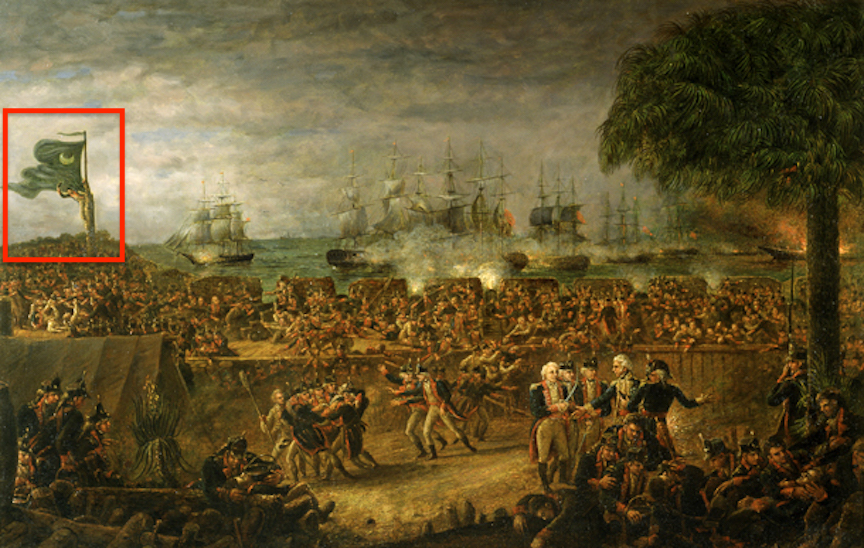
On 9 March 1776, Major Barnard Elliott of the new 4th Regiment of provincial troops recorded in his personal order book a summary of the new signaling protocol he received from Colonel Christopher Gadsden. Elliott’s manuscript text does not mention any physical apparatus, but the system clearly required at least one tall mast-like structure at each point in the chain of signals. When a ship of three masts approached the bar of Charleston Harbor, for example, the signal was small red pendant (i.e., pennant). A small blue pendant signaled the approach of an unfamiliar schooner or sloop. If one of the waterfront lookouts observed a coasting (that is, local) schooner or sloop approaching, Fort Johnson was ordered to “hoist the old common blue fort flagg, or jack.” Approaching brigantines triggered the raising of small white pendants. If any of the aforementioned vessels were merchantmen, the observer was to raise a large white jack with a red cross to supplement the appropriate colored pendant. Finally, and most importantly, if the observer identified an approaching vessel as a man-of-war, “the new Provincial Flagg [sic] will be hoisted & lowered as many times as there are men of war seen.”[4]
From its inception in November 1775, therefore, South Carolina’s new provincial flag functioned within a local lexicon of visual signals that used contrasting colors, shapes, and sizes to communicate maritime information vital to the security of the colonial capital. A large green flag with a white crescent, in my opinion, makes more sense in this semiotic context than a large blue flag, which an observer might easily confuse with “the old common blue fort flagg” that preceded Moultrie’s new banner. I’m not suggesting, however, that Moultrie flag was exclusively green during its early career. It could very well have existed in a variety of colors, especially after the colonel took possession of a large quantity of blue cloth from the provincial government in late January 1776. I feel confident, furthermore, that the men defending the unfinished, palmetto-log fort on Sullivan’s Island that 28th of June fought under a broad blue flag with a white crescent in the dexter corner, as described by an elderly William Moultrie twenty-six years later. By that point in the summer of 1776, the aforementioned signaling protocol was moot. Everyone in the region knew that a squadron of British warships had spent nearly a month reconnoitering the entrance to Charleston Harbor, and the men under Moultrie’s command were free to raise their flag of choice. Consider, also, that three days after that memorable battle, Susannah Elliott, the bride of Major Barnard Elliott, presented to the colonel a pair of silk flags for the heroic 2nd Regiment. Both banners bore the distinctive white crescent, but one was blue, and the other red.
From one sentence recorded two-and-a-half centuries ago by a pair of forgotten visitors, we’ve learned two important facts about South Carolina’s venerable state flag. First, the auspicious crescent first appeared on 22 November 1775, a date that might attract some official recognition in the future. Second, the flag’s design, specifically its principal color, was likely more mutable during its early existence than formerly acknowledged. While it remains a possibility that Lieutenant John Fergusson and Master William Pickard were both incapable of distinguishing green from blue, it is perhaps more likely that they recorded accurate observations of the flag’s colors on that historic day. In either case, I’ve enjoyed my “busman’s holidays” in London archives, and I’m looking forward to sharing more exciting discoveries with you the coming months.
[1] William Moultrie, Memoirs of the American Revolution, So Far As It Related to the States of North and South-Carolina, and Georgia, volume 1 (New York: David Longworth, 1802), 90–91.
[2] Lieutenant’s log (John Fergusson), Cherokee, 1775–76, ADM/L/C/284, Caird Library and Archive, National Maritime Museum, Greenwich, UK. Under the same date, sailing master William Pickard wrote “AM the Rebels at Fort Johnston [sic] hoisted their Provincial Colours[,] a white Crescent in a green field”; see Master’s log (William Pickard), Cherokee, 1775–77, ADM 52/1662, National Archives, Kew.
[3] “Journal of the Second Council of Safety, appointed by the Provisional Congress, November 1775,” in Collections of the South Carolina Historical Society, volume 3 (Charleston: South Carolina Historical Society, 1859), 205, 225, 226. The extant journal of the Council of Safety ends in late February, without articulating the conclusion of the signaling protocol.
[4] See the General Orders for 9 March 1776 in Barnard Elliott, “4th South Carolina Regiment order book, 1775–1778,” South Carolina Historical Society, 34-0205. A flawed transcription of Elliott’s “diary” appears in the Charleston Year Book of 1889, pages 151–262, but the original manuscript has been digitized and is now available through the Lowcountry Digital Library.
NEXT: Lord William Campbell, Sarah Izard, and their Carolina Connection, Part 1
PREVIOUSLY: The Demise of Butcher Town and the Charleston Abattoir
See more from Charleston Time Machine