
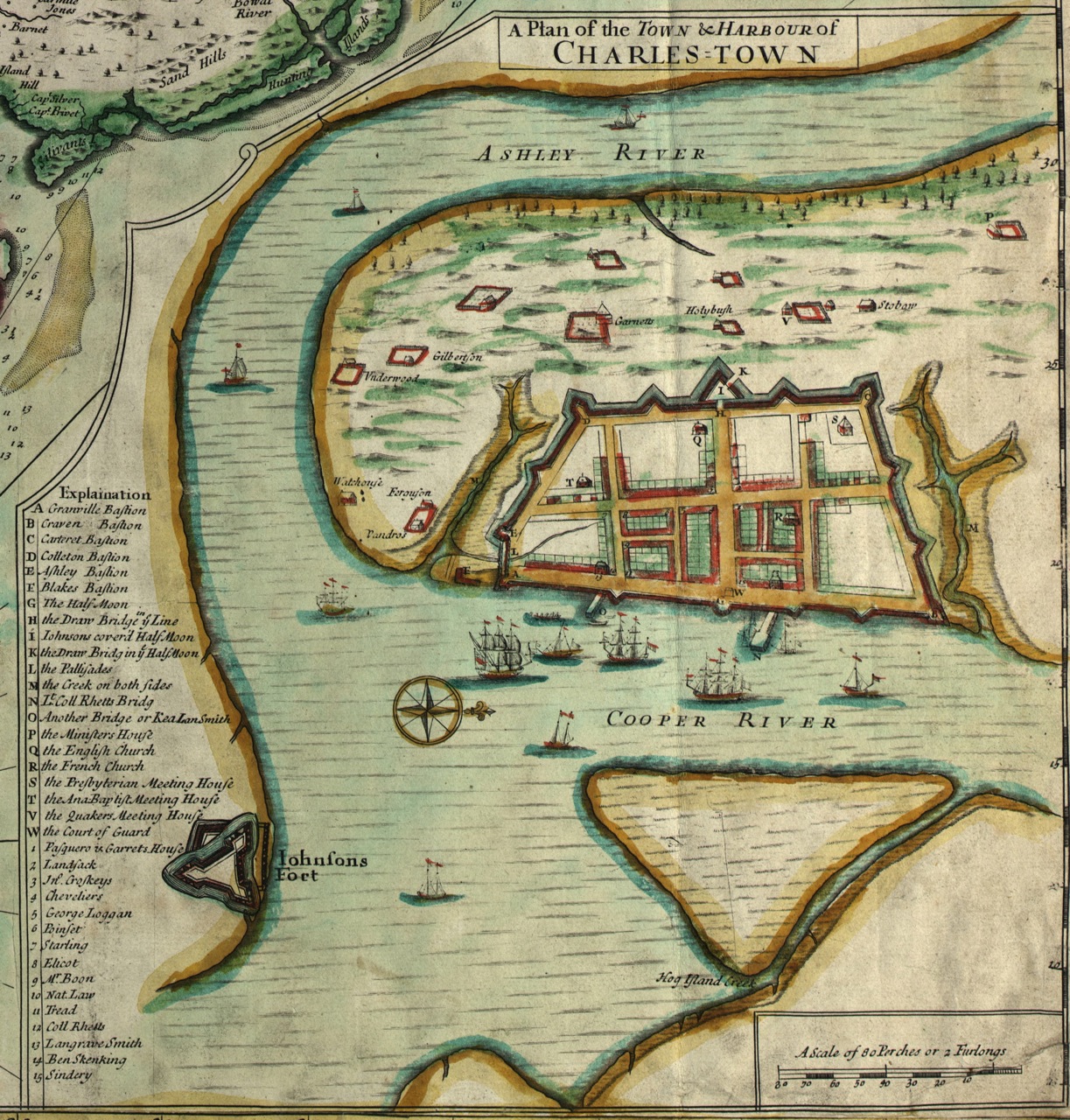
The residents of early Charleston lived cheek-by-jowl with the animals they consumed, and routinely witnessed cattle, pigs, sheep, and goats trotting through urban streets to meet the butcher’s blade. Efforts to push this bloody business out of the city center commenced in the late 1690s and evolved over the following century, during which local officials gradually pushed the slaughtering trade northward to a tidewater suburb that became known as Butcher Town.
At the root of this topic is the human consumption of animal flesh. Although few of us today consider the industrial pipeline necessary to produce the burgers, sausages, steaks, and barbeque we consume, the inhabitants of early Charleston were much more aware of the laborious path leading from farm to table. Prior to the advent of artificial refrigeration in the late nineteenth century, animal slaughtering around the world took place as near as possible—both geographically and temporally—to the point of consumption. Once killed, the animal’s flesh must be devoured or preserved in some manner before it decays into a poisonous substance. This bloody business produces powerful smells that offend the nose, but, in the minds of our ancestors, butchered entrails also corrupted the surrounding air, creating clouds of miasma or pollution that threatened the health of anyone inhaling the noxious vapors. For these reasons, the history of animal slaughtering across the Charleston landscape illuminates the community’s earliest and most enduring zoning battle, in which local authorities sought to balance two opposing concerns—the desire of private enterprise to slaughter animals as close as possible to the point of sale, and the desire of the general public to banish the noisome slaughtering business to the distant fringes of the community.
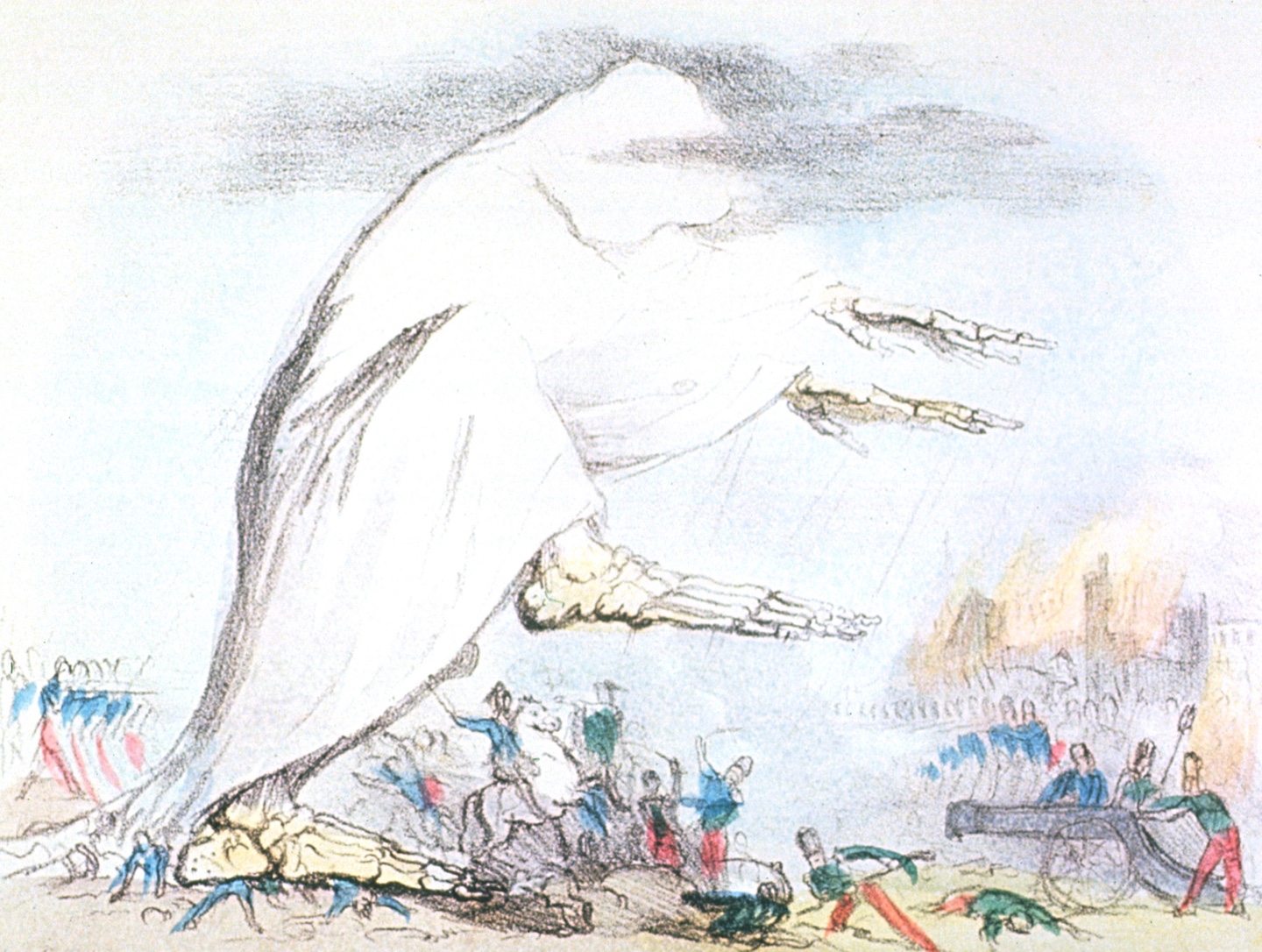
European cattle, pigs, sheep, goats, and other domesticated livestock first came to South Carolina in the early 1670s, principally from the older colonies to the north like Virginia and New York. Within a decade, the business of raising cattle and processing their flesh dominated the local economy, fueling the colony’s growth long before the commercial production of rice, indigo, and cotton. Fertile grasslands and savannas across the subtropical Lowcountry fostered the rapid proliferation of livestock, allowing settlers to establish extensive cow-pens and secure large tracts of land for future planting with minimal initial investment.[1]
While people living on rural plantations in early South Carolina routinely slaughtered animals for their own consumption, most of the beef raised across the colonial Lowcountry was destined for export. Free white drovers and enslaved horsemen drove herds of cattle from rural tracts scattered across the Lowcountry to the Charleston Peninsula, where they followed the sole road to the capital known as the Broad Path (now King Street). In or very near the nascent town, butchers used long knives to dispatch the animals and separate the muscular flesh from the skin, bones, and organs. Locals cured the fresh meat using imported salt to prevent spoilage, then packed the dry chops into locally-made barrels and rolled them to waterfront wharves for storage and sale. Ships bringing goods and people from England, New England, the Caribbean, and Africa purchased barrels of salted meat for consumption during long ocean voyages, or to sell to other parties in the meat-poor sugar colonies like Barbados, Antigua, and Jamaica.
The discarded refuse of animal slaughtering also fueled a suite of ancillary and equally offensive industries. Through the process of rendering, which requires large cauldrons of boiling water, laborers converted gristly animal fat into tallow, formerly the main ingredient in common soap and candles, while rendered hooves yielded a strong, gelatinous glue used in a variety of handicrafts. Tanners soaked raw hides in large vats steeped with tree bark and urine to make pliable leather. Families at the lower end of the economic spectrum transformed the severed heads, tongues, blood, and offal (internal organs) into a variety of edible products, and pulverized the bones into a powder used to supplement the diet of other domestic livestock. In short, our ancestors wasted very little of the animals they killed.
The numbers of domesticated animals across the Carolina Lowcountry increased rapidly during the final decades of the seventeenth century, as did the number of enslaved men and women imported from Caribbean colonies, and, starting in the early eighteenth century, directly from Africa. Although free white butchers, coopers, meat packers, leather tanners, soap boilers, and tallow chandlers controlled these allied industries in early South Carolina, enslaved men of African descent performed most of the dirty work. No laws beyond common sense regulated the labors of tradesfolk working within the environs of unincorporated Charles Town until the autumn of 1698, when the provincial legislature introduced the first approximation of a modern zoning ordinance. In the context of a law designed to improve the nocturnal police force and prevent fires, the government empowered a board of commissioners to close any animal pen, slaughterhouse, or other noxious enterprise within the urban landscape that, in their judgment, represented a nuisance or hazard to the community.[2]
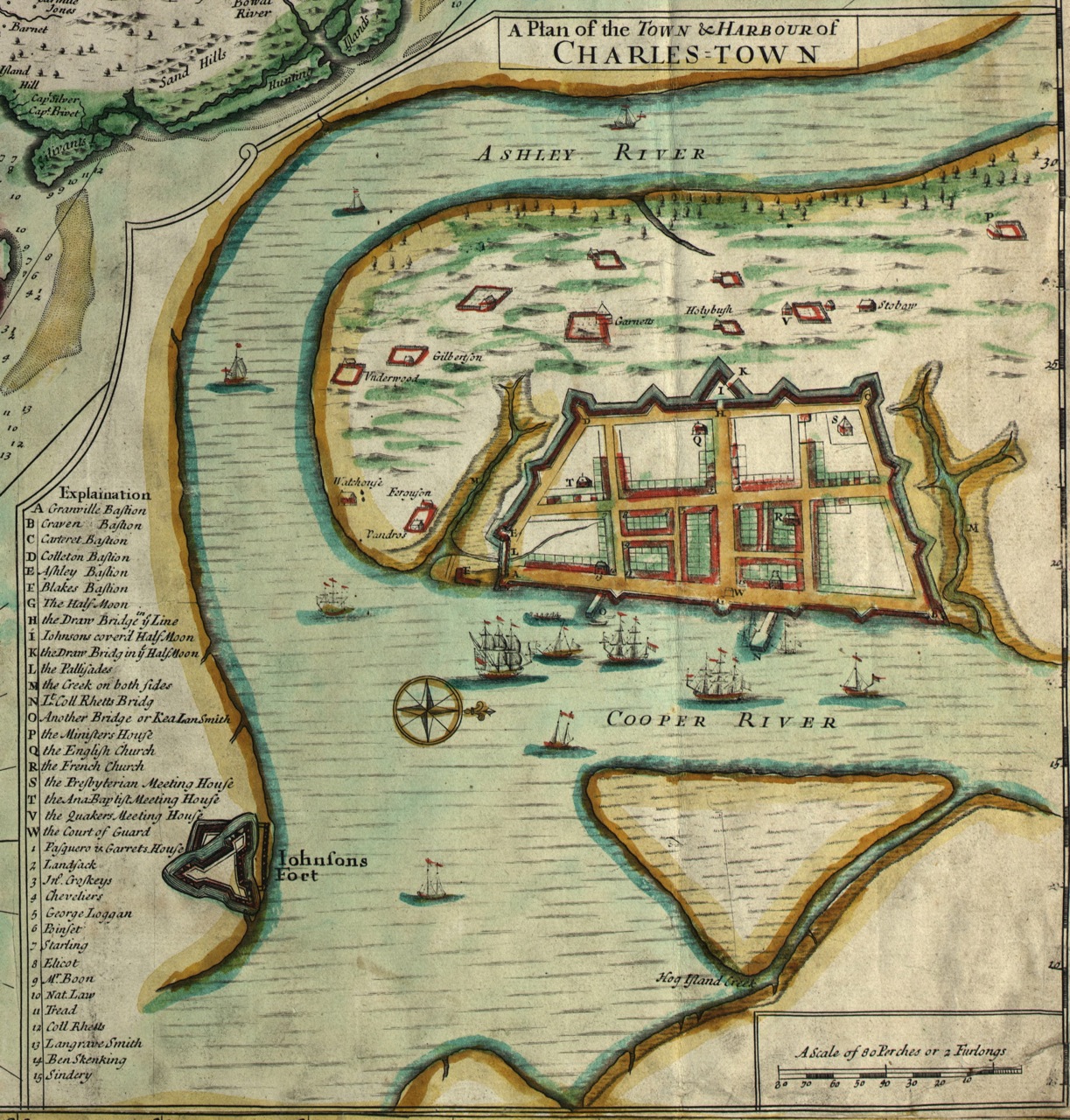
The vague authority created in 1698 became more specific six years later, coinciding with the construction of earthen fortifications or entrenchments surrounding sixty-two acres of urban Charles Town (see Episode No. 230). As that project neared completion in the autumn of 1704, the South Carolina General Assembly ratified an act prohibiting “the killing of beasts” within the bounds of what we now call the “Walled City.” The law’s preamble noted that “by dung and filth of the garbage and intrails of beasts, and the scalding of swine, killed in slaughter houses and yards within the intrenchments, the air is greatly corrupted and infected, and many maladies and other intolerable diseases do daily happen, as well to the inhabitants as strangers and travelers, in and out of Charlestown.” To preserve the health of the community, the government declared that henceforth “no butcher, or any other person or persons whatsoever, shall kill any cattle, sheep or hoggs, nor use or erect any slaughter house, cattle penn, or hogg sties, in either streets or yards within the intrenchments of Charlestown.”[3]
The civic powers articulated in 1698 and 1704 evidently pushed the business of animal slaughtering northward, beyond modern Beaufain Street, the center line of which marks the northern edge of the original town plan called the “Grand Model.” Beyond that point, the peninsular landscape commonly called “the Neck” was divided into a series of large suburban tracts held by a relatively small number of proprietors. Documentary references to the sites of animal slaughtering during the remainder of the colonial period are now sparse, but the evidence suggests a cooperative relationship between local butchers and suburban property owners. During the second quarter of the eighteenth century, for example, George Anson’s Bowling Green plantation, now called Ansonborough, included a forty-acre pasture now bounded by Calhoun, King, Society, and Anson Streets, with a slaughterhouse next to Anson’s brewery at the southeast corner of Anson and Society Streets, just a few hundred feet from his private wharf immediately north of the present Harris Teeter grocery store. Captain Anson, later Admiral Lord Anson, didn’t raise livestock, but he evidently generated a stream of revenue by tolling herds of transient cattle in his pasture and charging butchers for access to his convenient waterfront facilities.[4]
Similarly, in the early 1750s, the widow Elizabeth Harleston leased her 130-acre pasture, then called Coming’s Point but later known as Harleston Green, to local butcher William Harris, who charged customers for the privilege of tolling cattle and horses on the property due west of Anson’s pasture.[5] The owners of neighboring undeveloped suburban tracts, later known as Wraggborough, Mazyckborough, Hampstead Village, Newmarket, and others on Charleston Neck, probably enjoyed similar relationships with local butchers to toll herds of animals prior to slaughter. This hypothetical scenario gains credence when we consider a law ratified by the provincial legislature in 1746, requiring all animals intended for slaughter and sale to be “penned” for at least twelve hours prior to killing. Borrowing from English precedents, the law obliged cattlemen to negotiate with the owners of Charleston’s suburban pastures because customers believed that “killing cattle immediately after their being overheated by driving, often times occasions the beef to taint.”[6]
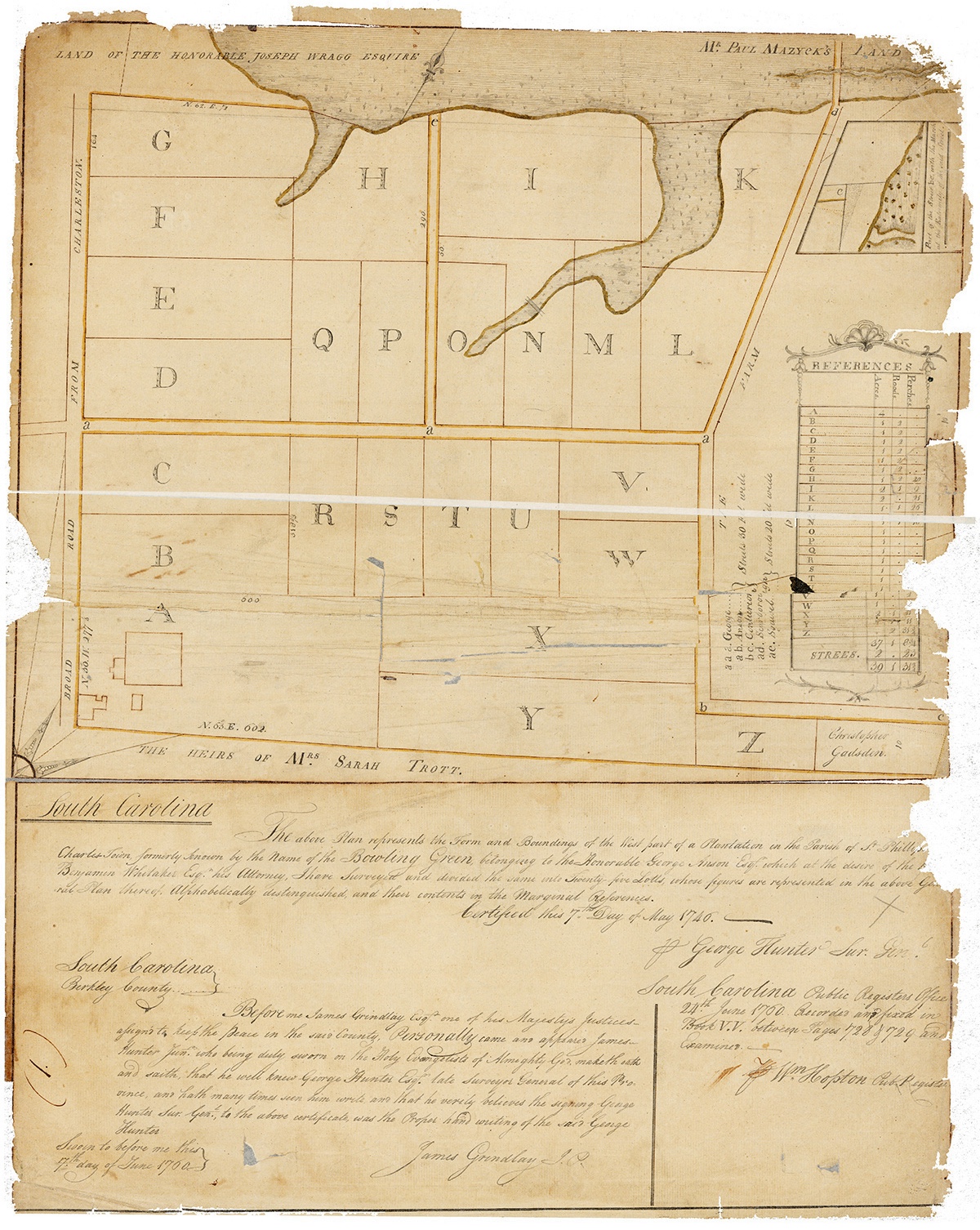
The subdivision of George Anson’s aforementioned forty-acre pasture commenced in 1745, and the first generation of occupants included a mix of both residential and commercial investors. A large tannery, for example, occupied the west side of modern Anson Street, between Calhoun and George Streets, until it was subdivided and gentrified after the American Revolution.[7] In the autumn of 1764, a grand jury complained about a pair of butchers, Jacob Bommer and Thomas Sykes, “for having slaughter-pens and killing cattle, in and about Ansonburgh [sic]; to the great annoyance of the neighbourhood, by the filth and stench of their pens, and to the endangering the lives of passengers passing and re-passing on the public road [i.e., King Street].”[8]
The 1769 genesis of Boundary Street (now Calhoun Street), along the northern edge of Ansonborough, created a new northern boundary for unincorporated Charles Town and hastened the outward migration of commercial slaughter pens.[9] During the late 1760s and 1770s, for example, a tavern known by “the sign of the Peacock,” situated on a four-acre, rectangular site at the southeast corner of King and Spring Streets, included “a slaughter pen” leased to local butchers on yearly contracts. The killing field in question evidently occupied the extreme east end of the tavern property, a once-marshy location now occupied by the Fetter Health Care center at 436 Meeting Street.[10]
Although the statutory prohibition of 1704 pushed the cattle-slaughtering business out of the walled city and into the northern suburbs of the colonial era, dealers in “small meats” (calves, pigs, sheep, and goats) exploited a sort of loophole in law. As I mentioned in a recent episode about Charleston’s waterfront markets, local butchers routinely killed dozens of small animals each day at the Lower Market at the east end of Tradd Street during the second half of the eighteenth century. That practice probably commenced several decades earlier, contemporary with the construction of a brick seawall along the eastern edge of East Bay Street and the rise of the town’s first wooden wharves extending into the Cooper River. Such infrastructure afforded boatmen a place to dock canoes and light watercraft carrying small animals from nearby plantations, and provided butchers with both a stage for slaughtering and a watery drain for the discarded entrails. The creation of the first “Bay Market” at the east end of Elliott Street in 1736 legitimized these daily practices, which migrated to the east end of Tradd Street with the opening of the Lower Market in 1750.
As the population of urban Charles Town increased during the third quarter of the eighteenth century, residents grew frustrated with the limited elbow-room at the end of Tradd Street and the site’s diminishing access to the Cooper River. In the spring of 1773, a grand jury complained about the “present practice of killing calves, sheep, &c. at the Lower Market, which renders it very offensive.”[11] The jurymen craved some change of policy or venue to render the waterfront market more sanitary, but the daily spilling of blood continued for several more years. In mid-June 1778, however, the Commissioners of the Markets notified the public that, after the end of the month, “they will not permit or suffer any cattle, sheep, lambs, calves, hogs, shoates, &c. to be killed or butchered in the either of the publick markets; but that they expect the venders will bring them properly dressed, and ready to cut up for sale.”[12] That wartime prohibition, if it was ever enforced, might have evaporated when British forces captured the city in May 1780.
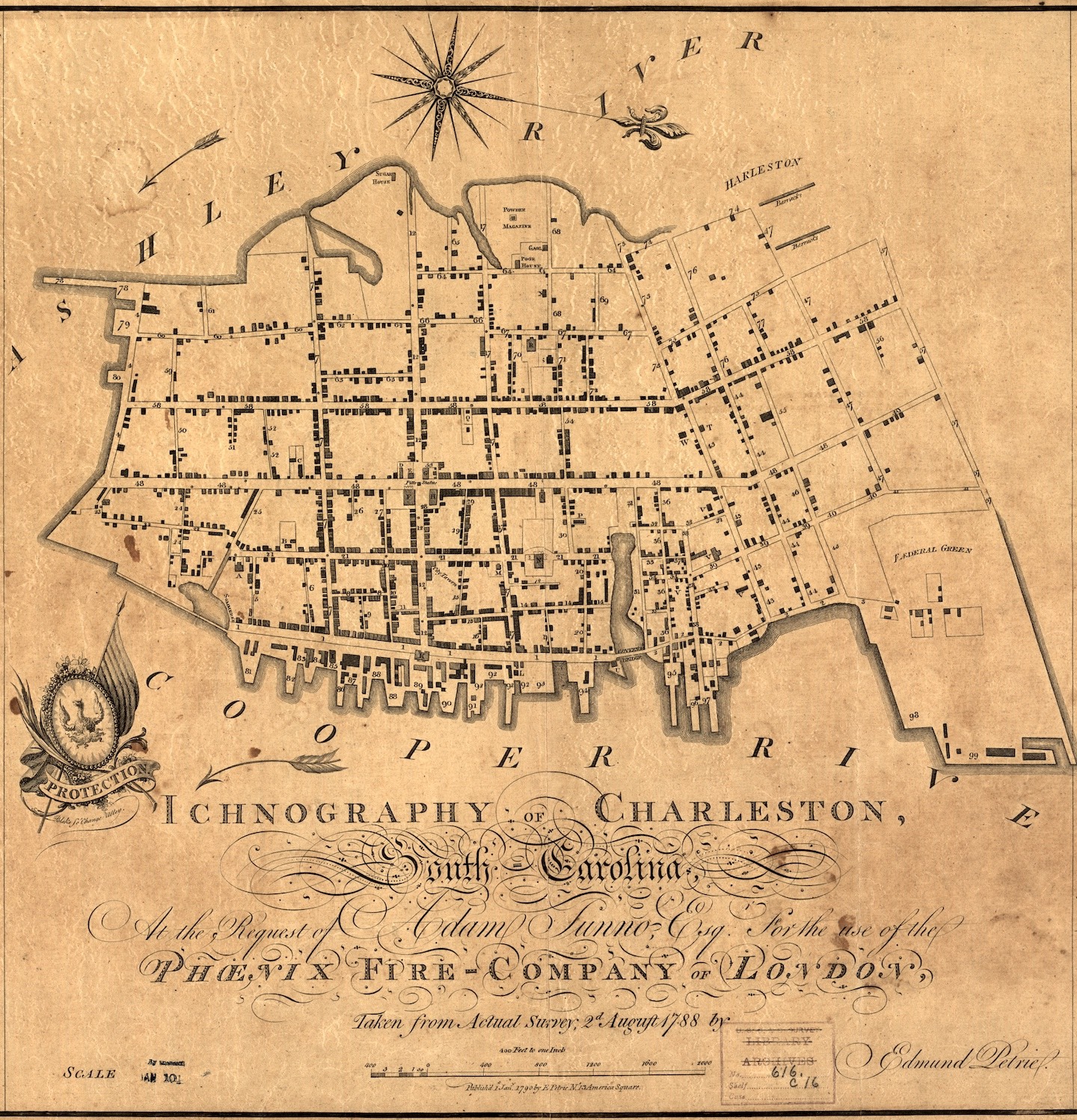
Following the conclusion of the American Revolution in the spring of 1783 and the formal incorporation of the City of Charleston in mid-August, newly-elected municipal leaders considered the most pressing issues facing the community. The wartime preoccupation with military affairs had evidently inspired local butchers to commence slaughtering animals at locations of their own choosing, without regard to public health, and the members of City Council determined to check their offensive liberty. In late September 1783, they ratified “An Ordinance to prevent the killing of cattle within the City of Charleston,” the jurisdiction of which encompassed the entire peninsula from White Point to the present Calhoun Street. Commencing ten days after publication of the new law, Council ordained that “no bullock, ox, cow, or other grown neat cattle, shall be killed within the bounds of the city,” and further “that no butchers-pen, or inclosure, for the purpose of keeping or slaughtering any such cattle, shall be thereafter continued within the city.”[13]
Meanwhile, the daily slaughtering of calves, pigs, sheep, and goats at the Lower Market continued through the remainder of the 1780s. The traditional prevalence of Black butchers working at the east end of Tradd Street became a point of public attention in August 1790, when a violent argument erupted within the crowded marketplace. Just after mid-day on a sweltering Friday afternoon, an enslaved man named Cudjoe (a West African word for Monday) allegedly struck a colleague without provocation. His enraged opponent, Jerry, the property of Mrs. (William) Washington, unsheathed his butcher’s blade and “plunged his knife into the breast of Cudjoe, belonging to Mrs. Clifford, and though assistance was immediately had, he expired in about five minutes.” White authorities immediately arrested Jerry at the Lower Market and confined him to jail. Following the usual brief trial before an ad-hoc court of two magistrates and five freeholders that Saturday, Jerry was condemned to death and hanged on Monday at high noon.[14]
At some point shortly after the lethal affray at the Lower Market in 1790, city leaders relocated the public slaughtering of “small meat” from the crowded east end of Tradd Street to Roper’s Wharf, five hundred feet to the south (now part of the Carolina Yacht Club premises), but the paucity of local records from that era has obscured the logistical details. The municipal Commissioners of the Markets pointed to the new location in the autumn of 1793, however, when they announced a novel regulation concerning the butchers’ business. Noting that “the practice of driving and hawling calves, sheep, lambs, &c. through the streets, to the place appointed for slaughtering them, causes them to be heated and unfit to be killed immediately,” they resolved “that in future, all mutton, lamb, [and] veal, which is intended for sale in the public market [at the end of Tradd Street], shall be brought to the slaughter place on Roper’s wharf, either in boats, carts, wheelbarrows or other carriages, under the penalty of forfeiting the same.”[15]
Conscious of its role in fostering improvements in public health, Charleston’s City Council in the spring of 1795 asked the recently-established Medical Society of South Carolina to recommend measures for “preventing the generation and spreading of contagious diseases, during the approaching summer and autumn.” The physicians’ formal response included a rational suggestion “that the slaughtering of animals either in Charleston or the vicinity, for market, be prohibited, except in such places as are daily washed by the ebbing and flowing of the tide.”[16] The retreating waters of each ebb tide, they believed, would carry away the offensive rubbish and dilute the risk to human health within the larger bodies of water surrounding the peninsula. After a period of deliberation, Council strengthened the cattle-slaughtering prohibition of 1783 with an amendment ratified in August 1796, declaring that “the health and convenience of the city require that the said prohibition be extended to every goat, sheep, hog, or calf slaughtered for sale, subject nevertheless to such regulations as the Commissioners of the Market may make in this behalf.”[17]
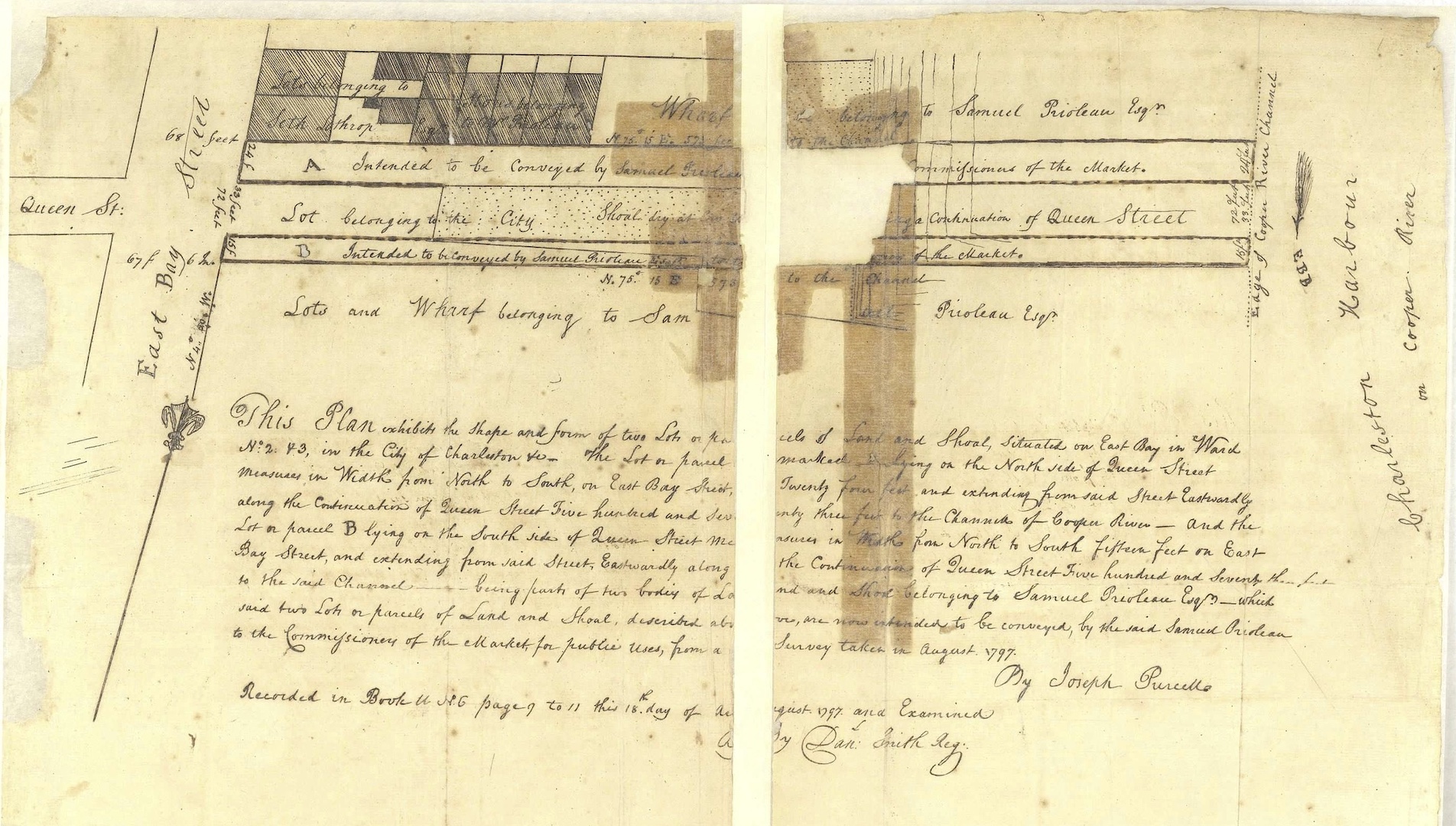
The market commissioners thereafter embraced the advice of the Medical Society, at least within the scope of their limited jurisdiction. Butchers had slaughtered small animals along the city’s Cooper River tidal waterfront for most of the eighteenth century, but the increasingly constricted space within that vicinity prompted municipal leaders in early 1797 to plan a new suite of consolidated facilities at the east end of Queen Street. The old Fish Market at that site was to be dismantled and the narrow roadway leading from East Bay Street to the water’s edge doubled in breadth. In addition, said a planning report from that era, “there will also be a great convenience and much cleanliness resulting from having a capacious water communication for the purpose of carrying off the filth necessarily attendant on a market, so that a [new] market for fish, and a slaughter house for small meat, may be erected with conveniency over the water at such a distance as not to be offensive.”[18]
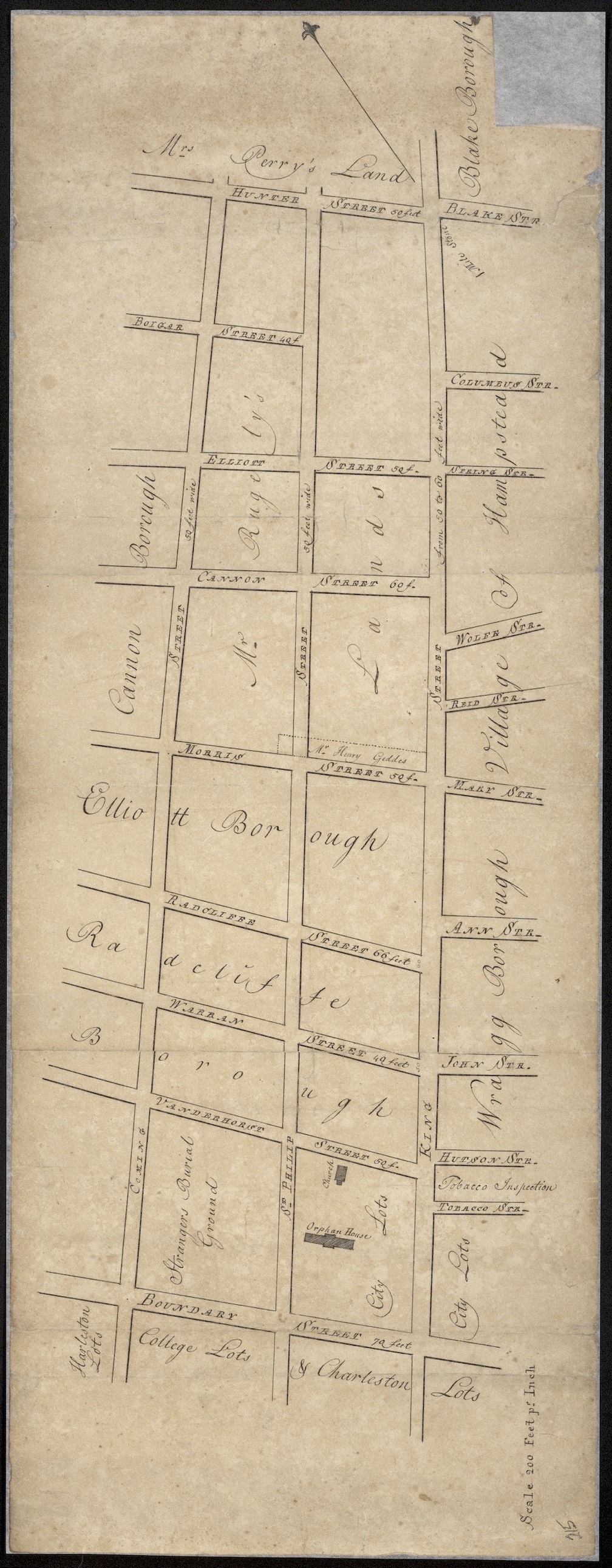
At the same time, however, the market commissioners were powerless to regulate the daily slaughtering of grown cattle among the peninsula’s northern suburbs. In June 1797, for example, a grand jury complained about “the number of slaughter houses close upon the public road, leading to Charleston”; that is, along upper King Street, the old colonial highway, or upper Meeting Street, created in 1785–86. The impaneled citizens deemed the roadside slaughter pens “a dangerous nuisance to the citizens passing the same; and recommend their being moved to some distance from the roads, and if possible to where the water can carry off the filth.” Court officials referred the matter to the attention of City Council, but the municipal government held no legal authority to impose its health-conscious will on the unincorporated Neck, north of Boundary Street.[19]
By August 1800, repeated infractions of existing regulations prompted the city’s market commissioners to reiterate their objection to “the impropriety, as well as inhumanity practiced by the butchers, who kill small meat, particularly calves, by hauling and forcing them along the streets, when they bring them to the slaughtering place” at the east end of Queen Street. The practice “heats and injures the creature,” said the commissioners, “and makes the flesh not wholesome and sweet, as it would be, if conveyed in a proper manner.” Henceforth, they vowed to enforce their 1793 regulation, “which is approved by the City Council,” “that in future no butcher or other person shall lead or drive calves to market, but shall bring them in carts, drays, or wheel barrows.”[20]
The local appetite for watching small animals paraded or carted through the streets of urban Charleston to their death reached its nadir during the early years of the nineteenth century. As I mentioned in a recent program about the creation of the Centre Market, a city ordinance ratified in August 1805 empowered the market commissioners to establish a “temporary” slaughtering facility at the watery east end of Market Street, but that plan never materialized. Two years later, when the Centre Market formally opened, Council reiterated the existing laws concerning market animals and added an unprecedented restriction. Beginning on 1 August 1807, declared the commissioners, “no sheep, swine, calves, or goats, intended for sale at the Centre Market, shall be killed at any place within the city, but that they shall be brought to market ready cleaned for sale.”[21]
The inhabitants of urban Charleston continued to dispatch small animals within the confines of their private property after the first August 1807, but persons attending the public market no longer witnessed the daily slaughter of flesh sold at retail. Butchers and dealers in small meats, like those specializing in larger cattle, had to secure new premises north of Boundary (Calhoun) Street to conduct their killing, and then transport the carcasses in covered vehicles to the butchers’ stalls in Market Street. Some of the slaughtering business had by that time settled into the unincorporated Village of Hampstead, where neighbors complained about the lack of sufficient tidewater to flush the discarded animal effluvia into the Cooper River. On the west side of the peninsula, however, inlets of the Ashley River provided better tidal flow to and from a cluster of new slaughterhouses standing on land recently subdivided by Daniel Cannon (1726–1802). “From this cause alone,” said a neighborhood petition in late 1801, the surrounding landscape “is freed from complaint.”[22]
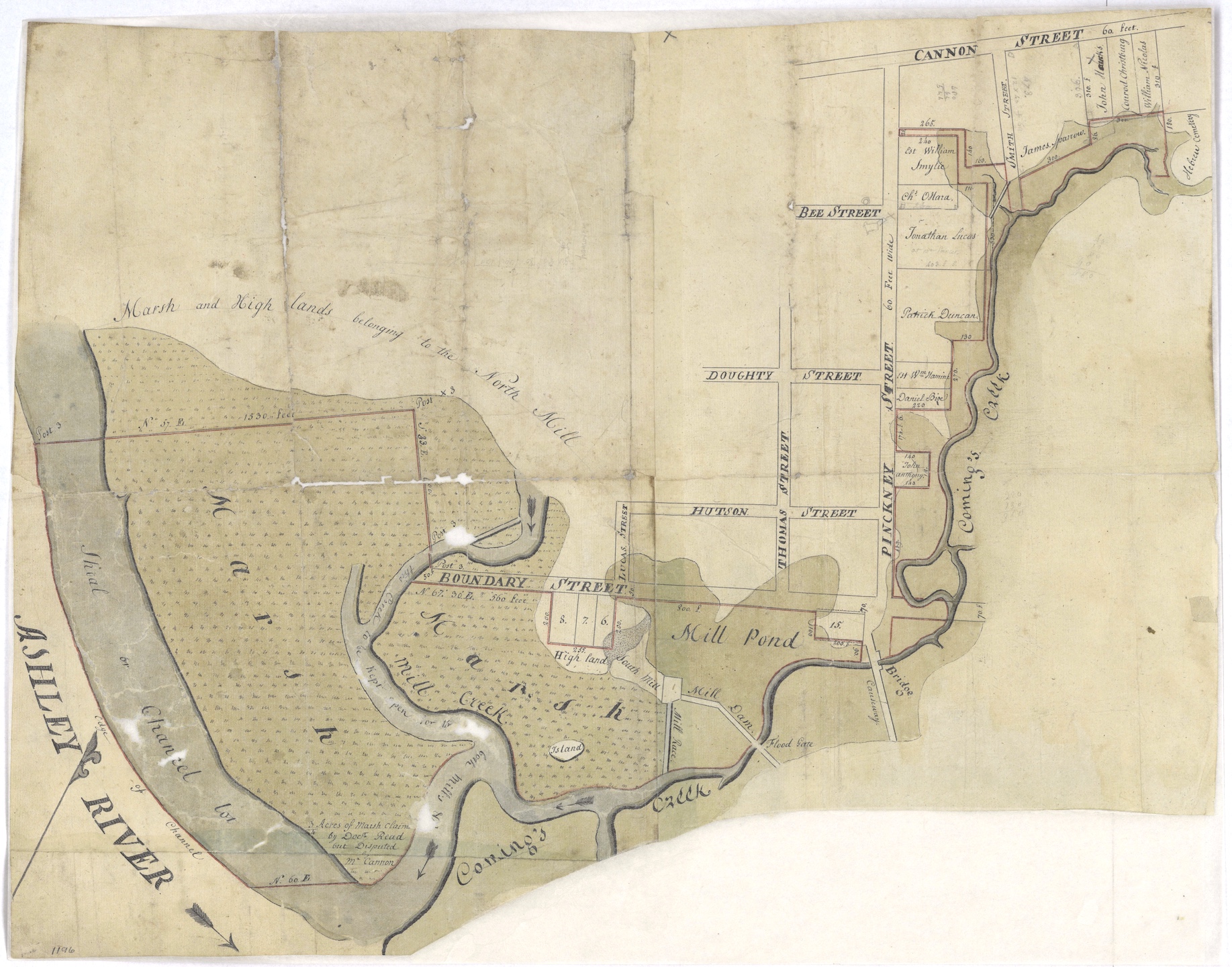
The water-adjacent site attracting a significant proportion of the slaughtering business at the turn of the nineteenth century surrounded a basin of low-lying terrain at the northeastern terminus of Coming’s Creek (aka Cannon’s Creek), which swelled twice a day into a shallow “mill pond” associated with sawmills closer to the Ashley River. In the late 1780s, near the end of his long career in Charleston, Daniel Cannon began subdividing his extensive acreage at the northwest end of Boundary (Calhoun) Street, creating a new neighborhood he called Cannonborough. Butchers, tallow chandlers, and soap boilers seeking tidewater locations beyond the city limits during the late 1790s purchased large lots surrounding Mr. Cannon’s mill pond, erecting slaughterhouses along the water’s edge and residences on the higher land abutting the south side of Cannon Street and the east side of modern Rutledge Avenue (formerly Pinckney Street, created in 1785–86; see Episode No. 81). A handful of newspaper notices published in the late 1790s and early 1800s identify this blood-soaked area as “Butcher Row,” but the more common designation was “Butcher Town.”[23]
Few vestiges of antebellum Butcher Town survive on the landscape of twenty-first-century Charleston, but there are two notable reminders of the neighborhood’s early days. Butcher James Sparrow purchased in 1797 Cannonborough lot No. 18, now No. 65 Cannon Street, extending 310 feet southward to the mill pond, and two years later purchased additional land extending his operations farther to the south. In the spring of 1822, shortly after Sparrow’s death, his creditors advertised his “late residence” in “Butcher Town” as “a comfortable dwelling house and every other building necessary for carrying on the butchering business on an extensive scale.” The property also included “a large new slaughter house extending [southward] over the pond,” which is now part of DeReef Park on the north side of Morris Street.[24]
Similarly, tallow chandler Patrick Duncan purchased in 1798 an expansive lot on the east side of the present Rutledge Avenue containing high ground abutting the western edge of Cannon’s mill pond. While enslaved people boiled butchered animal fat into tallow for candles and soap along the soggy eastern shore of Duncan’s property, his domestic partner, attorney James Nicholson, built a fine mansion near the lot’s northwestern corner. That impressive residence, now called the McBee House, adorns the present perfumed campus of Ashley Hall, an exclusive private school that once anchored the southwestern edge of Butcher Town.[25]
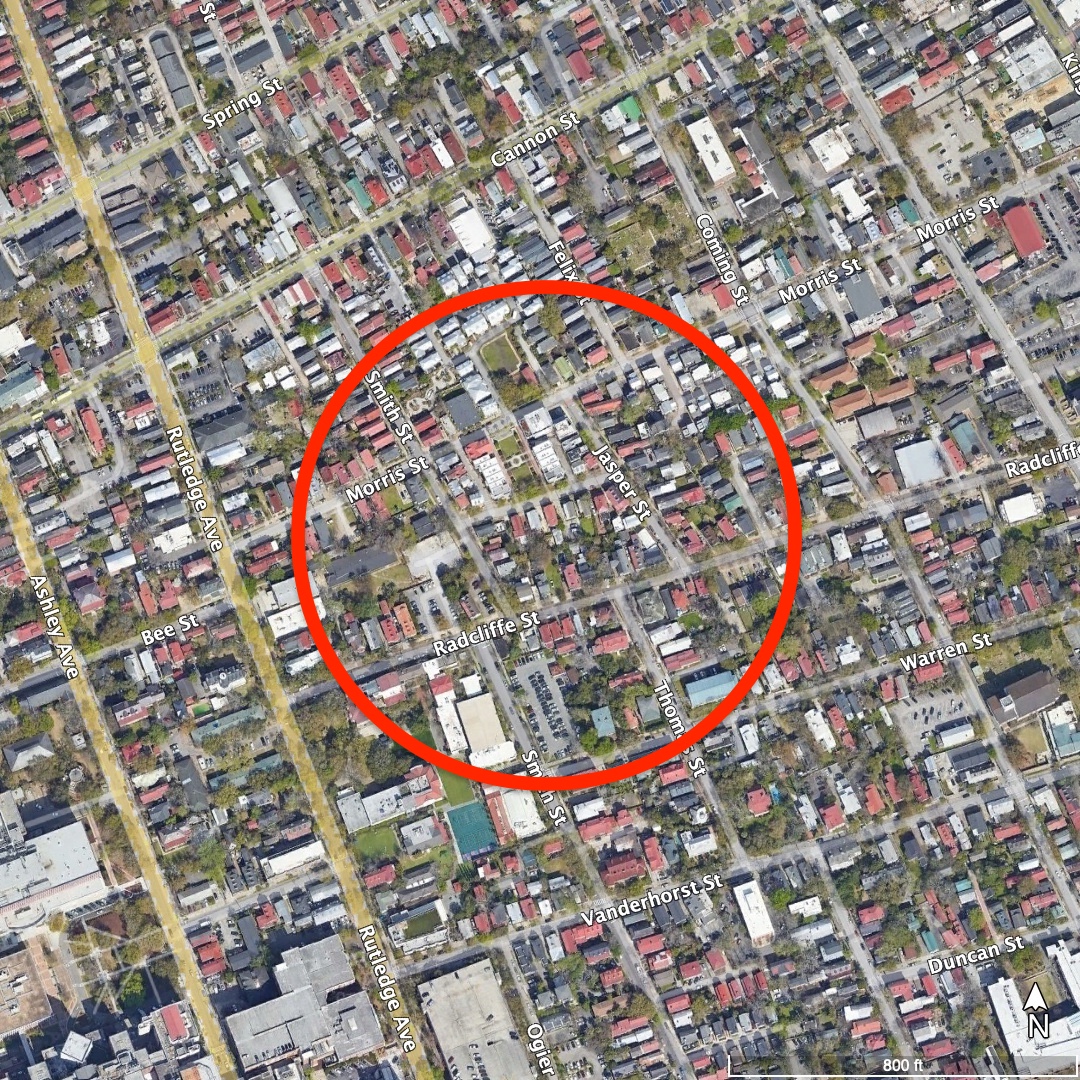
Animal slaughtering and tallow rendering dominated the northeastern corner of Cannonborough for nearly a half-century after the inception of Butcher Town at the close of the eighteenth century. As the neighboring swathes of vacant lands were subdivided and developed during the first half of the nineteenth century, residents along the western edges of Elliottborough and Radcliffeborough began to voice their displeasure with the noxious smells and dangerous effluvia emanating from the nearby slaughterhouses and rendering plants. Their complaints fell on deaf ears until the year 1850, when the City of Charleston formally annexed the unincorporated Neck and threatened the very existence of Butcher Town. In the next episode, we’ll follow the contentious struggle to force the slaughtering business into new northern suburbs, and trace the rise and fall of a forgotten municipal abattoir.
[1] For more information about the cattle industry in early South Carolina, see John S. Otto, “The Origins of Cattle-Ranching in Colonial South Carolina, 1670–1717,” South Carolina Historical Magazine 87 (April 1986): 117–40; Andrew Sluyter, Black Ranching Frontiers: African Cattle Herders of the Atlantic World, 1500–1900 (New Haven, Conn.: Yale University Press, 2012); Emma Hart, “From Field to Plate: The Colonial Livestock Trade and the Development of an Economic Culture,” William and Mary Quarterly 73 (January 2016): 107–40; Martha Zierden, et al., Emergence and Evolution of Carolina’s Colonial Cattle Economy, Archaeological Contributions 52 (Charleston, S.C.: Charleston Museum, 2022).
[2] See section 19 of Act No. 162, “An Act for settling a Watch in Charles Town, and for preventing of Fires,” ratified on 8 October 1698, in David J. McCord, ed., The Statutes at Large of South Carolina, volume 7 (Columbia, S.C.: A. S. Johnston, 1840), 7–12. Note that later acts concerning the urban night watch and general policing of the town included similar provisions.
[3] Act No. 231, “An Act against the Killing of Beasts within the Intrenchments of Charles Town,” ratified on 4 November 1704, in McCord, Statutes at Large, 7: 38. Note that I have retained the original spelling in this and other quotations in this essay.
[4] For more information about Anson’s pasture and wharf, see Charleston Time Machine episode #111, #195, and #260; the slaughterhouse is mentioned in a notice for the dissolution of Anson’s “old brewery” in South Carolina Gazette (hereafter SCG), 6–13 November 1755, page 3.
[5] See the advertisements of Harleston and Harris in SCG, 26 February–5 March 1750, page 3; SCG, 4–11 July 1754, page 3. William Harris identified himself as a butcher in a number of sale documents recorded in the 1740s and 1750s, and in his will dated 1 September 1754; proved on 27 August 1756; recorded in South Carolina Department of Archives and History (hereafter SCDAH), Will Book 1752–56, page 518; WPA transcript volume 7, page 551.
[6] See section 5 of Act No. 744, “An Act to prevent frauds and deceits in selling rice, pitch, tar, rosin, turpentine, beef, pork, shingles, staves and fire wood, and to regulate the weighing of the several commoditys and merchandize in this province,” ratified on 17 June 1746, in Thomas Cooper, ed., The Statutes at Large of South Carolina, volume 3 (Columbia, S.C.: A. S. Johnston, 1838), 686–91.
[7] William Yeomans and Thomas Hoyland purchased lots K and L in the 1745 subdivision of Ansonborough, and William Hopton purchased Hoyland’s share in 1749; see Charleston County Register of Deeds (hereafter CCRD), volume CC: 201–2 and CCRD FF: 136–38; see the advertisement for the subdivision of Hopton’s tanyard in Charleston Morning Post, 7 June 1787, page 3.
[8] SCG, 5–12 November 1764, page 1.
[9] Act No. 985, “An Act for laying out and establishing a public Street in Ansonburgh [sic], and the parts adjacent thereto,” ratified on 23 August 1769, in McCord, Statutes at Large, 7: 92–93.
[10] Tavern-keeper Dennis Egan described the feature as a “butcher’s pen” (SCG, 10 October 1768, page 2), “butchery pen” (SCG, 6 July 1769, page 3), and “slaughter pen” (South Carolina and American General Gazette (hereafter SCAGG), 7–14 January 1771, page 3). The Peacock tavern tract of roughly 4.5 acres was then owned by the estate of John Kelly (died 1766), whose ca. 1764 purchase from Valentine Klaudy [aka Klawdy or Claudy] was not recorded, but is mentioned in another Klaudy deed dated 15–16 October 1764, in CCRD C3: 238–44. A 1750 plat of the tract in question, including a watery inlet along its eastern edge, appears in CCRD A3, between pages 88–89.
[11] SCG, 24 May 1773, page 1.
[12] SCAGG, 18 June 1778, page 1.
[13] “An Ordinance to prevent the killing of Cattle within the City of Charleston,” ratified on 26 September 1783, in Alexander Edwards, comp., Ordinances of the City Council of Charleston, In the State of South Carolina, Passed since the Incorporation of the City (Charleston, S.C.: W. P. Young, 1802), 16–17.
[14] Columbian Herald, 14 August 1790, page 3; City Gazette, 14 August 1790, page 3; City Gazette, 14 August 1790, page 3.
[15] Charleston City Gazette, 27 September 1793, page 3.
[16] City Gazette, 8 May 1795, page 2.
[17] “An Ordinance to amend and Ordinance, entitled, ‘An Ordinance to prevent the killing of Cattle within the City of Charleston,’” ratified on 19 August 1796, in Edwards, Ordinances, 1802, 164–65.
[18] City Gazette, 7 March 1797, page 2.
[19] City Gazette, 22 June 1797, page 2.
[20] City Gazette, 1 August 1800, page 3.
[21] See section 8 and 9 of “An Ordinance for the uniform regulation and government of the Public Markets in the City of Charleston; for the adjustment of Weights and Measures in the said City; and for other purposes therein mentioned,” ratified on 6 May 1807, in Edwards, Ordinances, 1807, 432–53; City Gazette, 29 July 1807, page 3, “Public Notice.”
[22] SCDAH, Petitions to the General Assembly (series S165015), No Date, No. 5935 (circa November 1800); and 1801, No. 26.
[23] See, for example, City Gazette, 1 January 1799, page 2: “For Sale, A Valuable lot of land, in Cannonsburgh [sic], containing 335 feet on Cannon street, (commonly called Butcher Row) and 178 feet on Pinckney street [i.e., Rutledge Avenue]”; South Carolina State Gazette, 6 October 1800, page 2, reported that a recent hurricane had leveled the house of butcher Conrad Creitzburg “in Butcher Town” (i.e., the south side of Cannon Street).
[24] City Gazette, 19 March 1822, page 3; for details of Sparrow’s 1797 and 1799 purchases on the south side of Cannon Street, see CCRD S6: 323–26; CCRD X6: 267–70.
[25] Daniel Cannon to Patrick Duncan, tallow chandler, lease and release, 18 January 1798, CCRD T11: 315–19. In City Gazette, 13 October 1810, page 3, Nicholson described his residence with Duncan as part of “Butchertown.”
NEXT: The Demise of Butcher Town and the Charleston Abattoir
PREVIOUSLY: Charleston's Centre Market, Established 1807
See more from Charleston Time Machine