
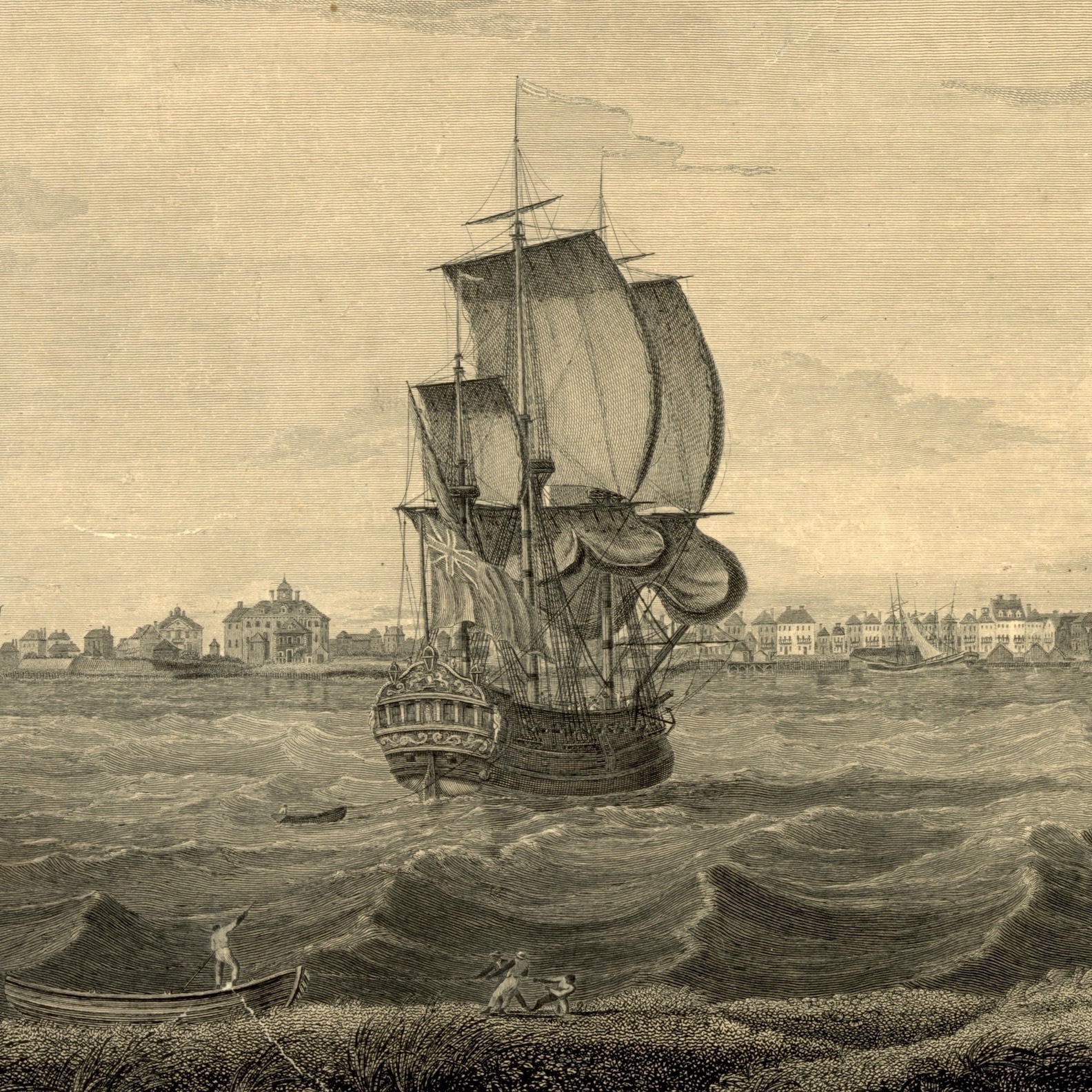
Lord William Campbell, the new royal governor of the colony of South Carolina, stepped ashore at Charleston in late June 1775 to an uneasy reception. Family, friends, and old acquaintances greeted him politely, but a pervasive spirit of rebellion clouded their sentiments. Insulted by apathy for his authority and direct expressions of seditious opinions, Campbell nevertheless chose to stand his ground and jettison a convenient means of escape.
At the conclusion of the previous episode, Governor Campbell sailed into Charleston Harbor on the evening of June 17th aboard the warship Scorpion, which anchored in the Cooper River nearly opposite Craven Bastion (now the site of the U.S. Customs House). The ship’s company were anxious to get ashore, having endured a “very tedious passage” of nearly ten weeks from England, but the late hour of their arrival obliged them to spend another night in cramped quarters.[1] At dawn on Sunday the 18th, crewmen hoisted from the deck to the river two boats nested one atop the other during the trans-Atlantic voyage—a slender, eight-oared pinnace, approximately twenty-five feet long, and a slightly shorter and broader “longboat” used to transport cargo between ship and shore.[2] Lowered carefully into the warm tidal stream and manned by salty oarsmen, the stout wooden craft were now ready to transport the governor’s family and baggage a short distance to the provincial capital.
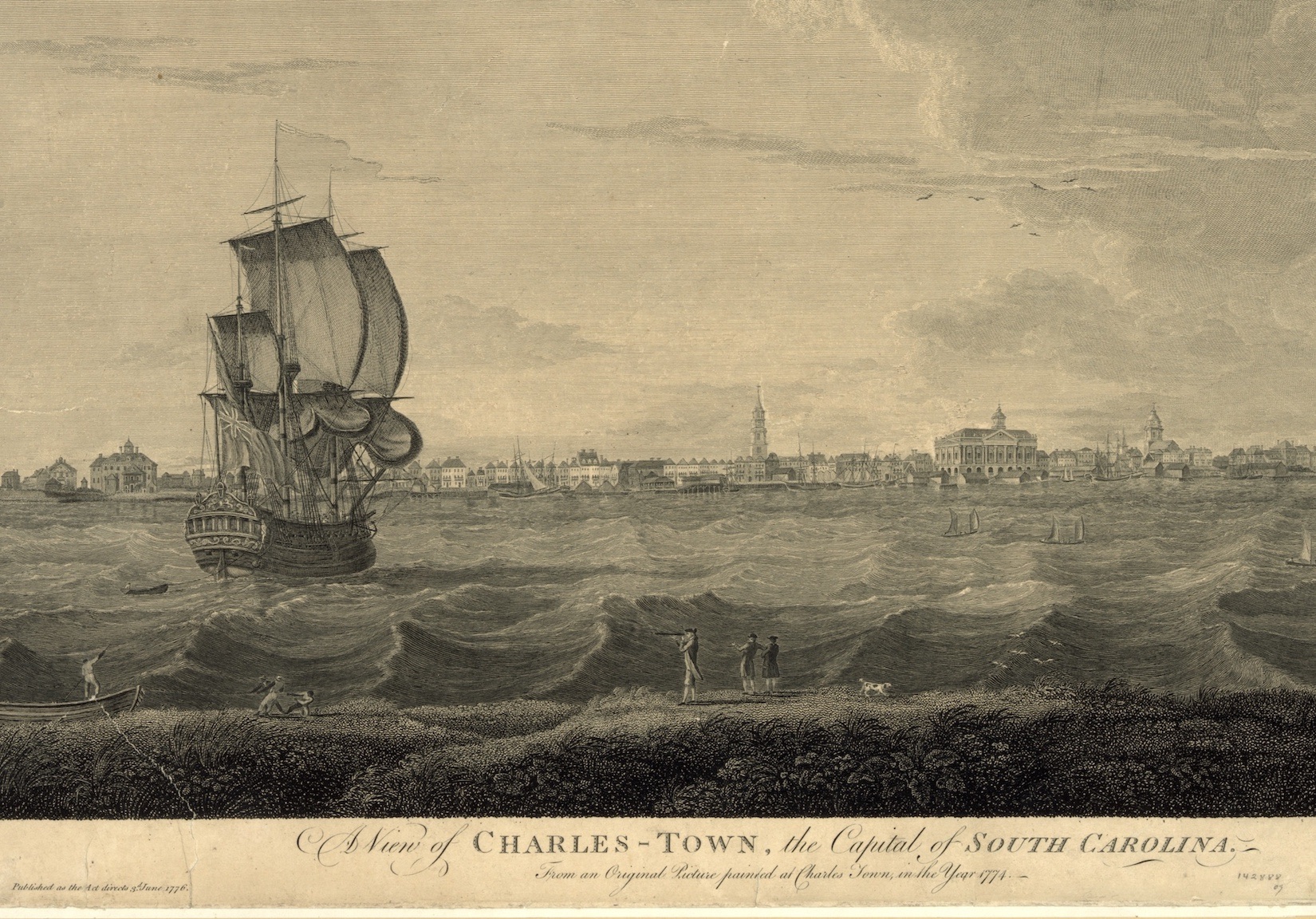
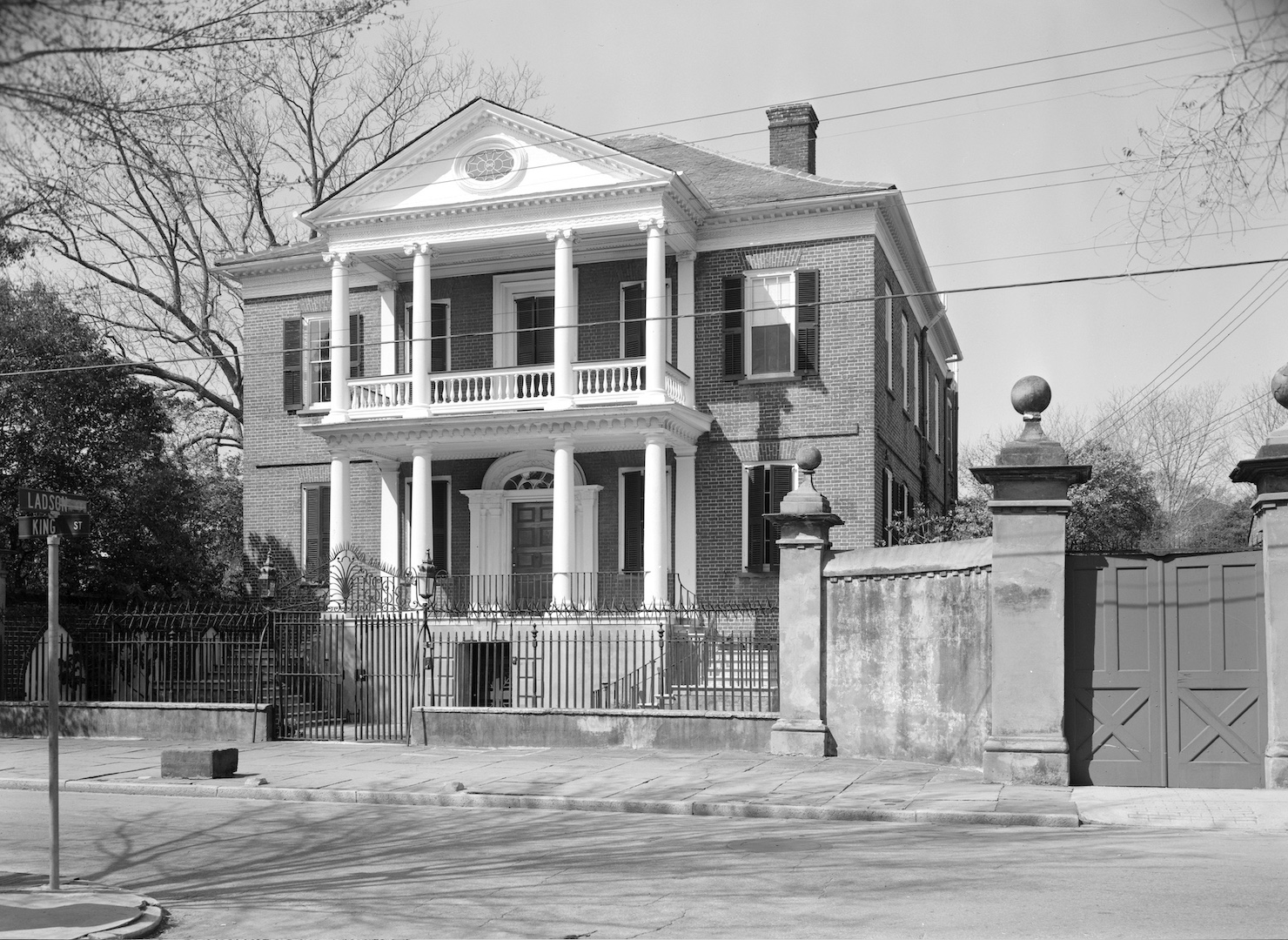
Sarah Izard Campbell gathered her three children from their suite below the quarter-deck and descended the ship’s ladder into the pinnace, likely accompanied by Sarah’s younger brother, Ralph Izard Jr., his teenaged bride, Elizabeth, and a corresponding number of personal servants. The remaining fifteen-odd members of the governor’s entourage probably accompanied numerous bulky chests of the family’s personal belongings, no doubt loaded into the longboat with block and tackle during the first hours of sunlight.[3] The passengers and their baggage might have received a warm welcome at the Charleston quayside from Mary Izard Brewton, Sarah’s first cousin, and her husband, a wealthy merchant-planter named Miles Brewton. The couple had recently constructed an elegant brick mansion near White Point (now 27 King Street), which they generously offered for the Campbells’ use while artisans and servants readied another house for the governor’s official residence.[4]
Lord William, meanwhile, remained aboard the Scorpion and likely received a morning briefing from his personal secretary. Following their initial conversation the previous evening, Alexander Innes had communicated with provincial officials in the capital, both loyalists and rebels, to schedule the obligatory ceremony of the governor’s landing at one hour past meridian on the 18th. Captain Innes, as he was commonly called, might have advised Campbell not to expect a warm reception. Days earlier, in fact, South Carolina’s Provincial Congress, the legislative branch of an expanding shadow government, had entertained a motion “to oppose the landing of the governor,” but the proposal was overruled.[5] Shortly thereafter, the same Congress created its own executive branch, a thirteen-member Council of Safety with nearly unlimited power. Campbell’s former acquaintance, Henry Laurens, was now the chair or president of both rebel bodies, and, for all practical purposes, functioned as the de facto governor of the province. Despite their rebellious machinations, however, President Laurens and his colleagues were not opposed to Lord William personally. Rather than insult an old acquaintance and distinguished representative of the British Crown, they reluctantly agreed to permit the usual public ceremonies attending the inauguration of the colonial executive, accompanied, as customary, by the capital’s urban regiment of armed militiamen.
Around the noon hour, junior officers aboard the Scorpion summoned all hands for the weekly reading of the muster roll under the ardent rays of a bright summer sun. The ship’s purser, Henry Searle, noted with quill and ink the attendance of seventy-six seamen and naval officers and twenty-two marines—the ship’s full complement assigned by the Board of Admiralty.[6] Captain Lord William Campbell might have addressed the men and thanked them for transporting his family safely across the Atlantic, but he did not resign his command of the king’s warship. His orders from the British government provided two options at this juncture—either sail the Scorpion to Boston to join the squadron under Admiral Samuel Graves, Commander-in-Chief of the Royal Navy in North America, or remain in South Carolina and attempt to restore a due obedience to British authority. Campbell had not yet determined his future course, and, for the moment, retained his naval command as a potential means of escape if the political climate ashore proved too hostile.
At 1 p.m., the Scorpion’s assembled crew snapped to attention and “manned ship,” arraying themselves along the length of the main deck and the yardarms above, while the gunners saluted their departing commander with a barrage of fifteen cannons. Captain Campbell and his secretary, accompanied by Lieutenant John Tollemache, and perhaps Master George Scott, senior warrant officer, climbed down the ship’s ladder and stepped aboard the waiting pinnace. Eight men pulled the oars and rowed the governor a short distance to the eastern edge of Champneys’ Wharf, directly in front of the new Exchange Building.[7]
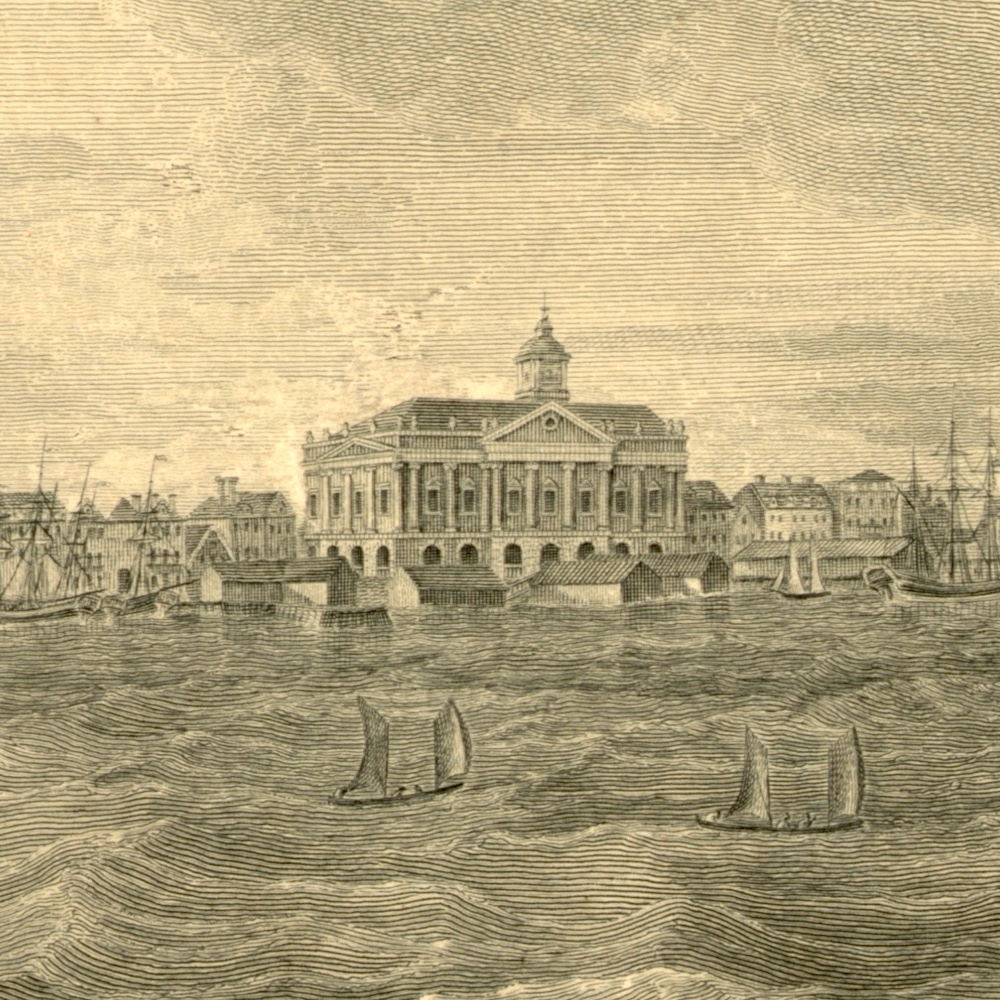
Waiting at the quayside stood the uniformed members of the Grenadier Company of the Charleston Regiment of Militia, arrayed in rank and file with shouldered muskets. At their commander’s word, the Grenadiers turned westward and escorted Governor Campbell and his suite to the steps of the Exchange and across the tiled floor of its open arcade. The lanky grenadiers paused at the building’s west portico and cleared a path for Lord William’s view of the assembled masses in Broad Street below. To the left and right on the elevated portico stood a paltry crowd of the king’s provincial officers—three of the twelve members of His Majesty’s Council for South Carolina, three judges appointed by the Crown, and a handful of minor officials who remained loyal to their royal master. William Henry Drayton, who was ejected from His Majesty’s Council several months earlier for his seditious support of American rights and now played a prominent role in the rebel alliance, observed from his station in Broad Street that Campbell’s entourage “did not exceed fifteen persons,” including a few local gentlemen of known allegiance. Conspicuously absent from the executive’s allies was Lieutenant Governor William Bull, who had quit his townhouse weeks earlier and retired to his country seat on the Ashley River. The sixty-five-year-old Bull was a veteran public servant, having served in all branches of the provincial government during his long career, but chose to remove himself entirely from the present political debacle.
A clerk perched on the west portico of the Exchange read aloud the governor’s royal commission to the assembled crowd, composed chiefly of plain-clothed citizen-soldiers forming the urban regiment of militia. Although the capital’s population at that moment included approximately twelve thousand people, more than half of whom were enslaved men, women, and children of African descent, the audience for the governor’s inauguration included no more than a thousand white men obliged to appear under arms as customary.[8] William Henry Drayton noted that a “trivial” proportion of them shouted positive acclimations at the conclusion of the public recitation, while the grim-faced majority endured the spectacle in “sullen silence.” The militiamen did not fire a celebratory feu de joie, as customary on such occasions in the past, nor were there any drums or fifes to enliven the scene with patriotic music. Instead, the Grenadier Company quietly reassembled in Broad Street and escorted Governor Campbell between two columns of mute musketeers that extended westwardly to the State House at the northwest corner of Meeting Street.
Lord William traversed the several hundred yards in awkward silence, denied even the ceremonial sword of state proudly held aloft at every gubernatorial procession in South Carolina since 1704. At the State House, Campbell and a number of civic officials ascended the stairs to the exquisitely furnished Council Chamber, where a clerk again read aloud his royal commission. The governor then swore the several required oaths of allegiance and followed his armed escort back to the Exchange for a third and final public reading of his commission. Before dismissing the militia regiment, Lord William retraced his steps through the columns of armed men to the State House, were caterers provided a “genteel entertainment” for the governor and his small circle of conservative allies.[9] Campbell joined his family at the Brewton house before nightfall on June 18th, concluding his first full day in the colony since his appointment to the governorship two years earlier.
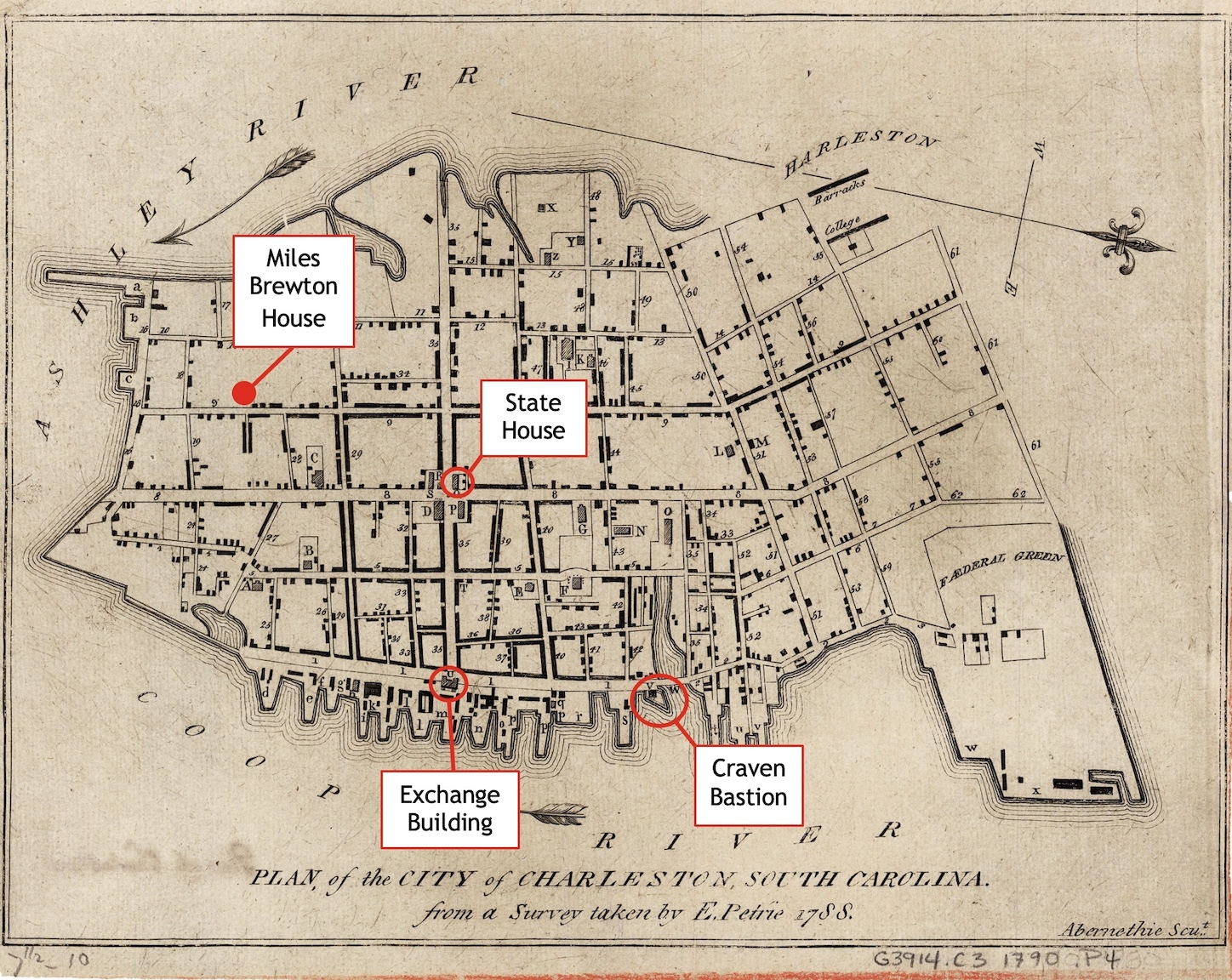
On the morning of Monday the 19th, while the rebel Provincial Congress deliberated within the State House, the governor issued a pair of proclamations from his temporary residence—the first continuing all civil and military officers in their positions, though requiring them to renew their oaths of allegiance to the Crown, and the second postponing the next scheduled meeting of the legitimate General Assembly to July 10th, when Campbell hoped a larger number of loyal legislators might attend.[10] If the governor and his wife, Sarah, sought information about their rice plantations at Wassamasaw Swamp and “Inverary” on the Savannah River, they were soon disappointed. Of the three trustees managing their joint properties, none were present in Charleston. Henry Middleton was in Philadelphia, representing South Carolina in the rebel Continental Congress, while Daniel Blake was in London and Benjamin Smith was dead. Letters of inquiry sent to the overseers at each plantation might not reach their destination, Captain Innes likely warned. The influence of the rebel party and their spies extended across the Carolina Lowcountry and up the coastline to Boston, and it was now impossible for the king’s loyal subjects to send communications over land without being intercepted. The new governor, like his peers in the northern colonies, would have to hire armed vessels to carry their dispatches by sea, or wait patiently for the arrival of a British packet vessel or one of the few warships patrolling American waters.
Speaking of warships, Governor Campbell undoubtedly quizzed his secretary about the status of the Royal Navy vessel assigned to the Port of Charleston. The ship-rigged (i.e., three-masted) sloop-of-war Tamar, slightly larger than the Scorpion and mounting sixteen carriage guns, was then anchored in Rebellion Road, near Sullivan’s Island, and had not moved in nearly three months. Lord William personally observed that the Tamar did not fire a friendly salute when the Scorpion sailed into the harbor days earlier, and no officers from the station ship attended his public inauguration, as customary.[11] Alexander Innes, having recently visited the idle Tamar, offered a few words in defense of its commanding officer. Captain Edward Thornbrough was “a very old” and “good officer,” he said, who “has been confined to his bed these two months.”[12] The widowed captain suffered from chronic gout, likely caused by a diet that included large portions of wine and salt-cured meat, and compounded by a lack of physical exercise while sequestered aboard ship. Never an outstanding officer, Thornbrough held a lieutenant’s rank until the spring of 1774, when, at the age of sixty-two, he was assigned to command the Tamar and ordered to sail from Boston to Charleston. Now isolated from naval colleagues to the north and spurned by rebel Carolinians, he had settled into a state of lethargic melancholy. He was, as Captain Innes informed the governor, “a poor, helpless, lame, bedridden old man, who has not even heard from [Admiral Graves in] Boston these three months.”[13]
As the lone station ship representing the king’s navy in South Carolina, the Tamar became a conspicuous target for rebel animosity in the summer of 1775. Although the rebel faction still permitted the Royal Navy’s victualling agent for Charleston, William Price, to supply the warship with food, drink, and firewood for cooking, local shipyards had, for several months past, refused Captain Thornbrough much-needed spare parts and access to careening facilities.[14] On June 8th, the Provincial Congress briefly discussed the possibility of outfitting a large merchant vessel with cannons to seize the Tamar by force, but the majority voted down the offensive proposal.[15] Despite such adversity, Alexander Innes opined that the arrival of both Governor Campbell and another sloop-of-war “may afford some countenance to the king’s friends, and will, I know, embarrass the other party, who have at present a clear field: On this account I presume his Lordship will detain the Scorpion, and never quit his government till the last extremity.”[16]

The tenure of the Scorpion in Charleston Harbor was explicitly temporary, Campbell informed his secretary. Months earlier, the Board of Admiralty had ordered him to direct the warship northward to join Admiral Graves at Boston, with or without his Lordship in command. The governor had only to decide whether to linger in South Carolina and defend the king’s authority, or abandon the rebellious colony and sail for Boston with his family. “Although he can do very little,” opined Captain Innes, the royal governor’s presence in the colony represented the last hope for a restoration of the political status quo.[17] Lord William agreed. As he quipped sarcastically in a later letter, “I am still in hopes our heroes here might come to their senses.”[18]
Following unrecorded conversations with friends and family, Governor Campbell elected to remain in Charleston and forsake his means of escape. A strong sense of duty to king and country, enhanced by lucrative connections to South Carolina, induced him to stand firm against the personal dangers posed by an increasingly militant rebel faction. “As I know my presence embarrasses them,” Lord William informed officials in London, “I am determined at all events to remain to the last extremity, and see what they dare do.”[19] On the morning of June 20th, Captain Campbell signed and closed his naval logbook and handed it to Lieutenant John Tollemache, to whom he relinquished command of the Scorpion. Twenty-six-year-old Tollemache, now addressed with the courtesy title of captain, commenced a new executive logbook that afternoon and roused his men to prepare the ship for service at sea.[20]
Later the same day, Campbell’s host, Miles Brewton, called at his King Street residence in company with militia Colonel Stephen Bull. Their visit was friendly, but not without political gravity. If the governor did not already know, he realized that his wife’s cousin, Mr. Brewton, had aligned himself with the rebel cause. As representatives of the Provincial Congress, then sitting at the State House, Brewton and Bull inquired when the governor might be available to receive a larger delegation from the extra-legal assembly bearing a formal address and declaration. The proposed meeting reeked of offensive sedition, but Campbell did not chastise the genteel messengers. Rather, he stalled for time to consider the matter, asking them to call again the following day at 1 p.m. for an answer.[21]
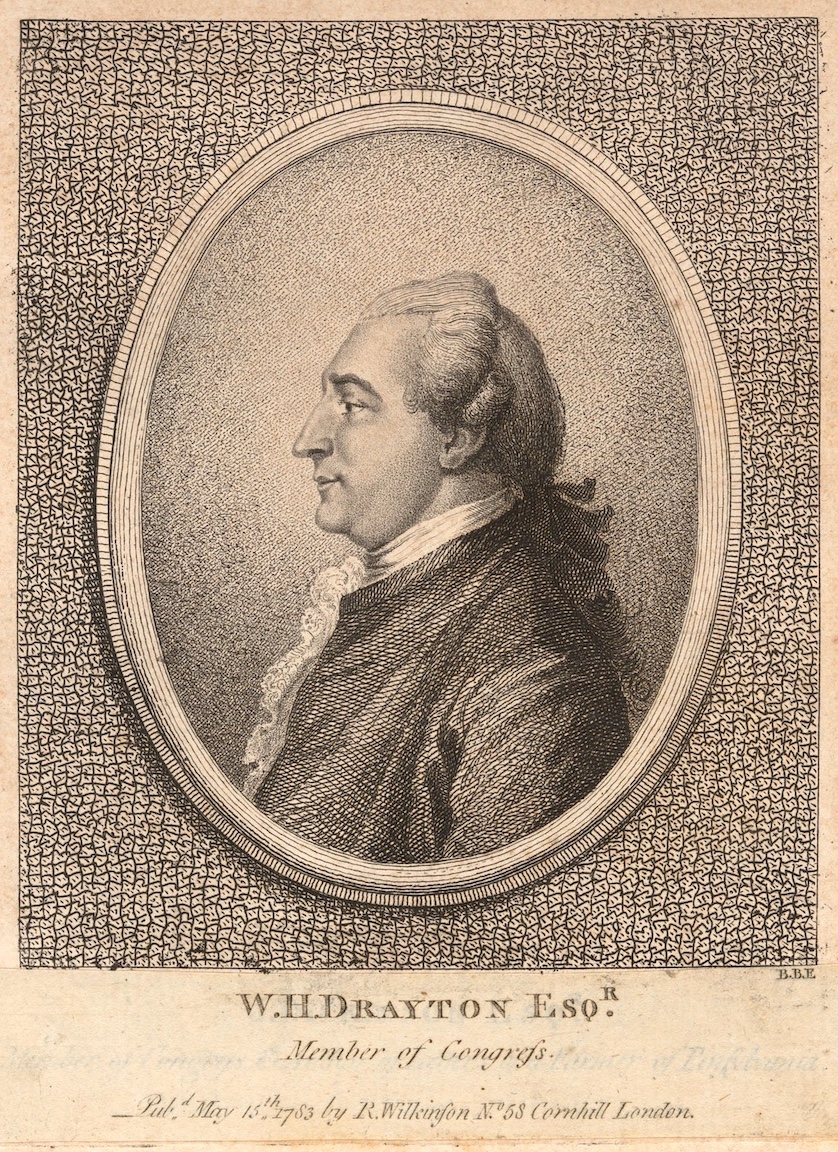
At the appointed hour on June 21st, the governor informed the same messengers that he was ready to receive members of the Provincial Congress. President Henry Laurens then dispatched from the State House thirteen delegates to call at Campbell’s residence. In transit, the select parties nominated one of their own, William Henry Drayton, to present their formal address. The irony of the task amused the thirty-two-year-old Drayton: His former attachment to the king’s authority had won him a seat on His Majesty’s Council for South Carolina in April 1772, while Campbell was sojourning in Charleston, and now he ranked among the most ardent rebels in the province. After entering the governor’s residence on the afternoon of June 21st, Drayton and Lord William exchanged polite bows before he “pronounced and presented the address with all possible respect and politeness.”[22]
“The Humble Address and Declaration of the Provincial Congress.
May it please your Excellency,
We, his Majesty’s loyal subjects, the representatives of the people in this colony, in Congress assembled, beg leave to disclose to your Excellency the true causes of our present proceedings: not only, that, upon your arrival among us, you may receive no unfavourable impression of our conduct, but that we may stand justified to the world.
When the ordinary modes of application for redress of grievances, and the usual means of defence against arbitrary impositions have failed; mankind generally have had recourse to those that are extraordinary—Hence, the origin of the Continental Congress—and hence the present representation of the people in this colony. It is unnecessary to enumerate the grievances of America—they have been so often represented, that your Excellency cannot be a stranger to them. Let it therefore suffice to say, that the hands of His Majesty’s Ministers having long lain heavy—now press us with intolerable weight. We declare, that no love of innovation—no desire of altering the constitution of government—no lust of independence—has had the least influence upon our counsels: but, alarmed, and roused by a long succession of arbitrary proceedings, by wicked administrations—impressed with the greatest apprehension of instigated insurrections—and deeply affected by the commencement of hostilities by the British troops against this continent; solely for the preservation and in defence of our lives, liberties and properties, we have been impelled to associate, and to take up arms.
We sincerely deplore those slanderous informations and wicked councels, by which His Majesty has been led into measures, which, if persisted in, must inevitably involve America in all the calamities of Civil War, and rend the British empire.—We only desire the secure enjoyment of our invaluable rights; and we wish for nothing more ardently, than a speedy reconciliation with our mother-country, upon constitutional principles.
Conscious of the justice of our cause, and the integrity of our views, we readily profess our loyal attachment to our sovereign, his crown and dignity, and trusting the events to Providence, we prefer death to slavery.
These things we have thought it our duty to declare, that your excellency, and through you, our august sovereign—our fellow-subjects—and the whole world—may clearly understand, that our taking up arms, is the result of dire necessity, and in compliance with the first law of nature.
We entreat and trust, that your Excellency will make such a representation of the state of this colony, and of our true motives, as to assure His Majesty, that in the midst of all our complicated distresses, he has no subjects in his wide dominions, who more sincerely desire to testify their loyalty and affection, or who would be more willing to devote their lives and fortunes in his real service.”[23]
Having concluded his assignment, William Henry Drayton offered the governor a manuscript copy of his speech. Campbell preserved a calm composure throughout the presentation, though its “daring language” and “very extraordinary and criminal nature” provoked strong feelings of contempt. He was tempted to express his indignation in no uncertain terms, but discretion subdued his temper. “When I considered the situation the province is at present in,” he explained to officials in London, and “that the violent faction who have precipitated the colony into these measures were prepared to come to the very last extremity and plunge it immediately into open and actual rebellion, I for once gave up my own feelings, from a persuasion it would be more for the interest of my royal master.”[24] Instead of responding harshly, Campbell offered a terse and politically neutral rebuttal:
“Gentlemen, I know of no representatives of the people of this province, except those constitutionally convened in the General Assembly; and am incompetent to judge of the disputes which at present unhappily subsist between Great Britain and the American Colonies. It is impossible, during the short interval since my arrival, that I should have acquired such a knowledge of the state of the province, as to be at present able to make any representation thereupon to His Majesty: But you may be assured, no representations shall ever be made by me, but what shall be strictly consistent with truth, and with an earnest endeavour to promote the real happiness and prosperity of the province.”[25]
Shortly after Drayton and the other delegates returned to the Provincial Congress, clerks at the State House drafted copies of both the “Address and Declaration” and the governor’s response for each of the three newspapers then active in Charleston. While re-reading his own manuscript copy of the address the following day, June 22nd, Campbell noticed, evidently for the first time, the phrase “to take up arms.” At once, he “became beyond measure anxious,” and asked Miles Brewton to intreat President Laurens to retract those particular words from the printed version of the address. The tacit call-to-arms was a bold affront to the king’s government, an offense for which Lord William allegedly said “he would give, [or] he would do anything to prevent.” Henry Laurens proudly ignored Campbell request, quoting, in his defense, a venerable rationale attributed to Pontius Pilate: “What I have written, I have written.”[26]
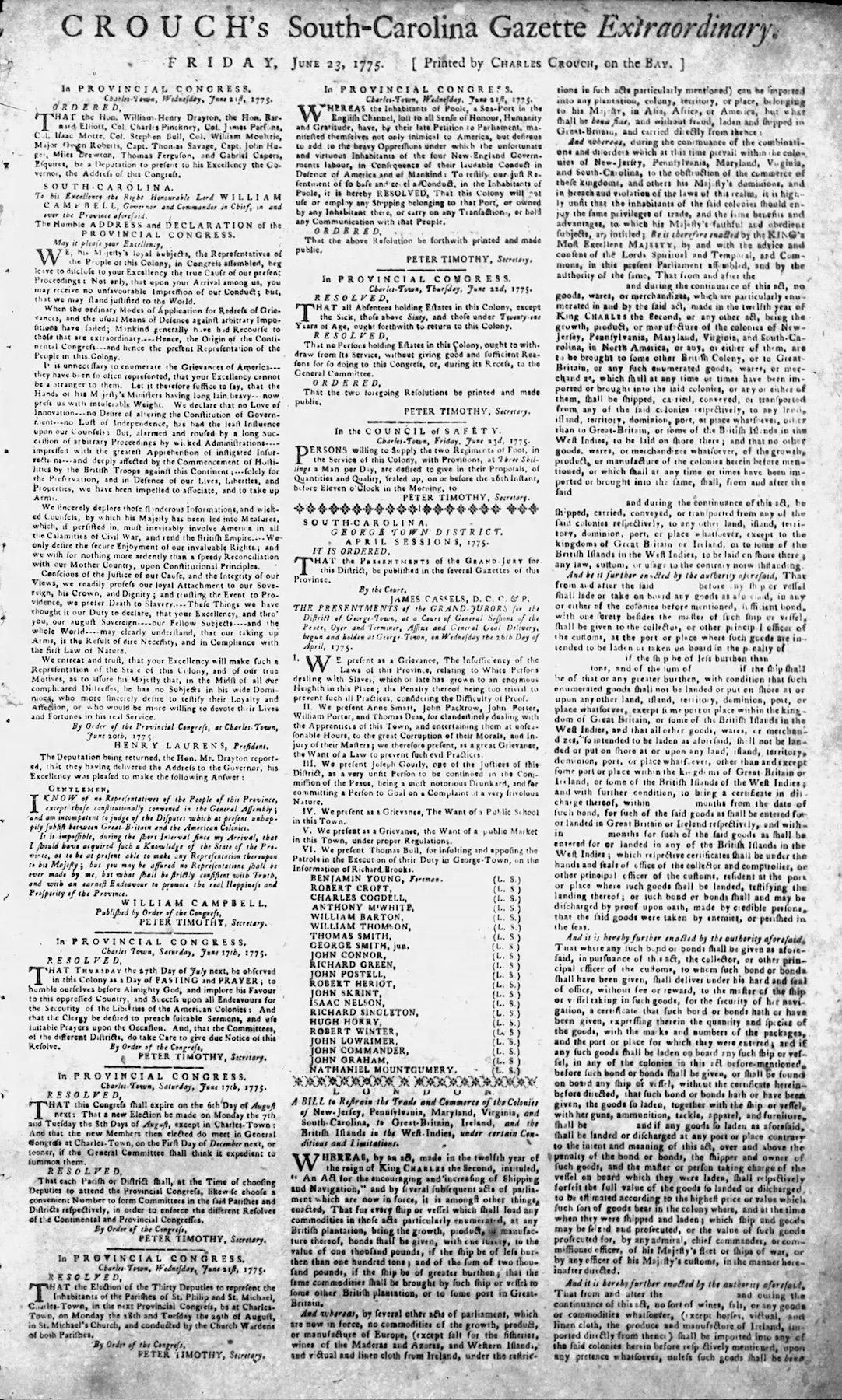
The first of several newspapers containing the “Address and Declaration” of the South Carolina Provincial Congress appeared on June 23rd, no doubt causing some measure of embarrassment to the governor. The following day, a Saturday, Henry Laurens ventured down King Street to pay a personal visit to Campbell at Miles Brewton’s house. The fifty-one-year-old president, speaking as a private citizen, welcomed his old acquaintance back to Charleston and offered his best wishes to the governor’s family. As Laurens later informed his son, John, in London, their conversation turned immediately to politics:
“His Lordship was sorry to find ‘this country in such confusion.’”
“I hope we are not in confusion, my Lord,’” replied Laurens. “We are acting out of the common line, tis true, [but] necessity obliges us to do so. I trust we are doing our duty according to circumstances. We are greatly distressed and are struggling for deliverance.”
“I am sorry it is so,” Campbell answered. “I don’t know what to say to it. I wish the Americans would be more moderate.”
“My lord,” said Laurens, “I dare not justify the Americans in all their measures. Some of their measures I condemn, but I condemn them as improper modes of resentment. Errors will appear, even on the side of the injured party, in all great quarrels; I perceive some [errors] in the conduct of the people in America, it cannot be otherwise, but this, I will be bold to say, my Lord, that agression [sic] does not lie on their side, and that they are heartily disposed now to a reconciliation; every man of common sense wishes it.”
“Well, I can assure you Mr. L[aurens],” said the governor, “I have authority to say, that [Prime Minister] Lord North and [Secretary of State] Lord Dartmouth too, wishes [sic] it as heartily as any man, I have authority for saying so.”
Laurens bit his tongue on Campbell’s disingenuous defense of the condescending British ministry, and chose his next words carefully: “It would be happy for us, My Lord, and for the whole British realm, if their Lordships would give us some proofs of their being in earnest.”
At this point, the arrival of another visitor disrupted the tense exchange between rival executives, giving Laurens an excuse to withdraw politely. With a quick bow, the rebel president “bid good morrow to the governor” and resumed his weekend leisure.[27]
On the morrow, however, trouble began to brew on the Charleston waterfront: Sailors deserting the sloop-of-war Scorpion sought to enlist in the South Carolina Provincial Army. Captain Tollemache was determined to reclaim his crewmen or inflict a commensurate blow, setting up an important contest for possession of an enslaved ship pilot named Sampson Waldron.
[1] Campbell described his voyage as “tedious” in a letter to Sir James Wright, Governor of Georgia, 23 June 1775, in SCDAH, Robert W. Gibbes Collection of Revolutionary War Manuscripts (S213089), box 1, folder 30.
[2] For more information about ship’s boats, see W. E. May, The Boats of Men-of-War; second edition (Annapolis, Md.: National Maritime Museum, 1999), 40, 56.
[3] As noted in the previous episode, the Scorpion departed from England in early April 1775 with twenty-six “supernumerary” passengers. At Madeira on 26 April, one George Campbell boarded the ship, “pr. request of [the British] consul,” and was identified in the ship’s books as supernumerary No. 27; see Muster books, Scorpion, 1775–76, ADM 36/8377.
[4] South Carolina and American General Gazette (hereafter SCAAG), 16–23 June 1775, page 3.
[5] Alexander Innes to Lord Dartmouth, 10 June 1775, in B. D. Bargar, “Charles Town Loyalism in 1775: The Secret Reports of Alexander Innes,” South Carolina Historical Magazine 63 (July 1962): 133.
[6] As mentioned in the previous episode, the Scorpion’s assigned complement was 100 men, but two of the seamen were fictitious “widows’ men”; see Muster books, Scorpion, 1775–76, ADM 36/8377.
[7] Captain's log, Scorpion, 1775, ADM 51/872; Master's log, Scorpion, 1775–76, ADM 52/1985; both held at the National Archives, Kew.
[8] Colonial-era population estimates for urban Charleston appear in Peter A. Coclanis, The Shadow of a Dream: Economic Life and Death in the South Carolina Low Country, 1670–1920 (New York: Oxford University Press, 1989), 114–16. See the brief description of the urban militia in South Carolina Gazette and Country Journal (hereafter SCGCJ), 16 May 1775, page 3; H. Roy Merrens, The Colonial South Carolina Scene: Contemporary Views, 1697–1774 (Columbia: University of South Carolina Press, 1977), 283.
[9] This description of Campbell’s landing and reception on 18 June 1775 includes details from SCGCJ, 20 June 1775, page 3; South Carolina and American General Gazette (hereafter SCAGG), 16–23 June 1775, page 3; Henry Laurens to John Laurens, 18 June 1775, in David R. Chesnutt, et al., eds., The Papers of Henry Laurens, volume 10 (Columbia: University of South Carolina Press, 1985), 183–85; John Drayton, Memoirs of the American Revolution, volume 1 (Charleston: A. E. Miller, 1821), 257–58.
[10] The text of both proclamations appear in SCGCJ, 20 June 1775, page 3; SCAGG, 16–23 June 1775, page 1.
[11] For more information about the Tamar, see Rif Winfield, British Warships in the Age of Sail, 1714–1792: Design, Construction, Careers and Fates (Seaforth, 2007), page 427 of the e-book edition. Although the SCGCJ reported that the Tamar had saluted the Scorpion on the evening of 17 June 1775, none of the extant logbooks from these vessels mention such a gesture.
[12] Alexander Innes to Lord Dartmouth, 3 June 1775, in Bargar, “Charles Town Loyalism in 1775,” 131.
[13] The death (in England) of Mary Thornborough (sic), wife of Lieutenant Edward Thornbrough, of His Majesty's Ship Captain, was reported in The Boston Gazette and Country Journal, 11 October 1773, page 3; Thornbrough's promotion to the Tamar was reported in The Massachusetts Gazette and Boston Weekly News-Letter, 28 April 1774, page 3; further details regarding Thornbrough and the Tamar will appear in future episodes; Alexander Innes to Lord Dartmouth, 10 June 1775, in Bargar, “Charles Town Loyalism in 1775,” 134.
[14] Lieutenant John Fergusson of the armed ship Cherokee, in Charleston Harbor in October 1775, identified William Price as “agent for supplyin[g] His Majesty’s Ships with provisions”; see William Bell Clark, ed., Naval Documents of the American Revolution, volume 2 (Washington, D.C.: U.S. Government Printing Office, 1966), 584.
[15] Henry Laurens to John Laurens, 8 June 1775, in Chesnutt, Papers of Henry Laurens, 10: 164–66.
[16] Alexander Innes to Lord Dartmouth, 3 June 1775, Bargar, “Charles Town Loyalism in 1775,” 131.
[17] Alexander Innes to Lord Dartmouth, 3 June 1775, in Bargar, “Charles Town Loyalism in 1775,” 131.
[18] William Bell Clark, ed., Naval Documents of the American Revolution, volume 1 (Washington, D.C.: U.S. Government Printing Office, 1964), 929–31.
[19] Lord William Campbell to the Earl of Dartmouth, 19 July 1775, in K. G. Davies, ed., Documents of the American Revolution, 1770–1783, volume 11 (Dublin: Irish Academic Press, 1976), 49–53.
[20] Campbell made his final log entry on the morning of 20 June; Tollemache’s first entry as captain appears under the heading of 21 June as “PM,” which, according to naval time, represents the afternoon of 20 June, according to civil time; both logbooks are found in ADM 51/872 at the National Archives, Kew.
[21] William Edwin Hemphill and Wylma Anne Wates, eds., Extracts from the Journals of the Provincial Congresses of South Carolina, 1775–1776 (Columbia: South Carolina Department of Archives, 1960), 59–61.
[22] Hemphill and Wates, Extracts from the Journals of the Provincial Congresses, 65; William Henry Drayton to William Drayton at St. Augustine, 4 July 1775, in Davies, Documents of the American Revolution, 11: 36–37. The thirteen delegates included William Henry Drayton, Barnard Elliott, Charles Pinckney (1732–1782), James Parsons, Isaac Motte, Stephen Bull, William Moultrie, Owen Roberts, Thomas Savage, John Huger, Miles Brewton, Thomas Ferguson, and Gabriel Capers.
[23] The full text of address of the Provincial Congress and Governor Campbell’s reply appear in Hemphill and Wates, Extracts from the Journals of the Provincial Congresses, pages 59–65 (from which I have reproduced the original spelling); SCAGG, 16–23 June 1775, page 3; SCCCJ, 23 June 1775, page 1; SCG, 7 September 1775, page 8; and in Drayton, Memoirs, 1: 259–62. Campbell enclosed a manuscript copy of the address and his reply in his letter to the Earl of Dartmouth, 2 July 1775, in CO 5/396, folios 155–56, at the National Archives, Kew.
[24] Lord William Campbel to the Earl of Dartmouth, 2 July 1775, Davies, Documents of the American Revolution, 11: 32–35.
[25] See endnote 23 above.
[26] Henry Laurens to John Laurens, 23–24 June 1775, in Chesnutt, Papers of Henry Laurens, 10: 190. The Latin version of the phrase in question is “Quod scripsi, scripsi.”
[27] Henry Laurens to John Laurens, 23–24 June 1775, in Chesnutt, Papers of Henry Laurens, 10: 194–95.
NEXT: The Flight of Sampson the Pilot in the Summer of 1775
PREVIOUSLY: Governor William Campbell and the Scorpion, sailing to Charleston in 1775
See more from Charleston Time Machine