
In the summer of 1775, amid smoldering tension between the British government and rebellious colonists, officers of the Royal Navy in Charleston quietly negotiated with an enslaved mariner named Sampson Waldron. The warship Scorpion briefly required his piloting skills to exit the harbor, but the prospect of freedom via service to the king induced him to remain aboard and commence a new life as an enemy to colonial resistance.
The main character of this program was a native South Carolinian of African ancestry known simply as Sampson during the first part of his life as an enslaved man in Charles Town (spelled “Charleston” since 1783). Although details of his biography are now obscure, and historians of the past two-and-a-half centuries have largely ignored his story, Sampson’s role in the American Revolution warrants closer study. Some readers will undoubtedly recall seeing his name mentioned in the writings of several eye-witnesses to the Battle of Sullivan’s Island on 28 June 1776, including William Moultrie, Henry Laurens, and others.[1] In recent years, scholars sleuthing within American archives have uncovered a few intriguing references to the pilot principally responsible for guiding British warships in and out of Charleston Harbor during the summer of 1776, who subsequently embarked on a succession of maritime adventures in the service of the Royal Navy. By supplementing American records with forgotten details inscribed within the manuscript records of the British Admiralty, we can begin to construct a more robust profile of a figure long obscured by the historical shadows of his more famous white contemporaries. Let’s begin to rediscover Sampson’s story by rewinding to his initial appearance on the historical stage, within the tense political atmosphere of Charleston Harbor during the sweltering summer of 1775.[2]
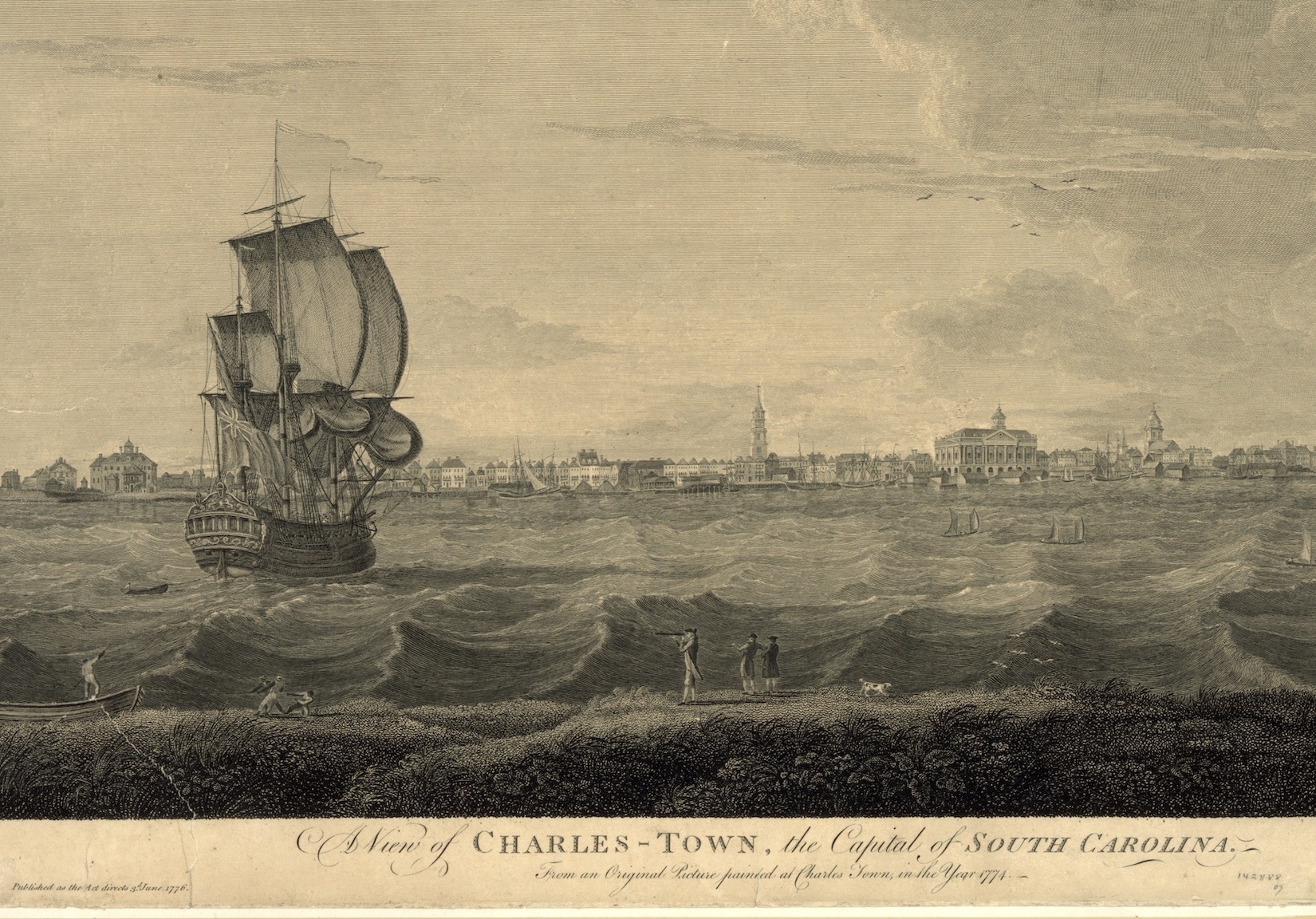
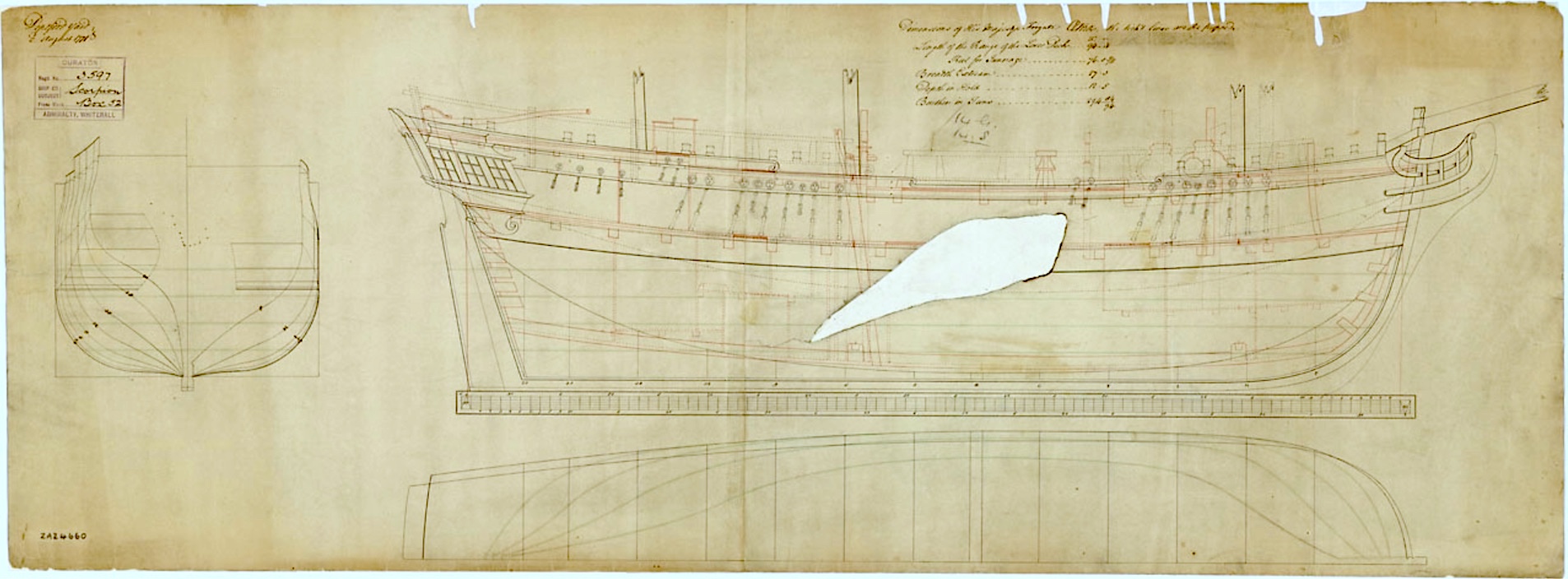
When Governor Lord William Campbell resigned his commission as captain of His Majesty’s sloop-of-war Scorpion on 20 June 1775, as described in the previous episode, his second-in-command, Lieutenant John Tollemache, assumed the curtesy title of “captain.” The fourteen-gun, ship-rigged vessel was then floating in the Cooper River, several hundred feet to the east of Craven Bastion (now the site of the U.S. Customs House), moored with a pair of anchors ahead and astern to keep it stationary during the ebb and flow of the daily tides.[3] Following instructions issued months earlier by the Lords of the Admiralty in London, Campbell directed Captain Tollemache to prepare the Scorpion to sail northward to Boston Harbor, to assist the ongoing British naval blockade under the command of Vice-Admiral Samuel Graves. Tollemache was a young but capable officer of genteel birth, and was no stranger to the swampy Lowcountry of South Carolina. As a junior officer aboard the sloop-of-war Martin, commanded by the poet-captain Thomas Hayward during the late 1760s, he had gained some familiarity with the coastline and harbors of the only North American colony populated by an enslaved majority.[4]
One of Tollemache’s first acts as commander of the Scorpion on the afternoon of June 20th was to dispatch a party of enlisted men in the ship’s longboat to fill a number of empty casks with fresh water. Their destination was a shipyard located within Hobcaw Creek, four miles distant, in the modern town of Mount Pleasant, the customary site for maintaining and repairing the king’s warships in Charleston Harbor during the previous five decades. Hours later, the longboat returned with filled casks of water, but without one of the crewmen—an able seaman named Andrew Herron. Captain Tollemache must have known, like all officers of that era, that sailors in port occasionally straggled ashore for days at a time, usually lost in a haze of drink and debauchery, before returning to their berths and steady diet of rations aboard ship. Rather than place a capital letter “R” next to Herron’s name in the official ledgers of the Scorpion, indicating that he had “run” or deserted, Tollemache simply noted in his logbook that the absent seaman had “left the duty on shore.”
The next day, Tollemache dispatched the longboat again to retrieve a supply of fresh beef from the navy’s local victualling agent, an errand that returned without a marine named James Oakes, who also “left the duty on shore.” Longboats sent ashore for additional provisions during the subsequent days similarly returned without a crewman or two, rising eventually to a total of nearly a dozen sailors and marines.[5] The captain spotted this pattern of disappearances after a few days and suspected that the missing men intended to withdraw themselves permanently from the king’s service. Although desertion from the Royal Navy was a serious offense during times of war, it was a relatively common occurrence during peacetime, regarded by most commanders as a nuisance rather than a crime. In ordinary circumstances, Captain Tollemache might have simply ordered his subordinates to canvas the waterfront and recruit a few willing hands to fill the empty berths, but the political and economic climate of that moment constrained their options and provoked a confrontation.
A suite of reciprocal trade embargoes imposed by the rebel Continental Congress and the British government in the spring of 1775 had decimated the flow of trans-Atlantic and inter-colony trade through the Port of Charleston, dramatically shrinking the population of seaworthy mariners in the vicinity. By the end of June, for example, merchant and planter Henry Laurens observed “I never saw Charles Town Harbour so naked as it is just now, only two topsail vessels in it, except about five days ago when there was but one.”[6] Although smaller vessels continued to ply local rivers and inlets, transporting goods and people between Lowcountry plantations and the capital, the enslaved mariners who dominated that local traffic could not volunteer for service aboard the Scorpion without triggering a legal contest between Captain Tollemache and their respective owners.[7] And because the British Board of Admiralty had not yet authorized the distribution of war-time “press warrants,” the captain could not legally kidnap or “impress” civilians and force them into the king’s service.
Unable to recruit replacements from the diminished local population of mariners, Captain Tollemache or his subordinates quizzed crewmen who had accompanied the deserters on shore, and perhaps canvased various taverns and brothels in town for evidence of their movements. Such efforts produced evidence suggesting that some or all of the absent men intended to enlist in South Carolina’s nascent provincial army, created just a few weeks earlier by the extra-legal shadow-legislature known as the Provincial Congress. In response to this information, the captain evidently confronted some officers of the new provincial regiments, probably at a tavern or coffee house within the capital frequented by men aligned with the rebel movement. Tollemache demanded that deserters from the Scorpion not be allowed to enlist in the provincial service, intimating to the rebel officers “that if he lost any [men,] he must distress the [shipping] trade.”
The captain’s thinly-veiled threat, in turn, inspired Lieutenant-Colonel Isaac Huger and Colonel William Moultrie, commanders of the rebel 1st and 2nd regiments at that moment, to seek advice from President Henry Laurens and the Council of Safety, the recently-created executive branch of South Carolina’s expanding shadow government. After some deliberation of the matter on the afternoon of June 26th, the Council of Safety advised the colonels to give the following contentious response, if challenged again by the king’s officers from the Scorpion: “We did not know that we had inlisted any of your men, but if any of them have inlisted, we dare not give them up.”[8]
The hostile words exchanged by officers of the provincial regiments and the Royal Navy added fuel to a smoldering paranoia then gripping the Lowcountry of South Carolina. Following the first bloodshed of the Revolution at Lexington and Concord, news of which arrived at Charleston during the second week of May 1775, parties on both sides of the political divide began circulating rumors about fictitious British plans to liberate and arm enslaved people willing to help suppress the growing American rebellion. White fears of violent Black resistance, a perennial concern in the early history of South Carolina, inspired a wave of arrests and interrogations in June that produced a paltry body of inconclusive evidence and frustrated rebel leaders.
The most famous victim of this white paranoia was Thomas Jeremiah, a prosperous free Black mariner of Charleston whose independence and professional acumen attracted particular scrutiny. “Jerry,” as he was generally known among the townsfolk, had long worked as a pilot for the Port of Charleston, one of an exclusive coterie of skilled seamen guiding large vessels through the maze of sandy shoals at the harbor’s entrance. His perceived loyalty to the Crown, whether real or imagined, augmented fears that this financially independent Black mariner might soon become a valuable ally to British naval forces sent across the Atlantic to punish rebellious Carolinians. Although President Henry Laurens personally suspected Jerry to be “among the most criminal” of the subjects interrogated in early June, he was released on recognizance shortly after Governor Campbell’s inauguration on June 18th.[9]
Having regained his freedom, albeit briefly, during the third week of June, Thomas Jeremiah might have discussed his predicament with a select few of his fellow pilots, a professional circle that included several enslaved men trained by licensed white pilots to augment their income. Jerry might even have discussed the situation with officers scouting for deserters from the Scorpion, which was then preparing for departure. Per instructions from Lord William Campbell, Captain Tollemache was waiting for the governor to complete a number of letters and reports to various British officials, which he was obliged to carry northward to Boston. The warship needed a pilot to exit the harbor, but all of Charleston’s white pilots had signed the rebel Association, an oath ratified by the Provincial Congress in early June, and pledged to deny their services to vessels of the king’s navy. Thomas Jeremiah, though at liberty, was evidently disinclined to assist the Scorpion, perhaps fearing that such an act would appear to confirm the accusations against him and seal his fate with the paranoid rebels. Through a series of private conversations not recorded for posterity, another candidate for the piloting task soon appeared.
On the morning of Sunday, June 25th, while most Charlestonians attended divine services at their respective places of worship, Captain Tollemache ordered gunners aboard the Scorpion to fire a single cannon. None of the town’s white pilots responded to the familiar signal, in accordance with their earlier pledge to the rebel Congress, but another man sprang into action, as if waiting for a pre-arranged summons. Along the waterfront just south of the Exchange building, a mysterious figure stepped into a canoe or dory and rowed several hundred yards to the warship moored in the Cooper River beyond Craven Bastion.[10] After some conversation with the ship’s officers, no doubt discussing conditions of wind, weather, and tide, the men agreed to wait until dawn the following morning to weigh anchor. Captain Tollemache evidently informed the ship’s purser, Henry Searle, that their guest would remain aboard the Scorpion for some unknown duration, and directed him to supply the pilot with the same generous rations of food and drink as the rest of the king’s mariners. Below deck, Mr. Searle complied by adding to the ship’s muster book one “pilot extra[ordinary],” whose name he spelled phonetically as “Sampson Walden.” The purser then inquired after Sampson’s place of birth, information required of all men entering the king’s navy at that time, to which question the pilot identified himself as a native of South Carolina.[11]
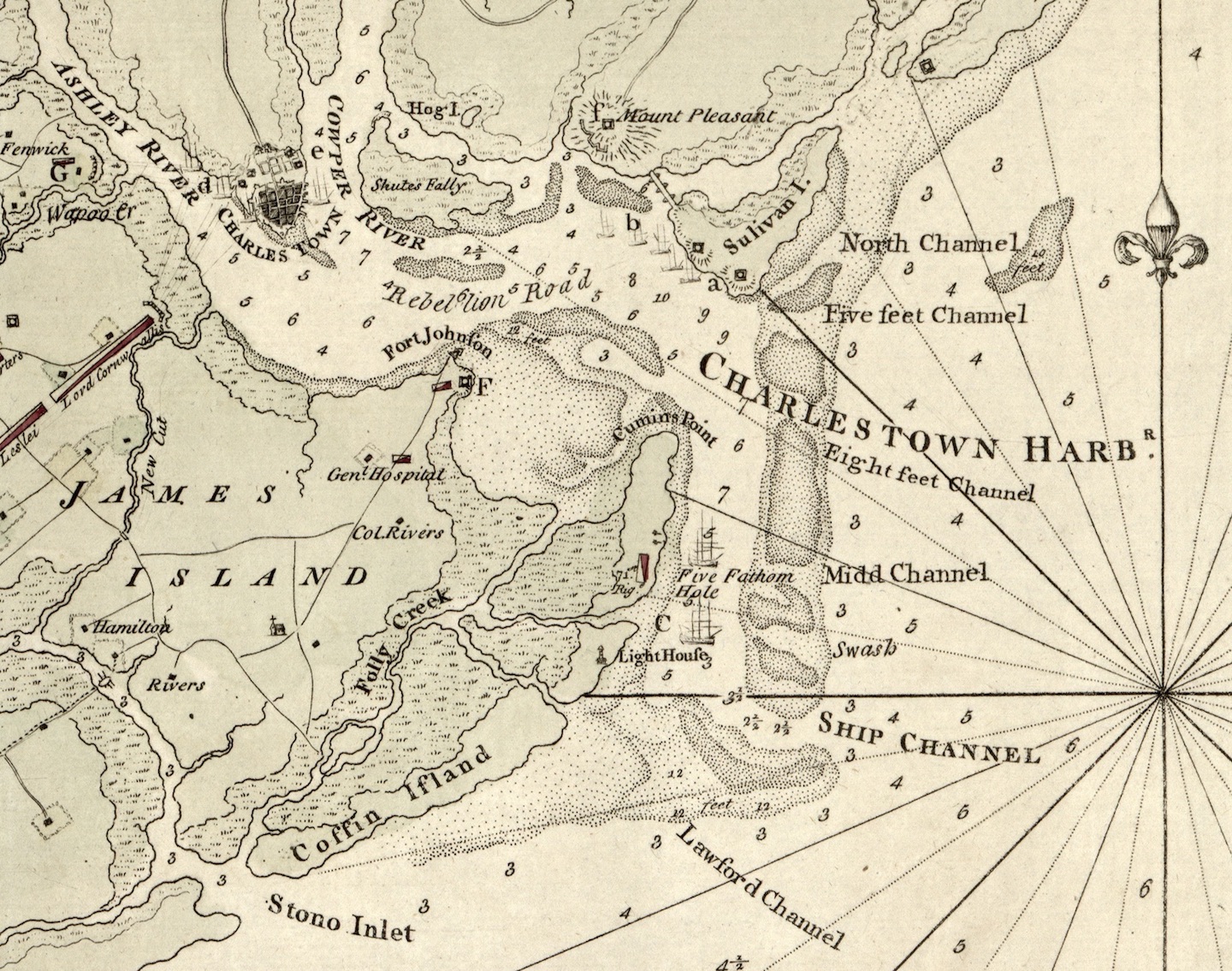
At first light on the fair morning of June 26th, crewmen began to unmoor the warship, rotating the wooden capstan to raise the stern anchor first. At 8 a.m., the king’s mariners hoisted aboard the bow anchor, spread a few canvas sails, and steered the ship towards the rising sun. The Scorpion sailed three miles to the east under Sampson’s guidance, passing along the southern edge of Shute’s Folly to a new anchorage in Rebellion Road, the traditional resting place for ships awaiting a favorable combination of wind and tide before traversing the bar and exiting the harbor. Nearby stood His Majesty’s sloop-of-war Tamar, idled by a lack of routine maintenance and by the aged captain’s chronic gout. At some point later the same day, after crewmen moored the Scorpion in the lonely roadstead, Sampson evidently left the warship and rowed back to town, as he and other pilots usually did after completing their maritime labors. Captain Tollemache still awaited Governor Campbell’s packet of letters, and he might have negotiated with the Black pilot to resume their collaboration a few days hence. If they discussed the possibility of Sampson departing permanently with the Scorpion, he likely returned to his domicile in town to gather personal items and, in clandestine conversations, to bid farewell to family and friends.
Sampson was, at that moment in late June 1775, the chattel property of one Jacob Waldron (died 1777), a veteran mariner and licensed branch pilot for the Port of Charleston.[12] Jacob and his older brother, Isaac Waldron (1717–1772), were professional mariners whose family roots stretched from Charleston to North Carolina and Rhode Island. Beginning around 1759 and continuing for at least a decade, the brothers Waldron took turns sailing their own vessels along a regular route between Charleston and Cape Fear, carrying both passengers and cargo. Their principal craft during that era was a schooner called the Rachel and Mary, which local newspapers occasionally identified as a “pilot boat.” Both men supplemented their incomes during the early 1760s by piloting other vessels in and out of Charleston Harbor, and this activity became their principal occupation by the end of the decade.[13]
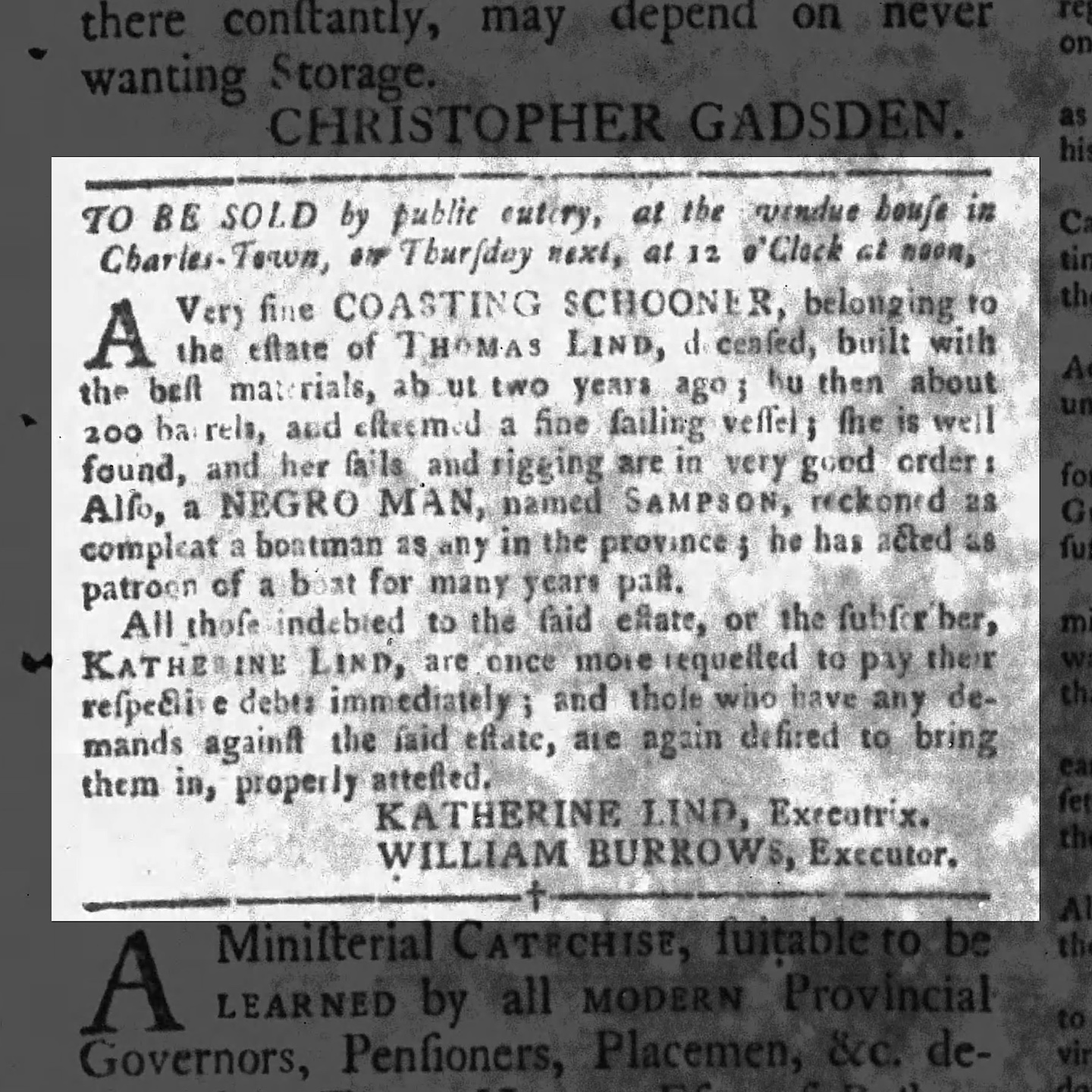
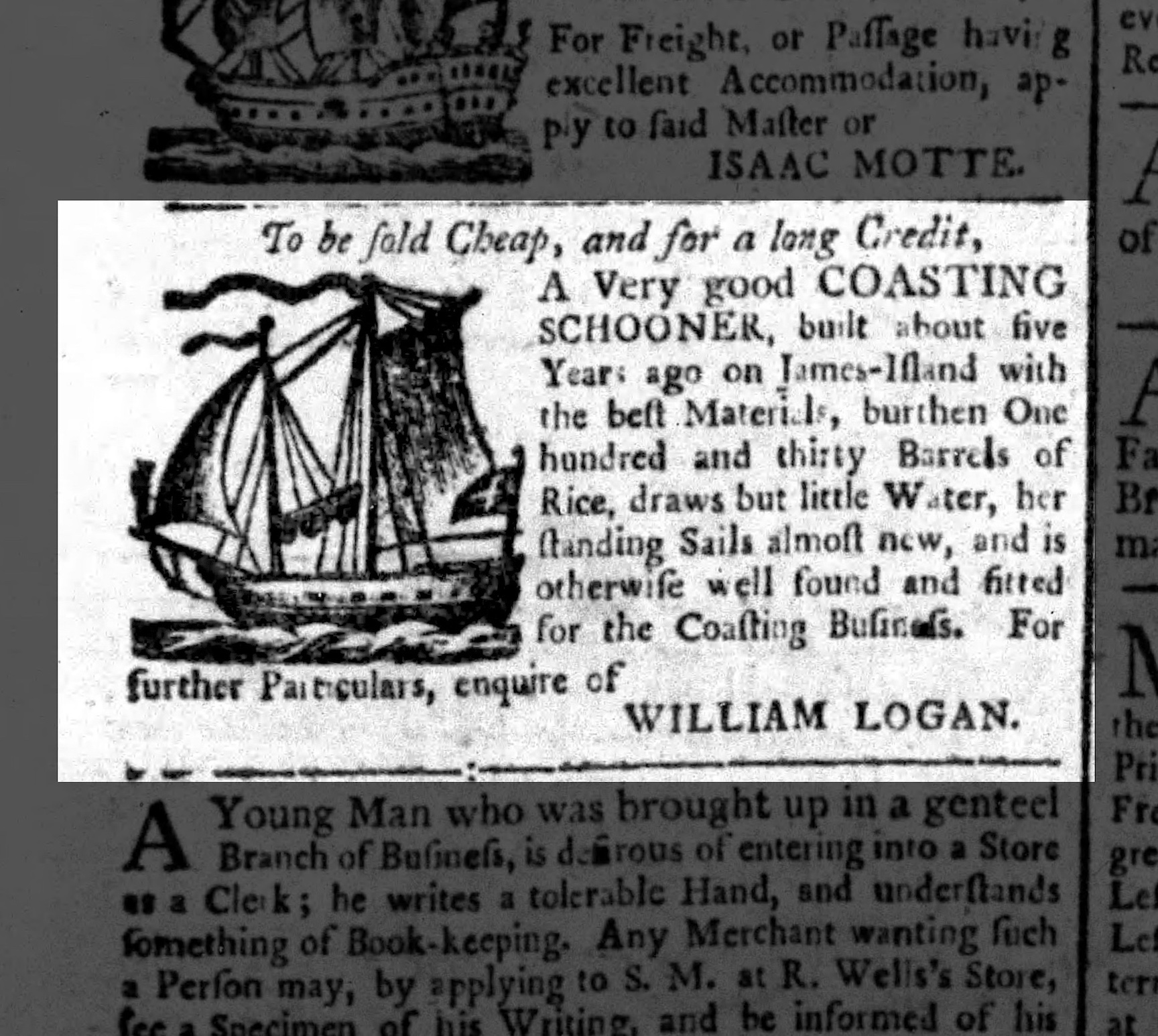
Both Isaac and Jacob Waldron individually owned several enslaved people to assist their labors at sea and to manage their domestic affairs on land. Jacob owned Sampson, and likely purchased him from the estate of Thomas Lind, who died in November 1771. Lind was a “factor”—a middleman facilitating commerce between local planters and trans-Atlantic merchants. From his office on Burn’s Wharf, north of the Exchange Building, Lind managed a small fleet of schooners, each crewed by enslaved men supervised by a “patroon,” transporting annually thousands of barrels of rice and indigo from various Lowcountry plantations to the Charleston waterfront, and then carrying imported merchandize back to the plantations. His estate included four schooners and approximately two dozen “boat Negroes,” most of whom were sold at auction in the weeks after Lind’s death.[14] His executors sold the most valuable assets separately in mid-January 1772—a relatively new schooner called the Industry, capable of carrying two hundred barrels, and “a Negro man, named Sampson, reckoned as compleat [sic] a boatman as any in the province; he has acted as patroon of a boat for many years past.”[15] Records confirming the sale of this Sampson to Jacob Waldron do not survive, but the white pilot undoubtedly recognized the value of acquiring such an experienced Black mariner.
Isaac Waldron died unexpectedly at sea in October 1772, after which Jacob inherited his property, including nine enslaved men, women, and children.[16] Two of the men in Jacob Waldron’s expanded household subsequently fled and became pilots for the Royal Navy, first Sampson and later a young man named Mercury, formerly Isaac’s property. At the time of Jacob’s death in October 1777, his remaining estate included fourteen enslaved people. His will manumitted three “old” women and one young woman with her two boys, after which Jacob’s executors sold the last members of the Waldron household, advertised as “two men and a boy used to the pilotage business,” the rest “washer women and house slaves.”[17] These long-forgotten men and women represented Sampson’s actual or surrogate family during the last years of his life in Charleston.
The Waldron brothers likely cohabitated during their entire tenure in Charleston, a logical arrangement for business partners working alternating shifts at sea. Jacob was evidently a bachelor, but Isaac had a wife, Rachel, who died in 1767.[18] Details of their early years in South Carolina are sparse, but in 1763 the Waldrons purchased the western half of a multi-story “tenement” standing on the south side of Broad Street, and in 1770 purchased the eastern half of the same brick building. The mid-century duplex in question, measuring thirty-six feet wide, disappeared long ago, and the site is now occupied by the buildings identified as Nos. 11 and 13 Broad Street.[19] The Waldrons and their enslaved servants likely occupied only the upper stories of the property in question. From the beginning of their tenure in 1763, they leased the ground-floor units fronting the street to a succession of shopkeepers selling clocks, watches, pharmaceuticals, cutlery, wine, and spirits.[20] Upstairs residents like Sampson would have encountered a steady stream of white customers and their enslaved servants whenever they ambled downstairs and stepped into heart of Charleston’s commercial district near East Bay Street.
In the months preceding his defection to the Royal Navy, Sampson evidently made the acquaintance of Peter Timothy, who in January 1775 moved the printshop of his South Carolina Gazette to a storefront on the south side of Broad Street, at the corner of Gadsden’s Alley—just a few steps west of the Waldron property.[21] Timothy acted as printer and secretary to both the rebel Provincial Congress and the Council of Safety during the summer of 1775, and four years later lobbied for Sampson specifically to be captured and executed as a traitor to the American cause.[22] In short, Sampson lived and worked within the epicenter of revolutionary rhetoric in South Carolina, and could not have been ignorant of the rising political tension within his community.
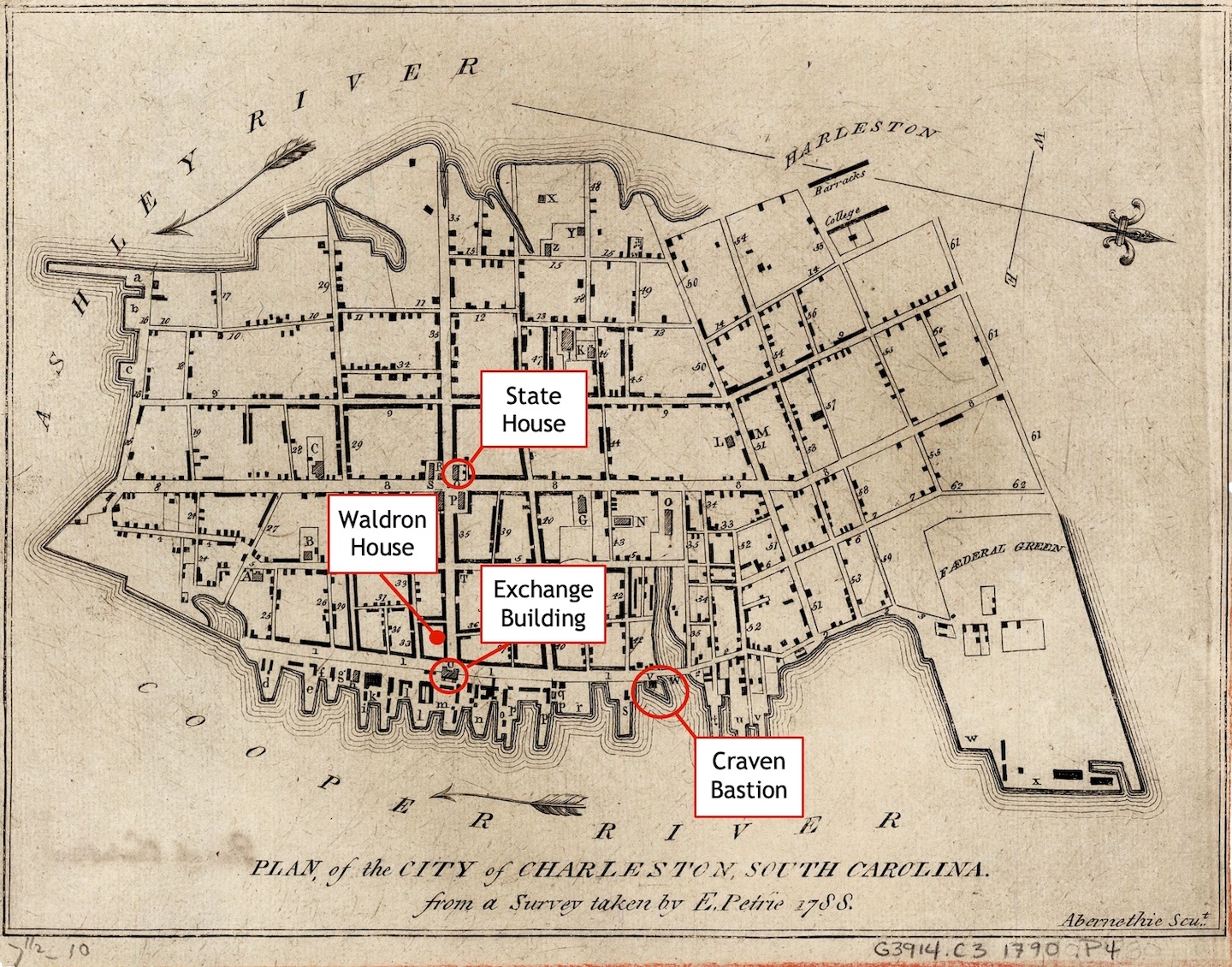
While documentary evidence enables us to reimagine the physical context in which Sampson lived and worked, we know nothing of the private conversations that influenced his decision to join the crew of the Scorpion. Nevertheless, we can surmise that he made a choice to accept an invitation to commence a new chapter of his life beyond Charleston. Jacob Waldron, for example, might have tacitly or explicitly consented to Sampson’s brief service aboard the warship on June 25–26th, trusting that the Black pilot would dutifully return to their Broad Street residence. We might imagine, further, that Captain Tollemache conversed with Sampson during that overnight errand, and mentioned the numbers of British regiments and warships then preparing to cross the Atlantic and suppress the growing American rebellion. The king’s navy would soon require a multitude of skilled pilots to navigate the shorelines, harbors, and inlets from Savannah to Boston. If Sampson were to join that naval campaign, he would receive the same shelter, victuals, and clothing as other mariners, and accumulate wages on credit like his fellow shipmates. Additionally, the Royal Navy did not recognize the institution of slavery among its crewmen of diverse backgrounds, a fact that undoubtedly influenced Sampson’s decision to abandon his life of legal bondage in South Carolina.[23]
What was at stake for parties in question? At this moment of significant tension between American colonists and British authorities, locals regarded Sampson as both one of the best pilots in the area and the legal property of a private citizen. His defection to the Royal Navy, therefore, amounted to grand larceny and a stinging rebuke of the budding rebellion. The racial paranoia gripping the Lowcountry of South Carolina during the summer of 1775 demonstrated to Sampson and his enslaved brothers and sisters that their freedom and their civil rights were not part of the revolutionary agenda. By asserting his personal agency and aligning himself with the so-called enemy, Sampson aroused the mortal wrath of men who fought to advance a racially-biased concept of American liberty.
For Captain Tollemache, the risk was far less personal. He had already announced his inclination to distress local shipping in some manner, to annoy Charlestonians who had welcomed deserters from the Scorpion into the ranks of the new rebel army. Although his threat earned the scorn and contempt of American rebels, the captain’s actions harmonized with Britain’s increasingly oppressive colonial policy. The Royal Navy was sending additional warships to silence American unrest, or so Lord William Campbell believed, and their future success required a number of skilled pilots like Sampson Waldron to penetrate the various coastal centers of resistance. In fact, Tollemache’s efforts to recruit Sampson away from American service might have followed advice from his former commander. Henry Laurens suggested as much in August 1776, when he informed his daughter in London that Sampson, the principal British pilot for the now-famous Battle of Sullivan’s Island, had been “stolen from this town” the previous summer “by his Lordship’s ingenuity.”[24]
Although we know nothing about the conversations between Sampson and the king’s officers in Charleston during the summer of 1775, it is noteworthy that the Scorpion did not fire any further signal guns to summon a pilot. Instead, the logbooks of Captain Tollemache and Sailing Master George Scott simply indicate that a pilot climbed aboard the sloop-of-war on the morning of June 29th “and took charge of the ship.” They did not identify the man in question, but, thanks to the survival of the muster books kept by Purser Henry Searle, we know it was Sampson of the house of Waldron.[25]
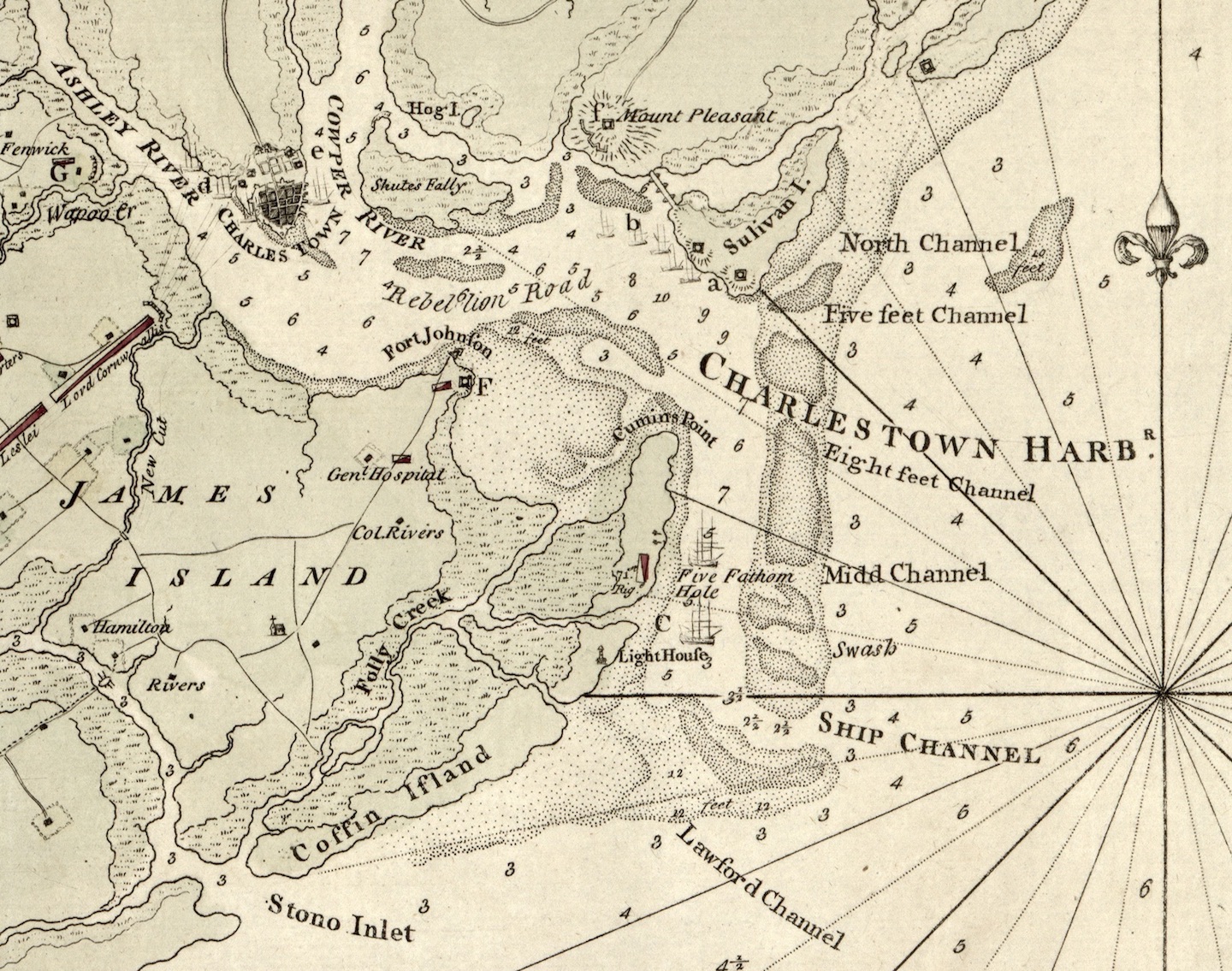
Before alighting from the Charleston waterfront, Sampson might have informed his owner, Jacob Waldron, that he would return in a day or two, as usual, after guiding the warship across the bar at the entrance of the harbor. In more private conversations, however, he likely divulged his escape plan to family and friends like Thomas Jeremiah. Perhaps he vowed to return with a squadron of powerful warships to punish the American rebels and liberate the king’s subjects living in bondage. Whatever his parting words, Sampson’s quiet departure marked the beginning of a long personal odyssey rather than a permanent exile.
On the morning of Monday, July 3rd, Governor Campbell’s private secretary, Alexander Innes, gently reminded him that the Scorpion could not begin its voyage to Boston without the governor’s packet of official letters. Lord William then finished a long report about Carolina politics to the Earl Dartmouth, Secretary of State for the American colonies. “The king’s ship is ready to sail,” wrote the governor in haste, “[and] I cannot think of detaining her any longer.” Innes himself probably delivered Campbell’s letters to the warship in Rebellion Road later that day, an errand prompted by the brazen rebel theft, one day earlier, of incoming British mail from the post office on East Bay Street.[26]
Crewmen aboard the Scorpion began to turn the capstan at 3 a.m. on 4 July 1775 to unmoor the ship for departure. A waxing crescent moon still hung in the starry sky as Sampson ascended steps to the quarterdeck and joined the officer of the watch. Aside from the warship Tamar moored nearby, with Sullivan’s Island in the background, the harbor was nearly devoid of ship traffic, and the elements presaged a fine summer’s day for sailing. Crewmen hoisted the bow anchor aboard at six o’clock, when the boatswain’s silver whistle piped instructions for men to haul the sheets and make sail. The pilot did not personally grip the ship’s wheel, but rather pointed ahead towards the rising sun and voiced directions that Sailing Master George Scott and his mate repeated down the chain of command. Over the next three hours, the Scorpion progressed slowly through the serpentine gauntlet of sandy shoals and verdant barrier islands leading to the open sea. Their journey paused at half-past nine, four or five miles east-by-south of the Charleston Lighthouse, to hoist aboard the ship’s pinnace and longboat. With Sampson’s piloting duties completed, Captain Tollemache ordered his subordinates to set a course to the northeast, first to Cape Fear, then onward to Boston.
When Sampson did not return to his domicile in Charleston later that day, or the next, Jacob Walden must have realized that his valuable chattel property had eloped with the departing Scorpion. This news, which he might have communicated directly to the Council of Safety, signaled a bad omen for the rebel movement in South Carolina. Whether he had been coerced by Captain Tollemache or had volunteered for the king’s service, they understood that Sampson possessed the skills required by British forces to penetrate the natural bar to Charleston Harbor and destroy local resistance to colonial rule. He was more than a runaway slave. He was the rogue key to the future of the rebellion in South Carolina.
Word of Sampson’s flight aboard the Scorpion soon spread across the rebel network within the colony and beyond. In a letter to his son in London, written on July 14th, President Henry Laurens reported that the British warship had carried away “a valuable black pilot, by way of reprisal & for worse purposes perhaps, for our refusing to return some of his seamen who had enlisted in the [provincial] regiments of foot.”[27] Laurens and his colleagues feared that Sampson would soon return with a more powerful naval force, a rational concern that provoked conversations about various means of deterrence. Two weeks after the departure of the Scorpion, Governor Campbell informed the Earl of Dartmouth that he had “just received an anonymous letter assuring me they [i.e., the rebels] have determined to destroy the light house, and cut down the landmark trees that direct the pilots in passing the bar of this harbour.” Such tactics, opined the confident governor, “will answer little end in preventing [the entry of British] men of war, as they can sound [the waters] and lay buoys along the channel.” “Besides,” continued Campbell, “Mr. Tollemache carried off in the Scorpion to Boston, a black fellow who is by far the best pilot in this harbour, and has [navigational] marks of his own, by which he will carry in any vessel in spite of what they [i.e., the rebels] can do.”[28]
Sampson the pilot did return to South Carolina with British warships during the full-blown war for American Independence—first in November 1775 with the familiar Scorpion, then again in June 1776 with the fifty-gun Bristol, flagship of Commodore Sir Peter Parker during the failed attack on Sullivan’s Island, and again in the spring of 1780 as pilot of the 64–gun Europe, flagship of Vice-Admiral Mariot Arbuthnot during the successful siege of Charleston. If you’d like to learn more about the revolutionary career of Sampson Waldron, stayed tuned to future episodes of Charleston Time Machine as we explore further unfamiliar stories from the crucible of our nation’s founding.
[1] William Moultrie, Memoirs of the American Revolution, So Far as It Related to the States of North and South Carolina, and Georgia, volume 1 (New York: d. Longworth, 1802), 171; Henry Laurens to James Laurens, 14 August 1776, in David R. Chesnutt, et al., eds., The Papers of Henry Laurens, volume 11 (Columbia: University of South Carolina Press, 1988), 245; William James Morgan, ed., Naval Documents of the American Revolution, volume 5 (Washington, D.C.: U.S. Government Printing Office, 1970), 861.
[2] Heretofore, the most significant discussion of Sampson’s career is Kevin Dawson, “Enslaved Ship Pilots in the Age of Revolutions: Challenging Notions of Race and Slavery between the Boundaries of Land and Sea,” Journal of Social History 47 (Fall 2013): 87–88. The author was indebted to the earlier work of William R. Ryan and William J. Harris relating to Thomas Jeremiah (see below).
[3] Throughout this essay, references to the location and movements of the Scorpion, as well as weather conditions and various activities of its crew and officers, derive from three manuscript sources held by the National Archives, Kew, England: Captain’s log (John Tollemache), Scorpion, 1775–76, ADM 51/872; Master’s log (George Scott), Scorpion, 1775–76, ADM 52/1985; Muster books, Scorpion, 1775–76, ADM 36/8377. Note that an incomplete transcription of the captain’s log is available in A. S. Salley Jr., ed., Captain Tollemache’s Journal of the Proceedings of H.M.S. Scorpion, June 21, 1775–September 18, 1775 (Columbia, S.C.: The State Company for the Historical Commission of South Carolina, 1919).
[4] For references to John Tollemache in the late 1760s, see Muster books, Martin, 1766–71, ADM 36/7432, 7433; W. E. May, “His Majesty’s Ships on the Carolina Station,” South Carolina Historical Magazine 71 (July 1970): 168; South Carolina and American General Gazette (hereafter SCAGG), 7–14 November 1769, page 3; SCAGG, 4–13 December 1769, page 2.
[5] See the entries for 21 June–4 July 1775 in Captain’s log (John Tollemache), Scorpion, 1775–76, ADM 51/872. According to Muster books, Scorpion, 1775–76, ADM 36/8377, the deserters included eight seamen (William Harvey, John Laws, Richard Ellis, Andrew Herron, Robert Watt, Felix McGinnes, Benjamin Wilmot, and Richard Derief, the last two having joined the ship on 20–21 June 1775) and three marines (Joseph Pain or Payne, Isaac Edwards, and James Oakes). Note also in the aforesaid muster books that the weekly musters held in Charleston Harbor on 18 and 25 June and 2 July 1775 counted the same number of men aboard ship, while the subsequent muster, held at sea on 9 July (having departed from Charleston on 4 July), counted eleven fewer men. The captain’s log entries demonstrate that he was aware of a succession of absences in late June, but he evidently hoped those absences would prove temporary, until the ship departed from Charleston.
[6] Henry Laurens to John Laurens, 2 July 1775, in David R. Chesnutt, et al., eds., The Papers of Henry Laurens, volume 10 (Columbia: University of South Carolina Press, 1985), 204. I have added commas to clarify the syntax.
[7] For more information about the “coastwise” trade between Charleston and the plantations, see Lynn B. Harris, Patroons and Periaguas: Enslaved Watermen and Watercraft of the Lowcountry (Columbia: University of South Carolina Press, 2014).
[8] This quote, with flawed spelling, appears in “Journal of the Council of Safety, for the Province of South Carolina. 1775,” in Collections of the South Carolina Historical Society, volume 2 (Charleston: South Carolina Historical Society, 1858), 30.
[9] For more information about Thomas Jeremiah, see William R. Ryan, The World of Thomas Jeremiah: Charles Town on the Eve of the American Revolution (New York: Oxford University Press, 2010); William J. Harris, The Hanging of Thomas Jeremiah: A Free Black Man’s Encounter with Liberty (New Haven, Conn.: Yale University Press, 2009); Henry Laurens to John Laurens, 18 and 23 June 1775, in Chesnutt, ed., Papers of Henry Laurens, 10: 183–85, 190–95.
[10] The 1777 estate inventory of pilot Jacob Waldron, Sampson’s owner, included both a canoe and a small dory. According to a report of storm damage in South Carolina Gazette (hereafter SCG), 7 June 1770, page 6, “Mr. Waldron’s pilot boat” was docked alongside Beale’s Wharf, slightly south of the present east end of Elliott Street. Considering that the Waldrons resided on the south side of Broad Street, near East Bay, they likely docked at or near that location regularly during the 1770s.
[11] References to the firing of the signal gun and the arrival of an unidentified pilot appear at the end of a succession of activities recorded under the heading of 25 June 1775 in the logbooks of both Captain Tollemache and Master Scott. According to British naval time-keeping of that era, the ship’s day commenced at noon, twelve hours earlier than civil time keeping on shore. The pilot’s arrival, therefore, occurred sometime before noon on 25 June, according to civil time. Similarly, Purser Searle inscribed Sampson’s name in the ship’s muster books with the nautical date 26 June 1775, indicating that his service officially commenced sometime after the noon hour on 25 June, civil time.
[12] Following Sampson’s entrance into the service of the Royal Navy in late June 1775, his name appears repeatedly in a succession of ships’ muster books as Sampson Waldron. Whether he personally embraced and asserted that surname, or whether it was imposed on him by British naval officers, is a question perhaps not answerable today.
[13] For reference to Waldron voyages, see, for example, SCG, 9–16 June 1759, supplement, page 2; SCG, 5–12 July 1760, page 3; SCG, 31 July–7 August 1762, page 2; SCG, 27 November–4 December 1762, page 4; SCG, 25 December 1762–1 January 1763, page 2; SCG, 29 October–5 November 1763, page 4; SCG, 14–21 September 1765, page 3; SCG, 6 June 1768, page 3; South Carolina Gazette and Country Journal (hereafter SCGCJ), 16 August 1768, page 3; SCG, 24 October 1768, page 3; SCAGG, 6 June 1769, page 3; SCGCJ, 23 January 1770, page 2; SCG, 18 July 1771, page 3; SCG, 19 September 1771, page 2; SCGCJ, 26 November 1771, page 2; SCGCJ, 17 May 1774, page 2.
[14] SCG, 7 November 1771, page 3; SCAGG, 11–18 November 1771, page 3; SCAGG, 18–25 November 1771, page 1; SCAGG, 10–16 December 1771, page 1. I have not located an inventory of Thomas Lind’s estate.
[15] SCGCJ, 14 January 1772, page 1. The unnamed schooner in this advertisement matches the description of the Industry, described in the aforementioned Lind advertisement in SCAGG, 10–16 December 1771, page 1.
[16] The death of Isaac Waldron was reported in SCG, 8 October 1772, page 3; SCGCJ, 13 October 1772, page 2; a tombstone at St. Philip’s churchyard in Charleston indicates he died on 6 October 1772 at the age of 55. Besides household furniture, the inventory of the personal property of Isaac Waldron, dated 29 October 1772, included one-half share of a “large pilot boat” and a “small ditto,” and nine enslaved people named Nanny (“old Negro wench”), Bella (“young Negro wench”), Binah (“young Negro wench”), Hannah (“girl”), Sam (“Negro fellow”), Dublin (“Negro fellow”), Mercury (“boy”), Jack (“boy”), and Larry (“boy”); see South Carolina Department of Archives and History (hereafter SCDAH), Inventories of Estates, volume Z (1771–1774), page 263.
[17] Gazette of the State of South Carolina, 14 October 1777, page 3; SCAGG, 16 October 1777, page 5; SCAGG, 23 October 1777, page 1; Will of Jacob Waldron, dated 23 December 1776, recorded in SCDAH, Will Book 1774–1779, page 517, and transcribed in WPA transcript volume for Charleston County, No. 17 (1774–79), pages 676–79. An inventory of the personal estate of Jacob Waldron, dated 30 October 1777 (i.e., after the departure of the pilots Sampson and Mercury), included Sam, Jack, Toney [sic], Binah, Hannah, Dublin, Larrey [sic], Sancho, Bobbet, Lucy, “Nany or Nancy,” Bellah, and Bellah’s “2 children boys,” named Scipio and Sam. A pair of marginal notes indicate that “Nany or Nancy” and Bellah (with her two sons), as well as Binah and Bobbet were “freed by the will”; see SCDAH, Inventories of Estates, volume CC (1776–1778), pages 371–73.
[18] Thomas Waldren [sic] and Rachel Waldren [sic] were buried at St. Philip’s churchyard on 1 and 18 January 1767, respectively, but their relationship, if any, is unclear. It is possible, however, that Rachel died from complications related to the birth of Thomas; see D. E. Huger Smith and A. S. Salley Jr., eds., Register of St. Philip’s Parish, Charles Town, or Charleston, S.C., 1754–1810 (Charleston, S.C.: The South Carolina Society, Colonial Dames of America, 1927), 315–16. SCGCJ, 20 January 1767, page 4, announced the death of Isaac Waldron’s wife, but did not name her.
[19] Bellamy Crawford to Isaac Waldron, “mariner,” feoffment, 14 January 1763, Charleston County Register of Deeds (hereafter CCRD), volume K3: 71–74; Rachell [sic] Waldron to Jacob Waldron, renunciation of dower, 10 February 1763, in SCDAH, Renunciation of Dower Books (Court of Commons Pleas), volume beginning in 1761, pages 138–39; George Kincaid, “cooper,” to Isaac Waldron and Jacob Waldron, “mariners,” lease and release, 13–14 February 1770, CCRD Q3: 1–6.
[20] According to the aforementioned deeds of 1763 and 1770, William Loocock occupied the eastern storefront in the Waldron tenement. Advertisements of further commercial tenants can be found in SCG, 23–30 June 1766, page 2 (Balguy Littlewood); SCG, 15–22 June 1767, page 1 (John Willan); SCGCJ, 31 May 1768, page 3 (vacancy); SCGCJ, 17 November 1772, page 2 (David Baty); SCGCJ, 9 March 1773, page 3 (vacancy).
[21] SCG, 23 January 1775, page 1. Gadsden’s Alley, which separates the present Nos. 17 and 19 Broad Street (and the present Nos. 8 and 10 Elliott Street), was created by the 1741 will of Thomas Gadsden.
[22] Jim Piecuch, Three Peoples, One King: Loyalists, Indians, and Slaves in the Revolutionary South, 1775–1782 (Columbia: University of South Carolina Press, 2008), 168–69.
[23] As early as April 1775, Vice-Admiral Samuel Graves in Boston expressed the need to recruit and retain as many pilots as possible to assist the king’s ships along the coast and harbors of North America. Later the same year, Graves reiterated the need for “good pilots . . . for the whole coast,” and instructed his subordinates to detain “such as you can meet with.” “If they will serve voluntarily,” he added, “they shall immediately commence pay”; see Vice-Admiral Samuel Graves to Admiralty Secretary Philip Stevens, 11 April 1775, in K. G. Davies, ed., Documents of the American Revolution 1770–1783, volume 9, (Dublin: Irish Academic Press, 1975), 93–96; Vice Admiral Samuel Graves to Captain James Wallace, 17 September 1775, in Clark, ed., Naval Documents of the American Revolution, 2: 129.
[24] Henry Laurens to Martha Laurens, 17 August 1776, in David R. Chesnutt, et al., eds., The Papers of Henry Laurens, volume 11 (Columbia: University of South Carolina Press, 1988), 253. Note that I have added an apostrophe to this quote to clarify the meaning.
[25] The aforementioned muster books of the Scorpion demonstrate that Sampson was present for the weekly muster held on 2 July 1775 and all subsequent weekly musters through the end of April 1776.
[26] The post-office robbery is discussed in John Drayton, Memoirs of the American Revolution, volume 1 (Charleston, S.C.: A. E. Miller, 1821), 309–11.
[27] Henry Laurens to John Laurens, 14 July 1775, in in Chesnutt, The Papers of Henry Laurens, 10: 220–21.
[28] Lord William Campbell to the Earl of Dartmouth, 19 July 1775, in K. G. Davies, ed., Documents of the American Revolution, 1770–1783, volume 11 (Dublin: Irish Academic Press, 1976), 49–53.
NEXT: The Tamar in Rebellion Road: Asylum for Loyalists in 1775
PREVIOUSLY: The First Days of South Carolina's Last Royal Governor
See more from Charleston Time Machine