
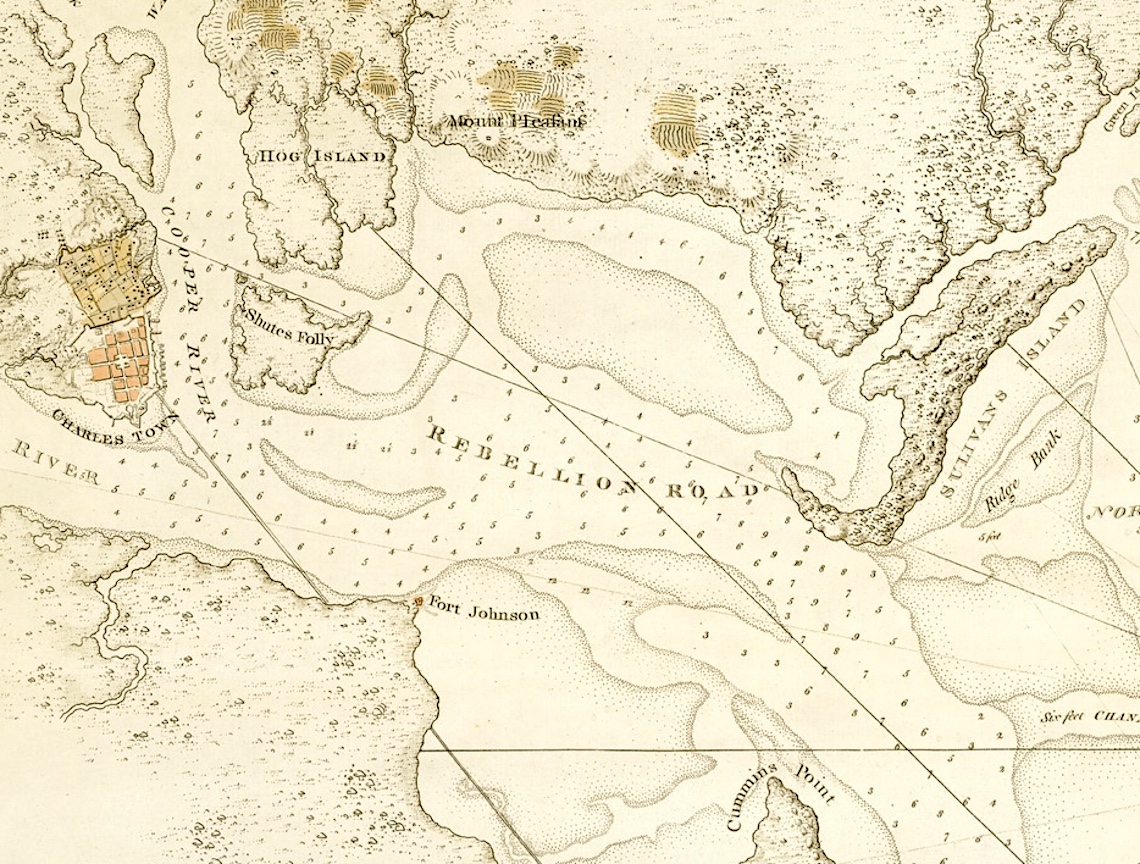
The last vestiges of royal authority in South Carolina, huddled within two small warships anchored in Charleston Harbor, survived the autumn of 1775 by cultivating a largely forgotten terrestrial connection. Surrounded by increasingly hostile rebel forces, British mariners established a foothold on Sullivan’s Island, both to supply their wants and to nurture an improvised sanctuary for political refugees.
When we left the scene at the end of the previous episode, in late September 1775, the warships Tamar and Cherokee had anchored one quarter of a mile offshore from the southwestern end of Sullivan’s Island, beyond the range of rebel guns within Fort Johnson on James Island. Weeks of stormy weather gave way to a stretch of clear skies and moderate breezes, affording the king’s mariners time to dry their sails and perform routine maintenance. The packet boat Swallow, which had arrived earlier in the month bearing incendiary news, sailed over the bar with a reduced crew on the morning of September 21st, carrying public and private correspondence back to England. The following morning, Governor Campbell traveled by boat to the nearby Cherokee, where crewmen fired an eleven-gun salute to welcome the provincial executive. Lord William no doubt discussed military matters with the commander, Lieutenant John Fergusson, but the real purpose of his first visit to the diminutive warship was probably more personal in nature.[1]
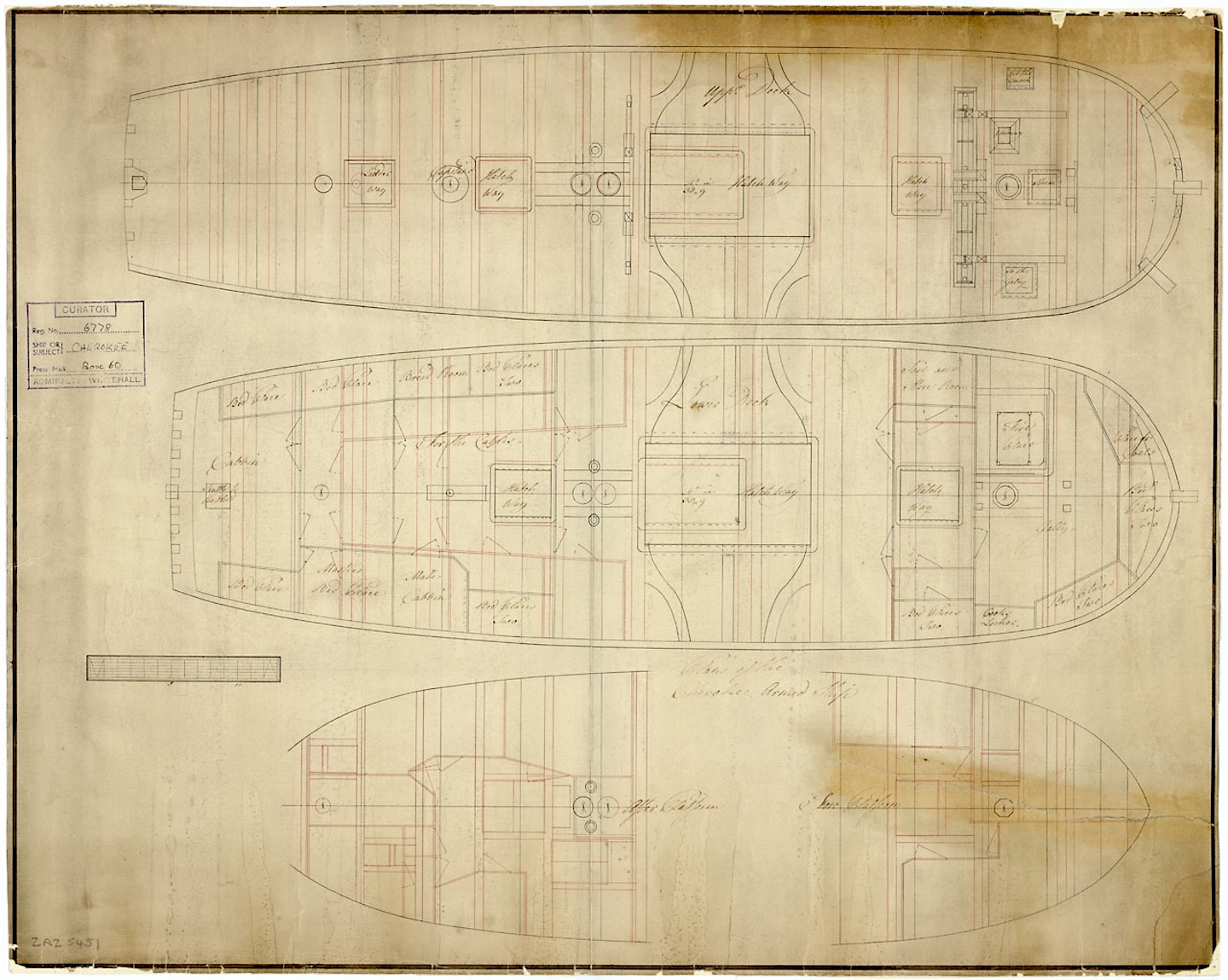
Campbell’s decision to detain the Cherokee in Charleston Harbor for defensive purposes had upset its principal passenger, William De Brahm, Surveyor General of the Southern Department of His Majesty Dominions in North America. The Royal Navy had purchased the ship specifically for De Brahm’s cartographic survey of the southern Atlantic coastline, but the collapse of British authority in thirteen of the colonies effectively cancelled that mission. De Brahm and his six-man surveying team occupied a suite of relatively commodious apartments aboard the Cherokee, which the governor judged sufficient for his personal needs. To facilitate a reunion with his wife and young children, who remained in rebel-occupied Charleston, Campbell persuaded De Brahm to seek permission from rebel authorities to move ashore and vacate the modest berths now required by the royal governor.[2]
While the disgruntled surveyor initiated plans for removing his team and their baggage from the Cherokee, Lord William departed from the ship and returned to the Tamar before noon on the 22nd. At 1 p.m., crewmen aboard both warships performed the obligatory ceremony of firing their cannons to commemorate the fourteenth anniversary of the coronation of King George III. The return of autumnal showers that evening dampened their festivities, however, and the sight of a new ship outside the bar at sunrise presaged the beginning of another tense confrontation.
On the hazy afternoon of September 23rd, a robust civilian schooner called the Polly traversed the sandy shoals forming the bar of Charleston Harbor and steered northward along the beach of Morris Island. After turning westward to round Coming’s Point, the northern tip of Morris Island, the Polly approached the sloop-of-war Tamar, which signaled for the schooner to pause for inspection. Its master, William Stone, informed the king’s mariners that he shared ownership of the vessel with several Charlestonians who happened to be leading members of the rebel faction. He claimed to be returning from the nearby port of Georgetown on routine business, but, below deck, British sailors found a large quantity of cannon shot, a cargo prohibited within the American colonies by the king’s proclamation of October 1774.
News of this discovery quickly traveled up the Tamar’s chain of command to Captain Edward Thornbrough and Governor Campbell, who remarked that the Polly was “a very fine schooner.” William Stone argued that the iron cannon balls in the hold were simply ballast and not cargo, but the presence of contraband aboard a vessel belonging to known rebels provided the king’s officers with an excuse for seizure. Lord William explained his decision in a letter to Secretary of State Lord Dartmouth: “As [the rebels] were then fitting out a vessel with the professed intention of attacking the king’s ships, and this schooner was perfectly well calculated for that purpose, I prevailed on Captain Thornbrough to detain her.” “By the governor’s desire,” said Thornbrough, the captain and his men confiscated the Polly and detained William Stone aboard the Tamar.[3]
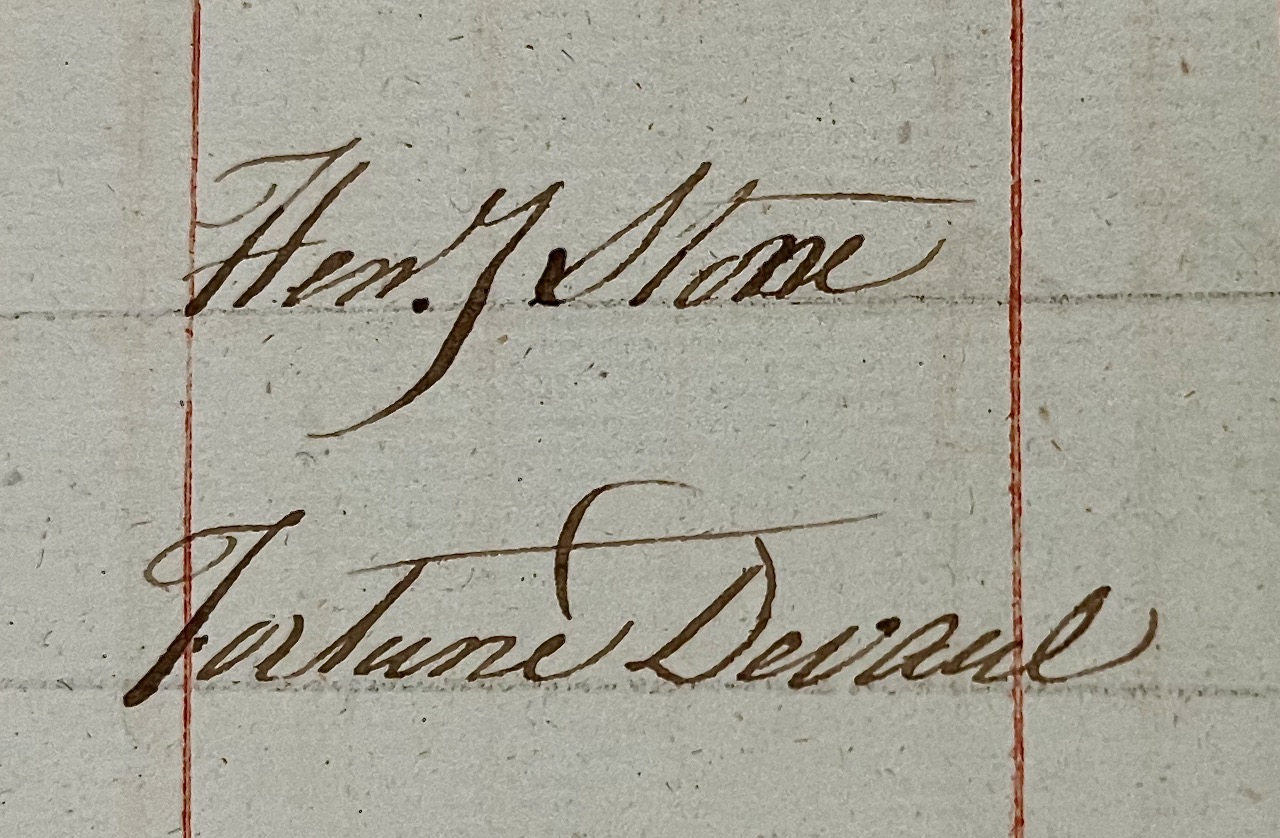
The king’s mariners also extracted from the prize schooner an enslaved man named Harry, whom William Stone described as “a most valuable Negroe man pilot, whom he brought up to that branch,” and another Black mariner named Fortune, the chattel property of a white pilot named Peter Devall (aka Peter Duval).[4] Like their Black colleague Sampson Waldron, who had departed with the Scorpion in July, Harry and Fortune evidently embraced the opportunity to gain freedom from slavery by agreeing to work for the Royal Navy. The purser aboard the Tamar, James Allan, inscribed their names in the ship’s muster books on September 24th as “Henry Stone” and “Fortune Devaul,” identifying them as “pilots borne for victuals.”[5] Both men remained aboard the Tamar for some months and participated in later British naval operations along the coast of South Carolina, unlike William Stone, who returned to Charleston “on parole” and later applied his professional skills in support of the rebel cause.[6]
While the king’s mariners inspected their prize and shifted personnel to the schooner Polly, the provincial General Committee sitting at the State House revisited a controversial debate. The latest correspondence from England, delivered by the packet boat Le Despencer on September 24th, confirmed the imminent arrival of British forces sent to punish the American colonies, and thus rekindled conversations about how to prevent their landing in South Carolina.[7] Three months earlier, members of the rebel committee had rejected a proposal to obstruct several of the navigable channels through the bar of Charleston Harbor. A revival of that proposal in late September compelled Chairman Henry Laurens to reassert his opinion that such efforts would ruin the port and destroy the local economy.[8] After a warm debate on 25th, however, the majority of the General Committee voted to block the two deepest channels through the bar by scuttling thirty-one schooners to create a line of obstructions extending nearly a mile and a half.[9]
Almost immediately after gaining approval for this ambitious project, its proponents realized that the work could not safely commence while the Tamar and Cherokee remained within the harbor and effectively controlled access to the bar. Their menacing presence inspired a new debate of some sort of action to destroy, seize, or drive away the British warships. Henry Laurens opposed the prospect of a direct attack: “If a serious attempt is made, there will be bloody work. The Tamar is as well prepared as such a crazy bark can be. The Cherokee is fitted for defence, & so is a fine schooner [i.e., the Polly], which the man of war lately seized for that very purpose.”[10] The chairman’s caution resonated with his rebel colleagues, who voted on September 27th to reject a motion to confront the warships. That decision jeopardized the related project to obstruct the bar, but events within the harbor soon inspired a reconsideration.
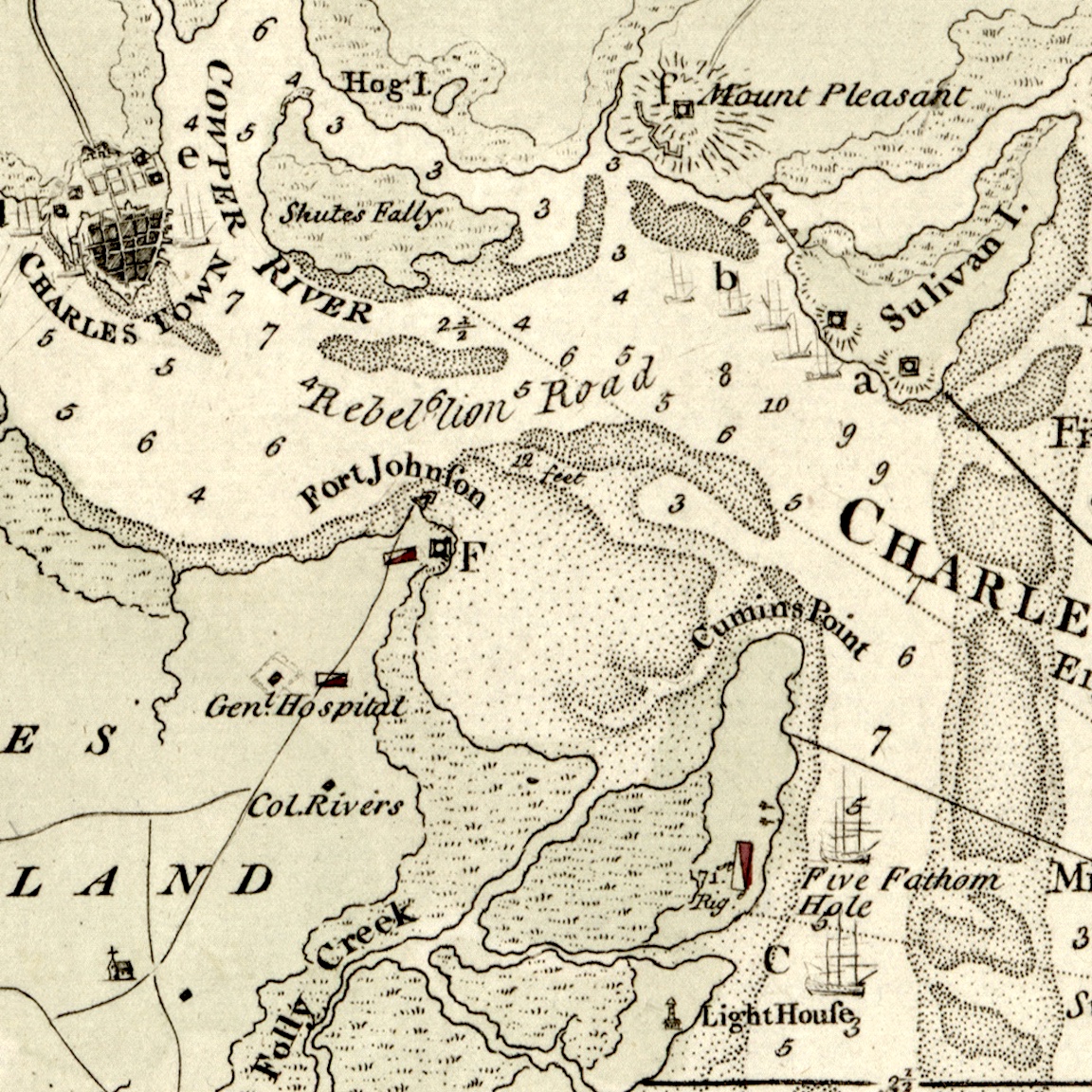
The king’s mariners anchored near Sullivan’s Island in late September 1775 either intuited the plans of their opponents in Charleston or received clandestine reports from agents unknown within the capital. In a letter sent to England, Governor Campbell stated that Captain William Pond, master of the packet Le Despencer, “has been particularly attentive and very useful in conveying letters and intelligence to and from the shore, as the men-of-war’s boats cannot now venture ashore without running the risk of losing their men.”[11] On September 25th, crewmen aboard the Cherokee spent the day “fixing boarding nettings fore and aft” to prevent hostile parties from climbing aboard. That same day, the Tamar moved one mile to the south and anchored a quarter of a mile off the beach of Coming’s Point. From their positions along the northern and southern edges of the shipping channel, the two warships asserted control over access to South Carolina’s principal port.

On the clear afternoon of September 28th, mariners aboard the Tamar observed some suspicious activity on the southern edge of the harbor. Captain Thornbrough gave the order to weigh anchor and make sail, then fired a gun “as a signal” for the Cherokee to follow. At 4 p.m., the two warships dropped anchor in shallow water near Coming’s Point and prepared “to intercept about 30 armed rebells which were in 3 canoes,” evidently dispatched from Fort Johnson on some secret mission. Lieutenant Joseph Peyton watched as the rebels landed on Morris Island. At 5 p.m., the Tamar weighed anchor again to drift closer, but the ship’s keel soon ground into the harbor’s sandy bottom. Sailors then descended overboard into the ship’s longboat and rowed northward, towards Sullivan’s Island, towing a kedge anchor attached to a long cable. After they dropped the anchor some distance beyond the stern, men aboard the Tamar rotated the ship’s capstan to drag or “warp” the vessel backwards into deeper water. Once floating freely again, Captain Thornbrough gave orders to make sail to the southward and fire two six-pounders at the rebels, “which made them retreat.” Lieutenant Peyton noted that the provincial soldiers scrambled back to their canoes and “put off” from Coming’s Point, but they did not retreat to Fort Johnson. Instead, the boats turned northward “and made for Sullivan’s Island.” The Tamar then “work’d” northward to reach the island before the canoes, firing two more six-pounders at the rebels, which finally convinced them to turn back to the fort on James Island.
At sunset, the two warships returned to an anchorage near the prize schooner Polly, one third of a mile to the southwest of the Pest House on Sullivan’s Island. Hours later, at 10:30 p.m., Captain Thornbrough received “an information” from an unidentified source, suggesting “that the rebells were to attack the ships.” The gouty, bed-ridden captain immediately ordered the men to clear the deck and maintain a vigilant watch at their respective stations. Young Lieutenant Peyton enforced the command, noting in his log that the sailors “kept under arms all night, from an information that we were to be attack’d.”
The action near Rebellion Road on September 28th evidently persuaded rebel leaders in Charleston to reconsider the proposal to attack, destroy, or drive away the king’s warships. The following day, members of both the General Committee and Council of Safety resolved to move forward with the controversial plan, appointing a subcommittee to devise the necessary offensive strategy. At the same time, however, the rebel body sent a curious letter to Lord William Campbell aboard the Tamar, questioning why the governor had withdrawn from the seat of his government and “retired on board the king’s ship.” Because his removal exacerbated the “general disquietude” of the colony and stoked fears of impending violence, the General Committee invited Campbell to return to Charleston, “the accustomed place of residence of the Governor of South Carolina,” assuring his safety as long as he took no “active part against the good people of this colony.”[12] Lord William replied on September 30th, rejecting the invitation “from a body assembled by no legal authority,” whose acts of “open rebellion” had obliged him “to take refuge on board the king’s ship in this harbour.” The Committee’s letter “deserves no answer,” said the governor, but he sent one anyway to clarify his terms: “I never will return to Charles-Town till I can support the King’s authority and protect his faithful and loyal subjects.”[13]
Meanwhile, news of the rebel government’s resolve to attack the Tamar and Cherokee terrified a sizeable portion of the residents in urban Charleston, who believed such offensive action “would bring on the inevitable destruction of this now flourishing town.” A petition circulated in early October, signed by 368 tax-paying citizens, opined that the warships would make “no attempt . . . to molest the same, unless hostilities were begun by firing on the British navy.” Under pressure from their cautious constituents, the rebel government quietly abandoned both the proposed attack and the related plan to obstruct the bar.[14] Their political reversal restored a modicum of peace to the capital, but the lingering presence of menacing warships in the harbor induced provincial leaders to exercise an abundance of caution. On October 5th, the Council of Safety issued a bluntly-worded recommendation to merchants, shop-keepers, and local citizens in general, advising them forthwith to remove their “goods, wares, and merchandize” from urban Charleston “to places of security in the country.”[15] This brief notice marked the beginning of a general evacuation of women, children, merchandize, furniture, and livestock from the capital, which continued well into the new year.
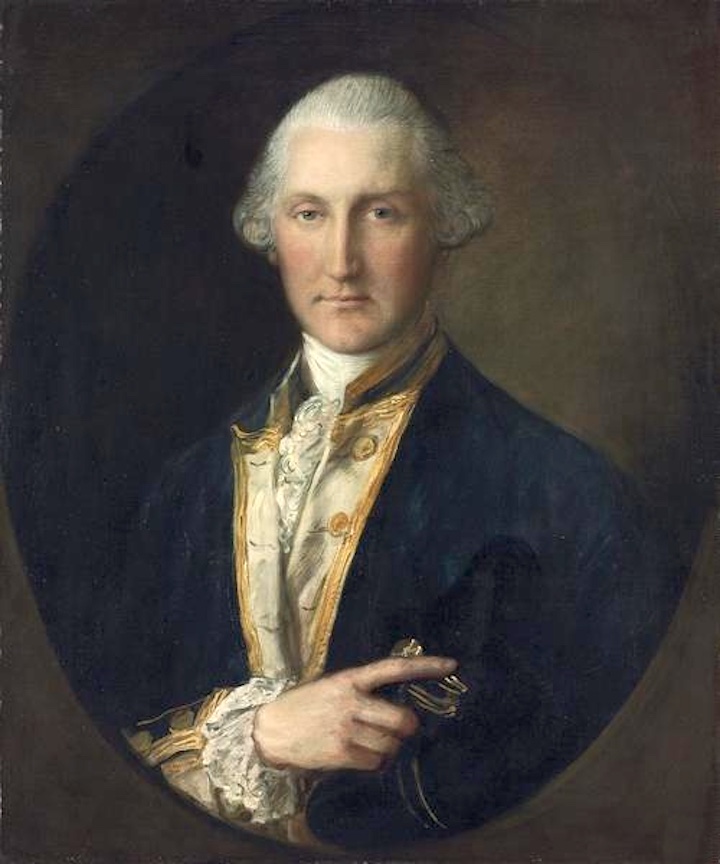
While the most affluent families in Charleston gathered their valuables and moved to their country estates, William De Brahm gained permission from the General Committee to move ashore with his surveying team and baggage.[16] Their removal from the Cherokee provided an opportunity for Governor Campbell and his civilian entourage, who transferred from the Tamar to the smaller warship on the cloudy morning of October 9th.[17] Francis Looby, a young Irishman employed as clerk and steward aboard the Cherokee, recorded in the ship’s muster book the arrival of the governor and thirty-four individuals, identified collectively as “Supernumeraries for Protection, borne for victuals only per request of Lord William Campbell.”
Besides the governor and his five white male servants, the new passengers included Campbell’s private secretary, Alexander Innes, and several men whose loyalty to the Crown hastened their exodus from the capital weeks earlier. The clerk identified two of the new arrivals as “Cudjo Black” and “Jolly Black,” almost certainly indicating persons of African descent, whose affiliations and backstory remain a mystery. Even more curiously, the majority of the names in the new passenger list represent people who allegedly came aboard the Cherokee with the governor, but whose presence was not previously recorded aboard the Tamar. From whence did these twenty-odd people come? The answer to that conundrum forms the key to unlock an important but largely overlooked story from the early stages of the Revolution in South Carolina.
In addition to the names mentioned earlier, the list of thirty-five passengers who boarded the Cherokee on 9 October 1775 includes the governor’s wife, their three children, three white female “attendants,” and several other domestic personnel who actually remained ashore in Charleston until the middle of December. Similarly, the ship’s muster books indicate that William De Brahm and his surveying team, who quit the ship by October 9th, were formally discharged from the books of the Cherokee on 1 March 1776. In spite of these contradictions, Mr. Looby, the ship’s clerk and steward, marked all of the aforementioned absent passengers as present for every weekly roll-call from mid-October 1775 through the early days of 1776. Although one might interpret these facts as clerical mistakes, or perhaps a means of reserving space for future lodgers, the contractual nature of the muster books, which specify the number of mouths to be fed at the expense of the Royal Navy, suggests a more intriguing story.
During the final months of 1775, Francis Looby padded the muster books of the Cherokee with a number of phantom passengers, a kind of clerical fraud not unfamiliar to the Royal Navy during the eighteenth century. Pursers and stewards aboard the king’s ships and merchant vessels alike occasionally pocketed the difference between the total budget for provisions and the value of the food actually delivered and consumed. In this case, however, it appears that Mr. Looby was following the directions of his superior officers, including Governor Campbell, at whose “request” the names of the absent passengers appeared on October 9th. Rather than seeking to make an easy profit during a period of crisis, the king’s officers evidently devised a subtle means of empowering the ship’s pursers to draw from the navy’s contractor in Charleston a greater volume of provisions than actually required to feed the ship’s company. Their motivation for committing such fraud is unclear, but, in my opinion, the inclusion of one Thomas Robinson within the muster books of the Cherokee on October 9th points towards a plausible solution.
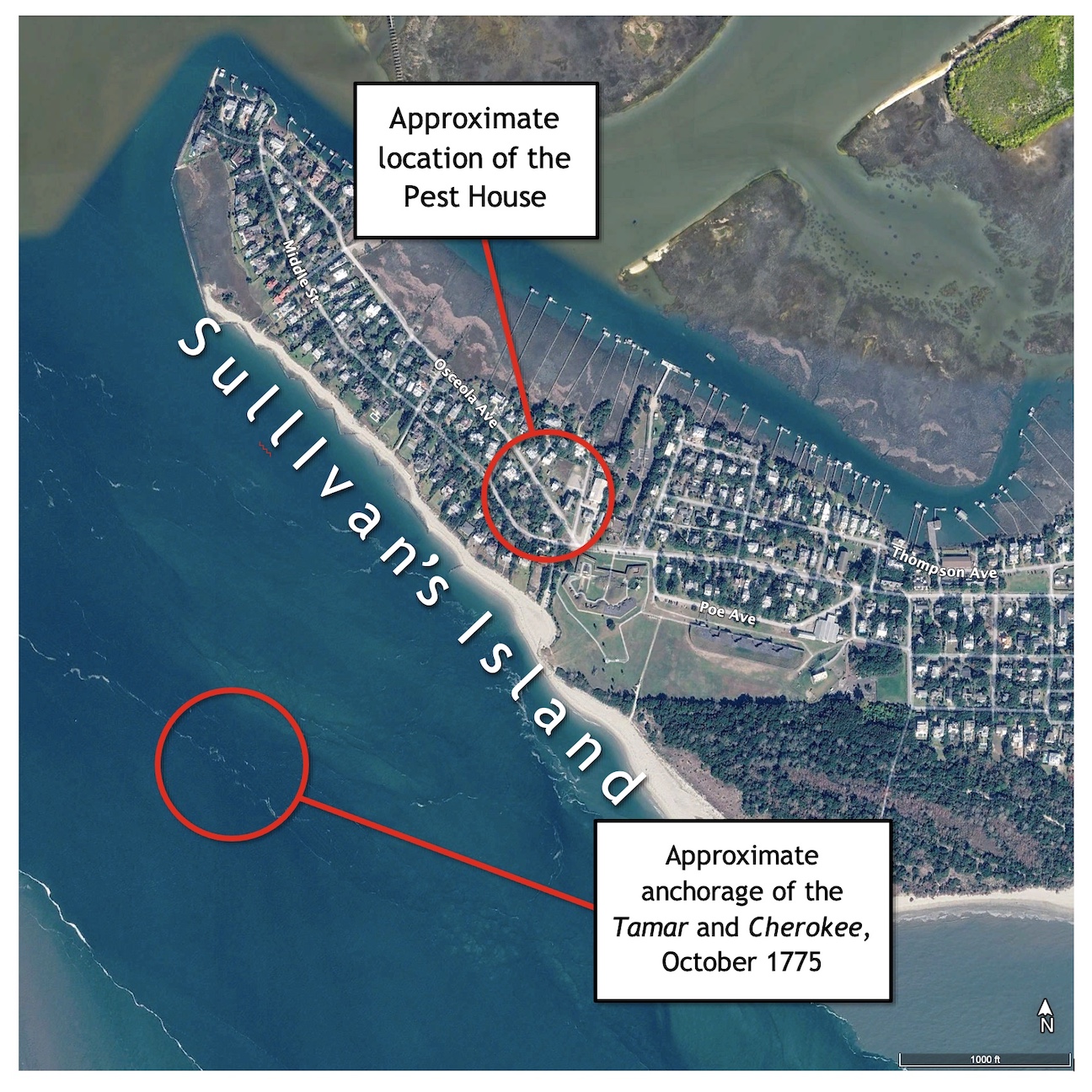
In the several years preceding his appearance aboard the Cherokee, Thomas Robinson drew a salary from the South Carolina General Assembly as caretaker of the Pest House on Sullivan’s Island. He evidently maintained the property while residing there with his family, and Robinson’s wife likely cared for sick immigrants who were occasionally confined to the public lazaretto. Nothing is known of their interactions with the thousands of African captives who arrived in Charleston Harbor during the final, richest years of the port’s colonial slave trade, all of whom were obliged by law to stretch their legs on Sullivan’s Island for a series of days before standing on the auction block in urban Charleston. Having survived the horrific Middle Passage across the Atlantic, some or perhaps all of those incoming Africans might have gathered around a communal well at the Pest House to drink fresh water and wash their bodies, perhaps crossing paths with Mr. and Mrs. Robinson during their brief stay on the island.
Although the flow of slave ships and most commercial traffic to Charleston Harbor ended with a series of trade embargoes in early 1775, and the dissolution of the provincial General Assembly in mid-September ended Thomas Robinson’s salary, the caretaker and his wife evidently continued their residence within the isolated Pest House. The addition of Thomas’s name to the muster books of the Cherokee therefore illuminates a forgotten link between ship and shore, through which the governor and officers of the Royal Navy fostered the growth of a nearly invisible community on Sullivan’s Island during the final months of the year.
No evidence survives of Governor Campbell issuing a formal notice or proclamation inviting loyalists—enslaved and free—to seek sanctuary on the island, but a handful of documentary clues suggest a message or rumor to that effect circulated quietly within the capital. The paranoia surrounding the trials of Thomas Jeremiah during the summer of 1775 alluded to such rumors, and the correspondence of several rebel agents during the ensuing autumn include vague references to dozens of runaway slaves sheltering within the island’s expansive maritime forest. Henry Laurens and his colleagues suspected, with some justification, that Lord William Campbell was transforming Sullivan’s Island into an asylum for runaway property, a kind of annex to the king’s warships in the harbor. By padding the muster books with phantom passengers, the king’s officers possessed the means to acquire a surplus of bulk provisions like beef, pork, rice, peas, butter, and rum from subcontractors within rebel Charleston, with which they might have fed dozens of refugees. Details of this hypothetical victualling enterprise are now obscure, but the growing number of runaways on the island during the final months of 1775 inflamed rebel resentment and eventually precipitated a fatal clash.
Among the loyalists sheltering at or near the island Pest House that autumn was George Walker, formerly the master gunner of Fort Johnson, with his wife and son. Rebel soldiers of the nascent 2nd Regiment had arrested Walker during their seizure of the fort on September 15th, then confined him briefly within the provincial barracks near Boundary Street in Charleston (now the epicenter of the College of Charleston). Walker was free on parole and visiting Governor Campbell by October 12th, when a small vessel entered the harbor in a state of distress.
John Wanton, master of the modest sloop Polly, was overjoyed when the king’s mariners hauled him alongside the Tamar for inspection shortly after sunrise. Weeks earlier, Wanton had departed from Newport, Rhode Island, on a short voyage to deliver apples and cider to the island of Nantucket, but a violent storm blew the Polly far off course. Struggling at sea for more than a week “without either chart or quadrant,” the sloop’s four-man crew eventually sighted the Carolina coastline. The hospitable governor offered refreshment to Captain Wanton, saying it was “a kind of miracle he made this harbour,” then commandeered the poor man’s sloop for the king’s service.
Under the pretense of assisting the Rhode Island mariner, Campbell placed George Walker, “an old seaman,” in command of the sloop Polly, and directed him to navigate southward to St. Augustine, the capital of British East Florida. The governor’s disingenuous aid to John Wanton masked his private motivations: Campbell sought to prevent the captain from sharing news of recent developments in New England with the rebels of Charleston, and he allegedly hoped to summon reinforcements from the Crown government in Florida.[18]
While the king’s mariners prepared the Polly for departure, the chief warrant officer aboard the Tamar, sailing master William Mead, died on the afternoon of October 12th. His shipmates carried the corpse ashore to Sullivan’s Island the following afternoon, amidst a blustering rainstorm, and buried him with military honors at an unspecified location.[19] The continuation of hard gales and heavy rain during the ensuing night drove the Tamar into the shallow sands fronting the island, obliging the crew to warp the ship to a safer anchorage on October 14th, now two-thirds of a mile to the southwest of the Pest House. This small change in anchorage might seem irrelevant, but it demonstrates how the king’s mariners, and the several local pilots aboard both warships, gained practical knowledge of the safest distance to anchor off the beach of Sullivan’s Island, information that proved vital in the famous battle of June 1776.
The Rhode Island sloop Polly sailed out of Charleston Harbor on the morning of October 15th, bound for St. Augustine, but it never reached that port. Captain Wanton and his mates overpowered and detained George Walker shortly after their departure, then steered the sloop into the Savannah River. After depositing the “rattling” old gunner on the shores of Georgia, Wanton turned the Polly northward and made sail for Newport. George Walker eventually hitched a ride back to Charleston, where in early November he became the new master’s mate aboard the Tamar.[20]
Back in Rebellion Road during the month of October, the king’s warships continued to draw provisions from naval contractor William Price in Charleston, but crewmen from the Tamar and Cherokee now played a more active role in fetching the firewood required to cook their victuals. Instead of receiving bulk quantities of chopped wood from town through the agency of Mr. Price, sailors now rowed ashore to Sullivan’s Island periodically to cut their own wood, a practice—as mentioned in the previous episode—that commenced on September 18th. Similarly, the king’s longboats continued the periodic duty of carrying ashore dozens of wooden casks to acquire bulk supplies of fresh water, but the maturing political crisis now restricted their range of sources. Following the rebel seizure of Fort Johnson in mid-September, the brick well associated with the Pest House on Sullivan’s Island became the sole source of fresh water for the British warships anchored in Rebellion Road.
The aggressive posturing of both British and American forces in Charleston Harbor in late September 1775 forced both sides to secure terrestrial footholds to defend their respective positions. By the end of October, the king’s mariners had established an amphibious connection to Sullivan’s Island, an acknowledged Crown possession coveted by the nascent provincial government. This relationship simultaneously bolstered Governor Campbell’s efforts to sustain the king’s authority in South Carolina and enraged members of the rebel faction in the capital. Please join me for the next episode, when we’ll see agents of the provincial government spread their sails to challenge British dominance within Rebellion Road.
[1] Throughout this essay, I have extracted descriptions of Cherokee- and Tamar-related activities, movements, weather conditions, and quotations from four manuscript sources at the National Archives, Kew: Captain’s log (Edward Thornbrough), Tamar, 1775–76, ADM 51/968; Muster books, Tamar, 1775–77, ADM 36/7697; Master’s log (William Pickard), Cherokee, 1775–76, ADM 52/1662; and Muster books, Cherokee, 1775–76, ADM 36/8049; and from two manuscript sources held at the Caird Library and Archives, National Maritime Museum, Greenwich: Lieutenant’s log (John Fergusson), Cherokee, 1775–76, ADM/L/C/284; and Lieutenant’s log (Joseph Peyton), Tamar, 1775–76, ADM/L/T/6.
[2] Alexander Innes to James Penman, 15 October 1775, in William Bell Clark, ed., Naval Documents of the American Revolution (hereafter NDAR), volume 2 (Washington, D.C.: U.S. Government Printing Office, 1966), 466–67.
[3] Lord William Campbell to the Earl of Dartmouth, 19 October 1775, in K. G. Davies, ed., Documents of the American Revolution, 1770–1783, volume 11 (Dublin: Irish Academic Press, 1976), 155–58; Edward Thornbrough to Admiralty Secretary Philip Stephens, 23 October 1775, in ADM 1/2591, at the National Archives, Kew.
[4] Memorial of William Stone, February 1785, South Carolina Department of Archives and History (hereafter SCDAH), Accounts Audited of Claims Growing out of the Revolution, claim No. 7432; Petition of William Stone and Isaac Huger, 21 February 1786, SCDAH, Petitions to the General Assembly, 1785, No. 41.
[5] Note that Fortune’s surname is spelled “Devaul” in the muster list fascicle for September 1775, but spelled “Devall” in subsequent fascicles, which also confirm that Henry Stone and Fortune Devall were “taken in the Polly schooner prize” on 24 September 1775, according to naval time reckoning.
[6] Memorial of William Stone, February 1785, SCDAH, Accounts Audited of Claims Growing out of the Revolution, claim No. 7432.
[7] South Carolina Gazette (hereafter SCG), 26 September 1775, page 3; Council of Safety to William Henry Drayton, 27 September 1775, in Chesnutt, Papers of Henry Laurens, 10: 431.
[8] Henry Laurens to James Laurens, 22 September 1775, and Henry Laurens to John Laurens, 23 September 1775, in David R. Chesnutt, ed., The Papers of Henry Laurens, volume 10 (Columbia: University of South Carolina Press, 1985), 414, 422–23.
[9] John Drayton, Memoirs of the American Revolution, volume 2 (Charleston, S.C.: A. E. Millers, 1821), 54–55; Henry Laurens to John Laurens, 26 September 1775, in Chesnutt, Papers of Henry Laurens, 10: 426–29.
[10] Henry Laurens to John Laurens, 26 September 1775, in Chesnutt, Papers of Henry Laurens, 10: 429.
[11] Lord William Campbell to the Earl of Dartmouth, 19 October 1775, in Davies, Documents of the American Revolution, 11: 158.
[12] The text of the General Committee’s letter of 29 September 1775 appears in SCG, 3 October 1775, page 3; Chesnutt, Papers of Henry Laurens, 10: 434–35; NDAR, 2: 243.
[13] The text of Campbell’s reply to the General Committee appears in SCG, 3 October 1775, page 3; Chesnutt, Papers of Henry Laurens, 10: 442–43; NDAR, 2: 260.
[14] Drayton, Memoirs, 2: 56–57; Thomas Ferguson to Christopher Gadsden, 5 October 1775, and “Report from the committee to obstruct the passages over the bar,” 5 October 1775, in R. W. Gibbes, ed., Documentary History of the American Revolution . . . 1764–1776 (New York: D. Appleton & Co., 1855), 198–99, 200–1.
[15] The earliest extant text of this “recommendation,” dated 5 October 1775, appears in SCG, 17 October 1775, page 4.
[16] Alexander Innes to James Penman, 15 October 1775, in NDAR 2: 466.
[17] Note that Campbell entered the Cherokee on the morning of 9 October 1775, according to the captain’s log and the ship’s muster books, but he and his secretary, Alexander Innes, were not formally discharged from the muster books of the Tamar until 28 October 1775.
[18] Alexander Innes to James Penman, 15 October 1775, in NDAR 2: 467; William Edwin Hemphill and Wylma Anne Wates, eds., Extracts from the Journals of the Provincial Congresses of South Carolina, 1775–1776 (Columbia: South Carolina Department of Archives, 1960), 93–97 (4 November 1775); SCG, 7 November 1775, pages 1–2.
[19] All of the extant logbooks of the officers present in Charleston Harbor at the time mentioned the 4 p.m. burial of William Mead (under the heading of 14 October 1775, nautical time), but only the logbook of Lieutenant Fergusson noted that he “was buried on Sullivans Island.” Mead’s own logbook is not extant, and was evidently discarded or lost after his death.
[20] Alexander Innes to James Penman, 15 October 1775, in NDAR 2: 467; Newport Mercury [Rhode Island], 27 November 1775, page 2; Under the date 7 November 1775, George Walker became crewman No. 265, master’s mate, in the aforementioned paybook and muster books of the Tamar.
NEXT: Firefight in Hog Island Channel: South Carolina's Tipping Point to War with Britain
PREVIOUSLY: Posturing in Charleston Harbor, September 1775: Prelude to a Firefight
See more from Charleston Time Machine