
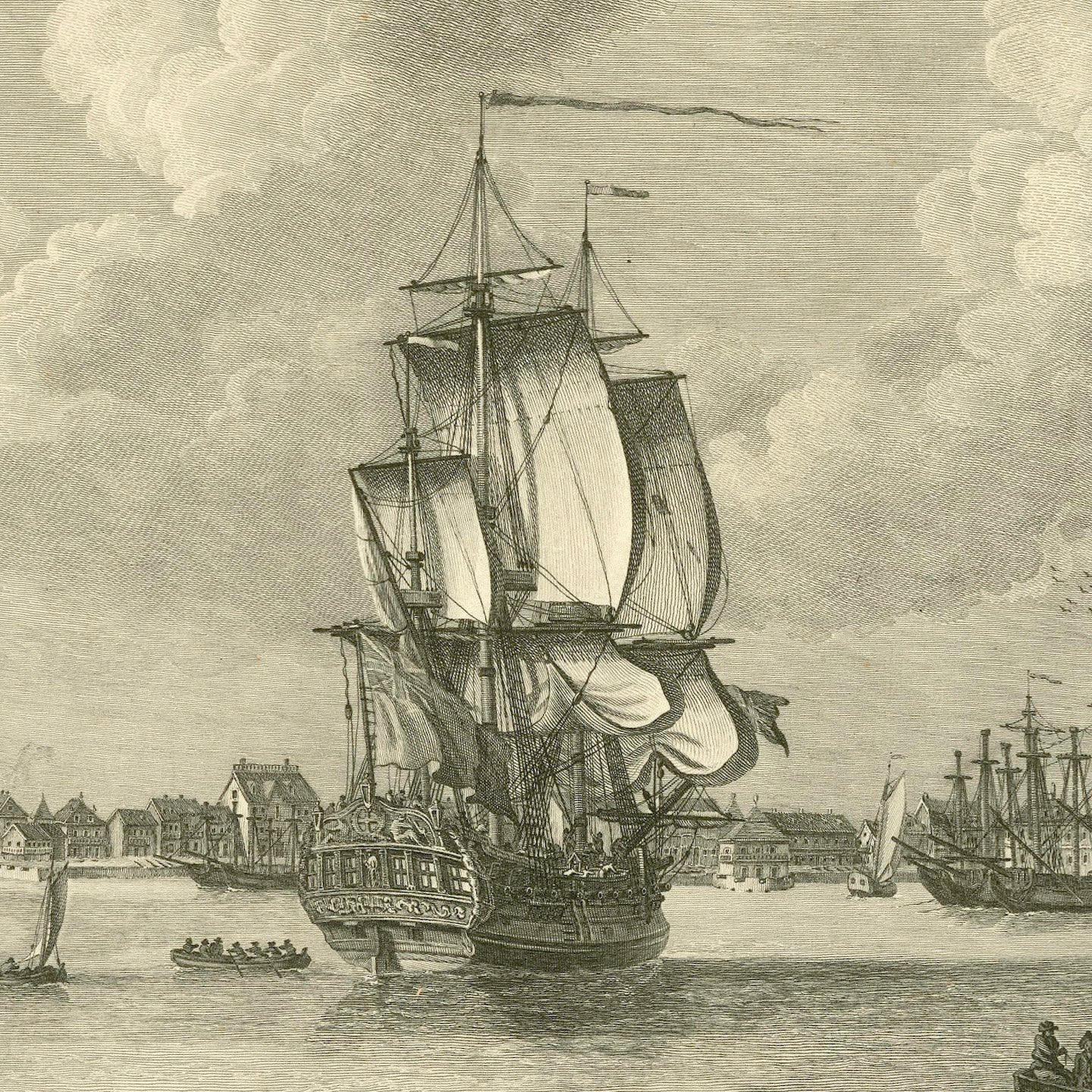
In the late winter of 1763, a young British officer sailed into Charleston Harbor aboard a warship assigned to protect the trade of a flourishing colony. Weeks later, Captain Lord William Campbell married a local heiress, Sarah Izard, and became invested in the slave-owning community. Their hasty union marked the beginning of a longer saga that culminated, twelve years later, with the unraveling of British authority in the province of South Carolina.
The principal character in this narrative, William Campbell (1737–1778), was the youngest son of the 4th Duke of Argyll, a prominent Scottish nobleman who pursued a successful career as an officer in the British Army.[1] Although he held no titles in his own right, Campbell’s class-conscious contemporaries addressed him with the courtesy title of “Lord William.” South Carolinians remember him as the colony’s final royal governor, immortalized in countless history books for his hasty, nocturnal flight from the capital in September 1775, after serving barely three months in office. That anecdote, while both factually accurate and mildly amusing, fails to convey the gravity of an important turning point in the long history of South Carolina. To gain a better appreciation for the complex circumstances that compelled Campbell to flee from his home that September evening, and to better understand his connections to Carolina, we need to rewind our imaginary time machines to Lord William’s earliest encounters with the people and politics of colonial Charles Town (spelled “Charleston” since 1783).
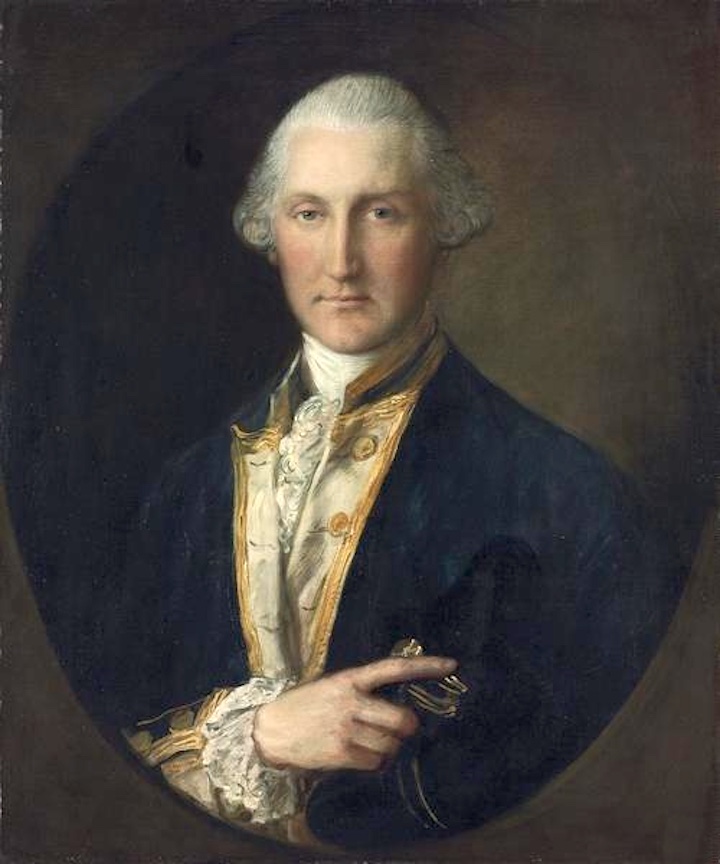
Like many other cadet sons of the British aristocracy, Lord William Campbell joined the Royal Navy in his youth and prepared for a career as a commissioned officer. Midshipman Campbell served in India during the late 1750s, supporting the British East India Company’s subjugation of the native population during a period of violent resistance. Returning to Britain in 1760 and qualifying as a lieutenant, he was wounded during the capture of Belle Île, off the coast of Brittany in the spring of 1761.[2] His nation was, at that time, mired in a global conflict known in England as the Seven Years’ War. Although Britain and France were the principal combatants on the European continent, the war also involved numerous colonial territories stretching from the Philippines to the Americas. France was losing ground by the time Lieutenant Campbell returned in the autumn of 1761, but the war suddenly expanded the following January, when Spain joined the fray in support of the French Crown.
Immediately thereafter, the British ministry approved a plan proposed by Admiral George Anson, then First Lord of the Admiralty, to send a large naval expedition across the Atlantic to attack Havana, Cuba, the epicenter of Spanish colonial power in the Caribbean Sea. Dozens of warships and scores of troop transports were set in motion during the early weeks of 1762, when Anson and the other noblemen forming the Board of Admiralty commissioned Lord William Campbell to command the modest sloop-of-war Carcass, then being converted into a bomb vessel at Portsmouth Dockyard. The twenty-five-year old commander dutifully attended that work during the ensuing spring, but the massive expedition fleet departed from England without the Carcass and commenced the Siege of Havana in early June.[3]
Two bloody months later, on 13 August 1762, Spanish colonial officials surrendered the heavily fortified city of Havana (and, in effect, all of Cuba) to British forces. News of this monumental development had not yet reached England when, on August 20th, the Lords of the Admiralty raised Commander Campbell to the rank of captain and assigned him to the Nightingale, a twenty-two-gun frigate carrying 160 men. The sixth-rate ship was then moored at Woolwich Dockyard in the River Thames, where Campbell joined the crew on the afternoon of the 25th and began preparing for active service.[4]
Two weeks later, on September 10th, the Lords of the Admiralty issued detailed orders for the captain of the Nightingale. After getting the ship ready for the sea, Campbell and his crew were to sail to Spithead, a broad anchorage outside Portsmouth Harbor, on the south coast of England, and there collect a convoy of merchant vessels bound for South Carolina and Georgia. He was to escort the ships across the Atlantic as soon as possible, “using your utmost endeavours to prevent them from falling into the hands of the enemy.” Having arrived at the port of Charleston, the colonial capital, Campbell was to confer with the senior naval officer serving on the Carolina Station, Captain John Botterell (ca. 1716–1793) of His Majesty’s Ship Success, and follow his directions “for the protection and security” of both South Carolina and Georgia. Campbell’s assignment did not permit him to linger in the colonies, however. The Lords of the Admiralty instructed him to remain at Carolina “’til the first day of April next; when, having previously given proper notice to the [parties] concerned, you are to collect the homeward bound trade, and taking them under your care, proceed with them without loss of time to England.”[5]
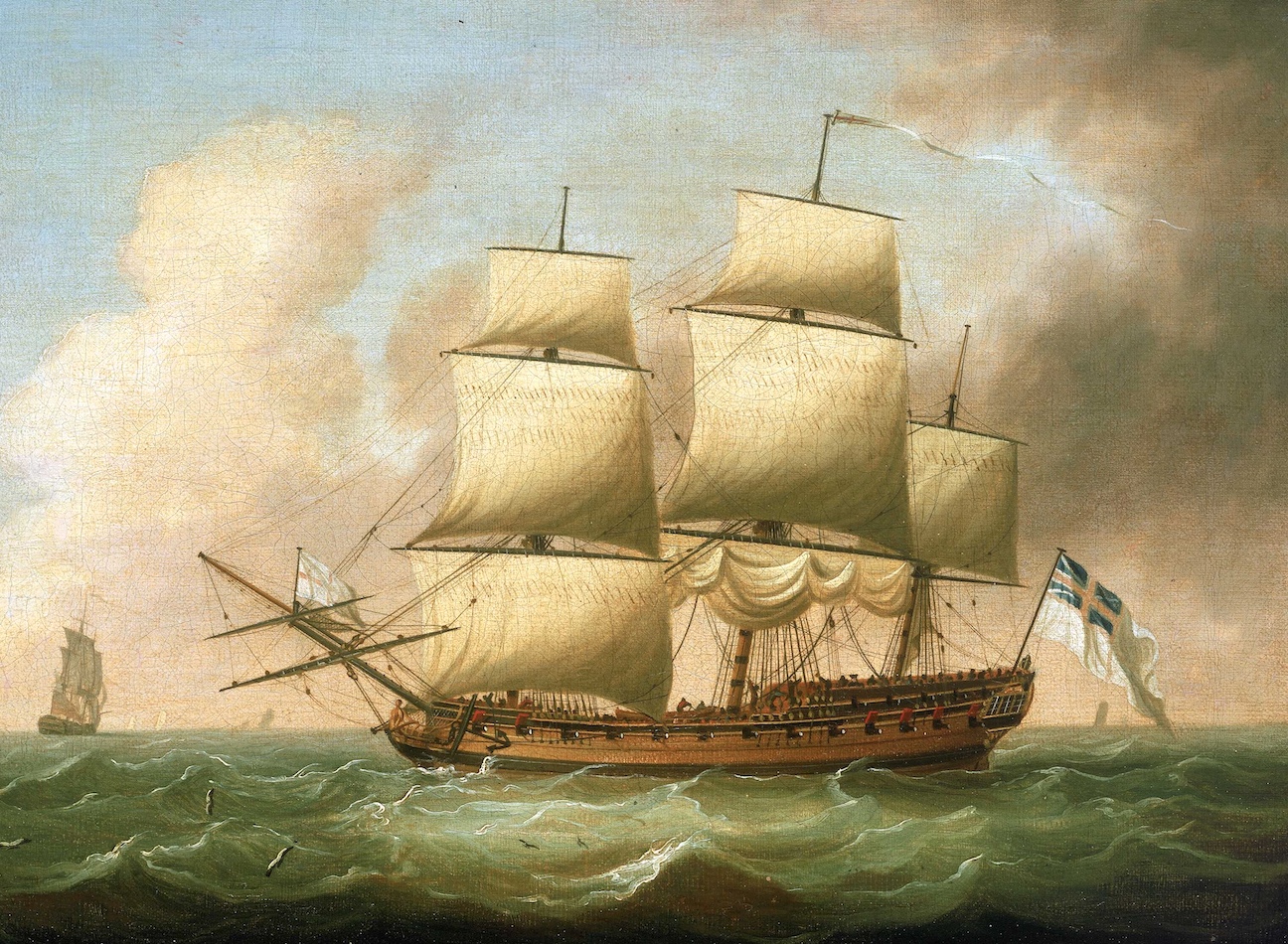
After two months of preparations at Woolwich, the Nightingale weighed anchor on 24 October and began winding down the River Thames. The ship paused for a week at Long Reach to take in the ship’s armaments and gunpowder, providing the captain with an opportunity to dispatch an important letter. Campbell informed the Admiralty that the lieutenant assigned to his ship had never made an appearance and asked the board to commission a replacement. Considering “that there is only one lieut[enan]t to be on board,” he politely requested “that I may have somebody that is something of an officer.”[6]
The Nightingale resumed its seaward journey in early November, sailing from Long Reach to the mouth of the Thames, around the curving coast of Kent, past the white cliffs of Dover, and along the southern coast of Sussex to Spithead, where Captain Campbell and his men anchored among a crowd of warships and merchant vessels on November 15th. At sunrise the following day, the Nightingale fired a gun and made the customary signal (i.e., loosening the top of the ship’s foretopsail) to gain the attention of all masters of merchant vessels bound to the southern colonies of North America. While dozens of civilian mariners made their way to the warship to confer with Lord William Campbell, Lieutenant George Newton (ca. 1720–1782), nearly a decade older than the captain, climbed aboard the Nightingale to serve as his second-in-command.
In company with a convoy of twenty-four merchant vessels, the Nightingale weighed anchor from Spithead at dawn on November 20th and began sailing westward along the coast of southern England. Five days later, the flotilla was approximately 190 nautical miles southwest of the Lizard Point in Cornwall, the southwestern-most point of Britain, when a storm began to brew. Normal squalls of rain increased to “violent storms of wind” and “great swells” in the sea during the twilight hours. Shortly after midnight, Captain Campbell ordered his crew to furl up the sails and turn the ship into the wind to avoid capsizing. As the Nightingale rocked before the battering gales, a powerful gust cracked the mainmast, a stout timber approximately two feet in diameter. Seaman hauling down the main yards and rigging in the darkness battled high winds and towering waves that crashed along the deck and flooded the ship’s hold. The storm abated at sunrise on the 26th, when the king’s mariners counted only a few members of their convoy still in sight.
As crewmen aboard the warship effected various repairs, braced the damaged mainmast, and worked the mechanical pumps to drain seawater from the hold, they discovered leaks in the hull that could not be fully stopped. Concerned for the safety of his men and their mission, Captain Campbell faced a difficult decision. At dawn on November 27th, the Nightingale fired a gun and made signals to summon the master of every vessel remaining in convoy for a conference aboard the warship. Hours later, Campbell gave the order to turn about and make sail for England. Rough seas continued to batter the damaged vessels as the remaining convoy retraced their path to the northeast and reached Plymouth Sound on November 30th. While the merchant vessels dispersed across the placid harbor, the Nightingale moored at the Royal Navy’s sprawling dockyard in the River Tamar.
Two weeks later, having replaced the ship’s mainmast and patched most of its leaks, crewmen aboard the Nightingale made the customary signals to reassemble its civilian convoy. The warship set sail from Plymouth on the afternoon of December 15th and turned once again to the southwest, embarking across the wide Atlantic with a diminished crowd of fourteen vessels.
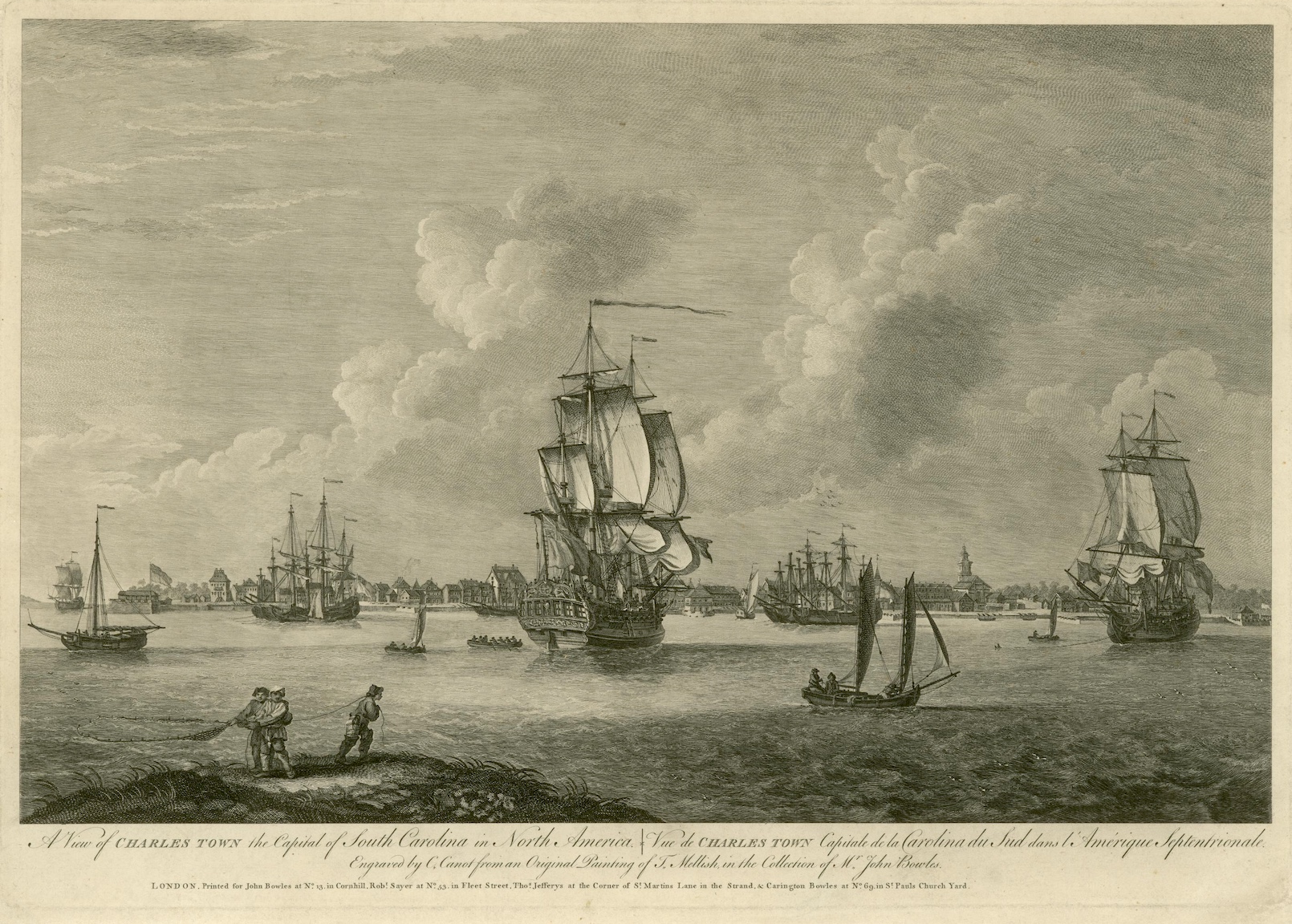
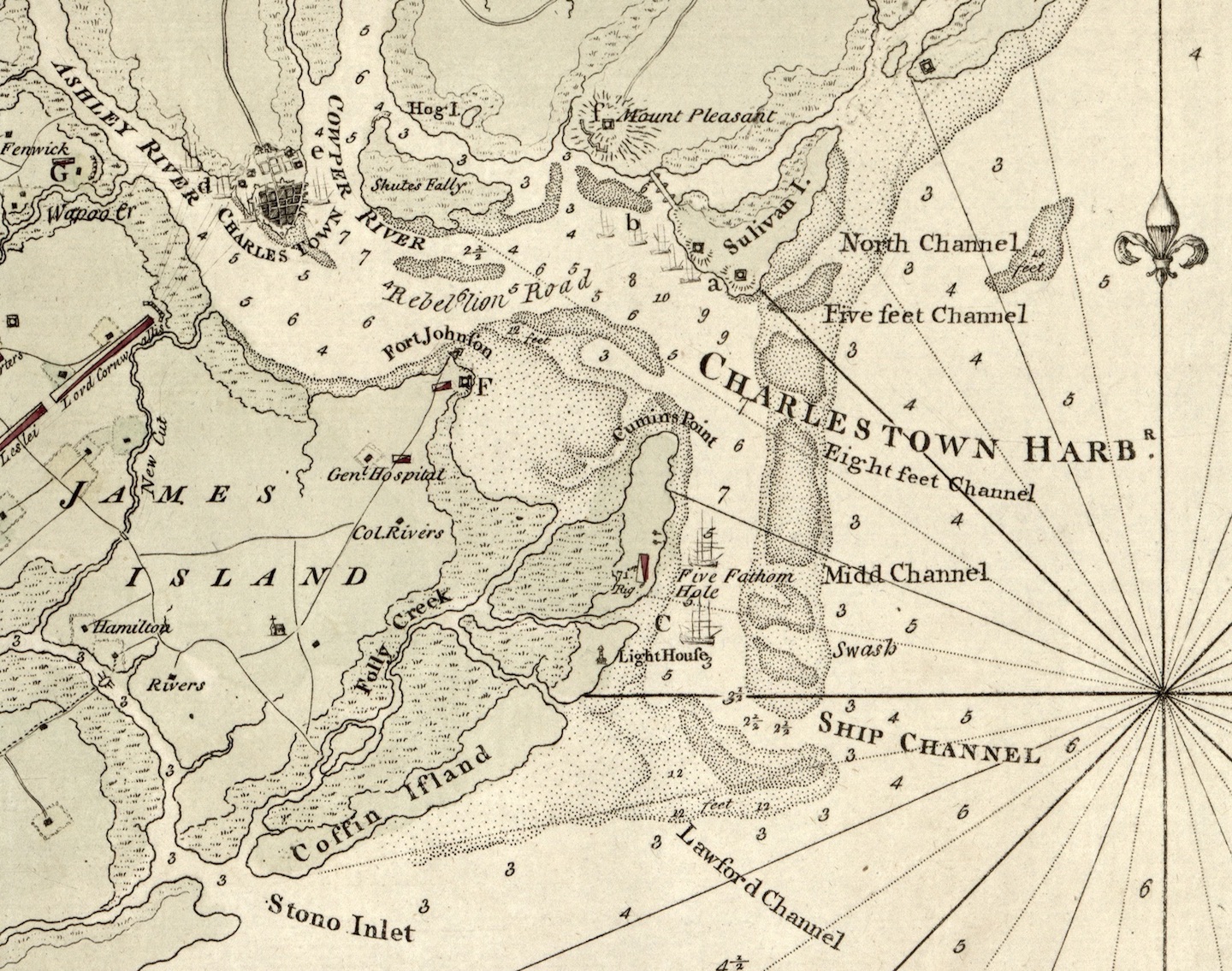
At first light on the morning of 9 February 1763, crewmen perched high in the rigging of the Nightingale sighted land dead ahead. The captain’s nautical charts, shared with Lieutenant George Newton and Sailing Master Matthew Davis, led the ship directly to the bar of Charleston Harbor, where the convoy anchored before sunset. The following day, while local pilots guided the waiting merchant vessels into the harbor one by one, His Majesty’s sloop-of-war Bonetta, a smaller vessel recently assigned to the Carolina Station, came alongside the Nightingale and lent a pilot to the larger frigate. Both warships crossed the bar on the morning of February 12th and, hours later, the Nightingale moored in the middle of the Cooper River, slightly north of the sand bar called Shute’s Folly and due east of Rhettsbury plantation.[7] Like other warships of its class, the frigate carried two boats, a stout yawl for transporting heavy cargo, and a longer pinnace for carrying passengers in style and comfort. After hoisting the boats from the deck and lowering them into the slow-moving river, the captain and his subordinates enjoyed ready access to Charleston’s bustling urban waterfront.
Captain Campbell recorded no details of his personal activities during his visit to Charleston during the early weeks of 1763, but he probably followed the same pattern of movements tread by scores of other naval officers serving in the American colonies. As a commissioned representative of King George III, Campbell likely sought an audience with the provincial executive, Governor Thomas Boone (ca. 1730–1812), a gentleman of similar age who had arrived in December 1761. Boone had inherited Carolina property from his great-uncle, Joseph Boone, and married a local girl during an earlier visit to the colony, facts that fostered high hopes for the success of his administration. Shortly after his arrival as governor, however, Boone clashed with headstrong members of the elected assembly, especially a thirty-eight-year-old firebrand named Christopher Gadsden, who asserted procedural rights of the colonial assembly that diverged from British precedent. Increasing friction between the executive and legislative branches paralyzed South Carolina’s provincial government during the remainder of 1762, but Boone hoped that a new round of winter elections would end the stalemate. The newly-elected representatives had assembled in Charleston on 24 January 1763, according to orders, but immediately commenced a familiar chorus of procedural complaints. Rather than hear further arguments in favor of colonial rights, Governor Boone dismissed the Assembly and postponed their next meeting to September.[8] The political gulf between the king’s government and the colonial population, as Captain Campbell might have observed, had never been greater in South Carolina.
Turning to his naval colleagues, Campbell no doubt socialized with Captain John Carey, commander of the Bonetta, who had participated in the recent siege of Havana and was afterwards dispatched to protect the Carolina coastline. Spanish privateers sailing from St. Augustine had been harassing British vessels outside the bar of Charleston Harbor in recent months, but that scourge was abruptly silenced by the recent arrival of astonishing news. Rumors of a conditional truce between Britain, France, and Spain reached both South Carolina and Florida one week before the arrival of the Nightingale, and on February 12th, the day Campbell stepped ashore, the local South Carolina Gazette published the full text of the official preliminary articles of peace, signed in France by representatives of the warring parties in November 1762. The Carolina colonists still waited for confirmation of the treaty’s ratification, but its contents must have elicited cheers in the streets of Charleston. According to the Gazette, the Spanish Crown had agreed to abandon its centuries-old claim to the mainland colony of La Florida, held since 1513, in exchange for the return of the Island of Cuba. After nearly a century of anxious rivalry between English Carolina and Spanish Florida, their Spanish neighbors would soon evacuate the mainland and withdraw to the Caribbean.[9]
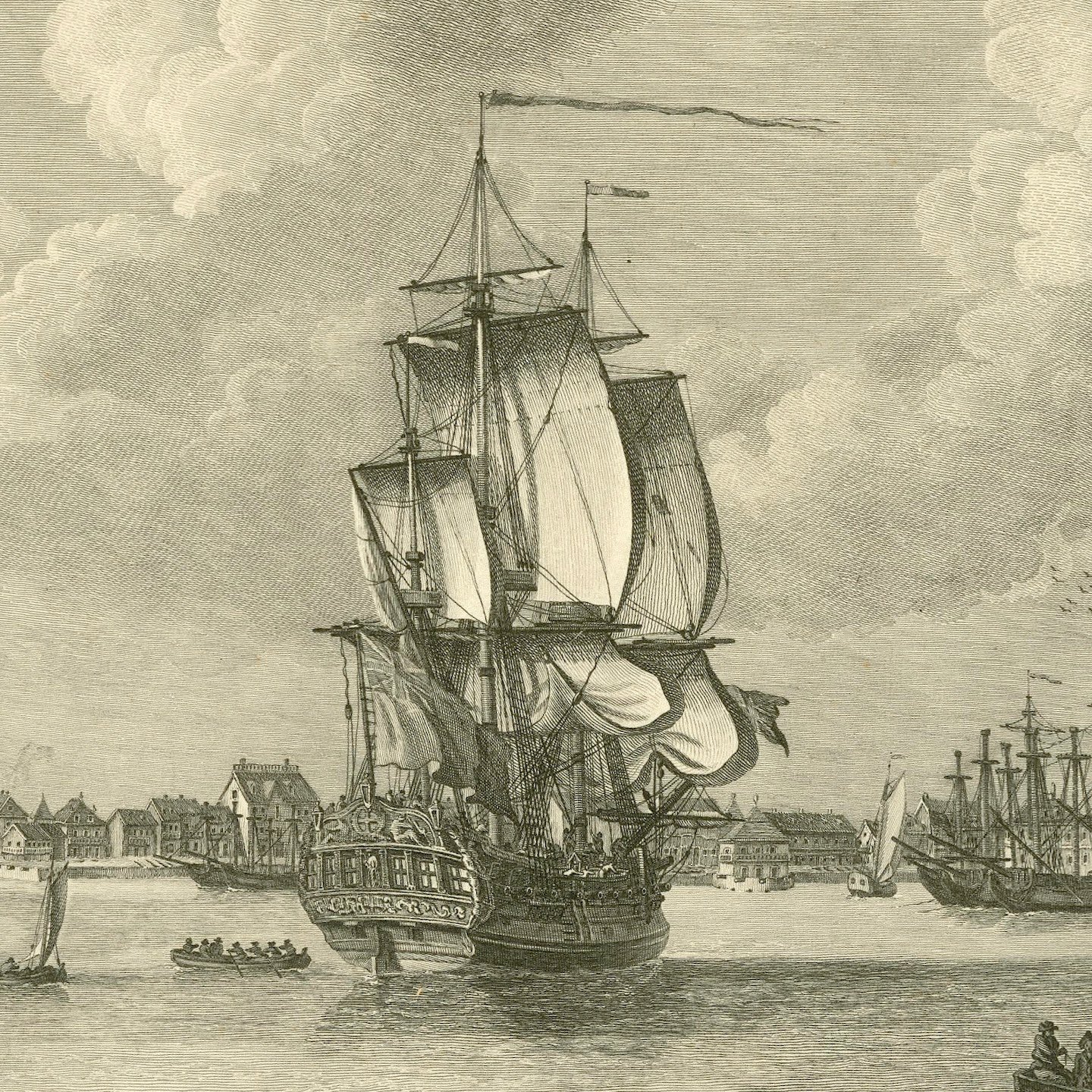
While Captain Campbell socialized on shore in Charleston, the crew of the Nightingale did not remain idle. Between periodic rounds of shore leave during their ten-week respite in the harbor, the motley seamen performed a variety of mundane tasks like scraping and repainting the spars, masts, and hull, and stowing quantities of bulk provisions delivered by local contractors. Periodically they dispatched shore parties in the ship’s yawl to a commercial shipyard within Hobcaw Creek, a tributary of the Wando River, where the king’s warships and other large vessels routinely acquired supplies of fresh water and firewood. Rather than sail the Nightingale four miles upstream to careen within Hobcaw Creek, the crew shifted its guns and cargo and heeled the ship from side to side while moored in the Cooper River, scrubbing the starboard and larboard sides in turn.
The local population of British mariners doubled on the morning of February 23rd, when two twenty-gun frigates assigned to the Carolina Station, the Success and the Mercury, both returned from month-long sea cruises and anchored in the harbor near the Nightingale.[10] Although the Admiralty had ordered Lord William Campbell to place himself under the command of Captain John Botterell of the Success during his tenure in Charleston, Botterell was no longer the most senior officer present. Captain Samuel Goodall of the Mercury, like Captain Carey of the Bonetta, had participated in the recent siege of Havana and was afterwards assigned to the Carolina Station. Although scarcely older than Lord William and similarly new to the captain’s rank, Goodall served as the senior representative of the Royal Navy in Carolina for the duration of Campbell’s visit.
As such, Captain Goodall and his naval colleagues attended Governor Boone at the steps of the South Carolina State House in Broad Street on the afternoon of February 28th to witness an obligatory public event. One day earlier, Governor Boone had received a packet from London containing official confirmation that the governments of Britain, France, and Spain had ratified the preliminary articles of peace. To publish this important news with due pomp and circumstance, the king’s representatives gathered at the State House at 4 p.m. to hear Provost Marshal Daniel Doyley read aloud the official proclamation of peace, which he then repeated, “in the usual form,” at several additional street corners within the urban landscape. Immediately afterwards, Governor Boone drafted a polite letter to the Spanish governor of Florida, formally acknowledging the truce between their respective crowns. Boone handed his letter to Captain Goodall, who dispatched Captain Carey in the sloop-of-war Bonetta to St. Augustine to confirm their governor’s acknowledgement of the cessation of hostilities and the surrender of Spanish Florida.[11]
News of the formal truce and the long-coveted possession of Florida brought welcome relief after seven years of warfare that had dampened the profitable plantation economy of colonial South Carolina. The peace of 1763 marked the beginning of the most significant boom in South Carolina’s early history, a period of unbridled confidence in the permanence and strength of Britain’s North American colonies. Amidst a season of celebration in the Carolina capital, the young bachelor Lord William Campbell gained privileged access to social events hosted by the local gentry, no doubt including a succession of dinner parties, dances, and musical soirées that introduced him to the colony’s most eminent families and their most eligible daughters.
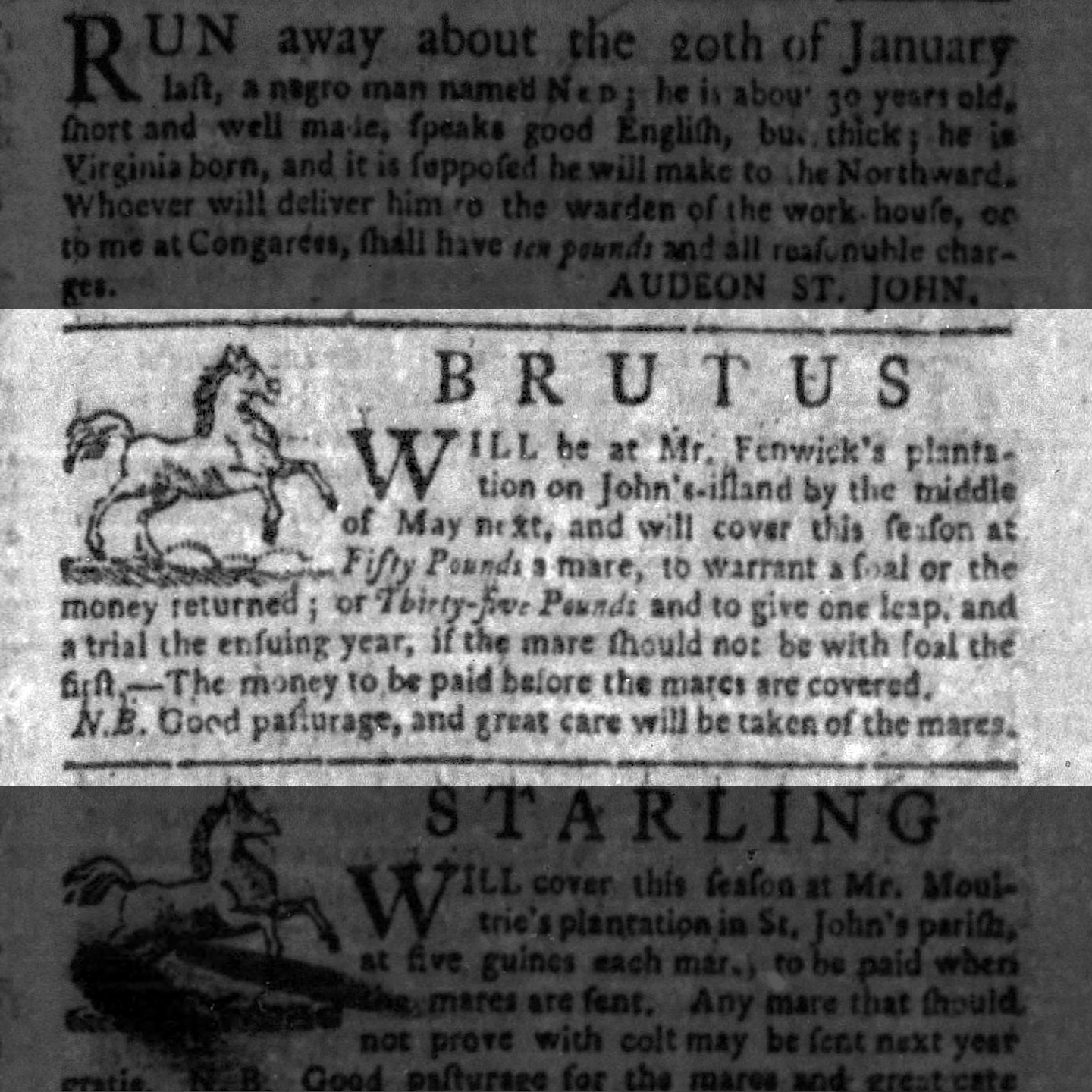
Campbell had arrived one week after the town’s principal social event of the winter season, the annual equestrian sport held at Newmarket Racecourse on Charleston Neck, just over a mile north of the provincial state house. Successive days of heats around the one-mile oval track entertained crowds of the plantation elite and inspired wagers large and small. One of the stars of the 1763 turf was a young stallion named Brutus, the imported offspring of a British thoroughbred, which had bested all competitors in recent races.[12] Brutus belonged to the estate of one of South Carolina’s wealthiest planters, Ralph Izard (1717–1761) of Burton plantation in the nearby parish of St. George, Dorchester, who had died two years earlier, and Izard’s executors now managed both his prize stallion and the family’s extensive property on behalf of his widow and minor children. In the aftermath of the Charles-Town Races in early February, however, Landgrave Edmund Bellinger III, wealthy owner of the rival stallion Steady, challenged Brutus and the Izard clan to a private contest the following month.
Captain Campbell was in town for the event held at Newmarket Racecourse on March 16th, and must have stood among the local elite who gathered to witness the sport. The executors of Ralph Izard’s estate, Henry Middleton (1717–1784), Daniel Blake (1731–1780), and Benjamin Smith (1717–1770), all wealthy men of the highest social rank in Carolina, likely chaperoned the late planter’s young family, including his attractive eldest daughter, Sarah Izard, aged between sixteen and twenty years. At this event, or perhaps an earlier occasion, Lord William and Sarah exchanged salutations and enjoyed some fleeting moments of polite conversation. If there was a spark between the pair under the fragrant canopy of early spring weather, it proved the highlight of the day. Punters placed heavy odds on the Izard’s stallion Brutus—six to four against Bellinger’s Steady in the first of three two-mile heats—but the local press reported that Steady won a hollow victory. Despite the loss, odds on Brutus were two to one for the second heat, which commenced with both jockeys whipping their mounts into action from the starting line. Steady immediately distanced Brutus, however, and those betting on the Izard clan were devastated. The defeated horse and jockey did not even finish the heat, reported the South Carolina Gazette, but instead “prudently retreated into the woods.”[13]
Regardless of the precise circumstances of their introduction, Lord William Campbell and Sarah Izard developed some intimacy in the days preceding his obligatory departure from South Carolina. The young lovers might have pined for time to grow better acquainted, but the captain’s duty to king and country abridged their budding relationship. From the moment of his arrival, Campbell had made no secret of his orders to set sail in the Nightingale for England on the first of April.[14] As that day drew near, he might have proposed marriage to Sarah, and might have been surprised by her response. She was already engaged to marry another suitor, and had jilted an earlier fiancé when the present beau appeared—or so alleged the author of a spiteful poem published later that spring. While details of the couple’s amorous negotiations vanished centuries ago, documentary evidence of Campbell’s subsequent movements survive.[15]
Observing his orders from the Admiralty, Captain Lord William and his men began preparing their warship for departure in late March. On the afternoon of the 25th, the Nightingale fired a gun and made the signal to summon masters of merchant vessels wishing to form a convoy back to England. Three days later, the sloop-of-war Bonetta returned to Charleston Harbor from St. Augustine, bringing confirmation that the Spanish governor had acknowledged his king’s promise to cede Florida in exchange for Cuba.[16] The costly Seven Years’ War was effectively over, save the ratification of a formal treaty by the warring parties, and the Admiralty would soon recall most of the king’s ships from the American colonies to save further expense.[17] Despite his incipient affection for Miss Sarah Izard, Captain Campbell watched his crew stow bulk provisions, fresh water, and firewood aboard the Nightingale during the last days of March for the long voyage back to England. Mariners under his command began to unmoor the warship from the Cooper River at dawn on the first of April. At 11 a.m., the tidal breeze propelled the frigate three miles eastward to a new anchorage in Rebellion Road, the customary resting place for vessels preparing to cross the bar and exit Charleston Harbor. The Nightingale could have departed with the next favorable confluence of wind and tide, but the ship did not stir again for several weeks. Campbell’s reluctance to part from Sarah, not inclement weather, delayed his return to England.
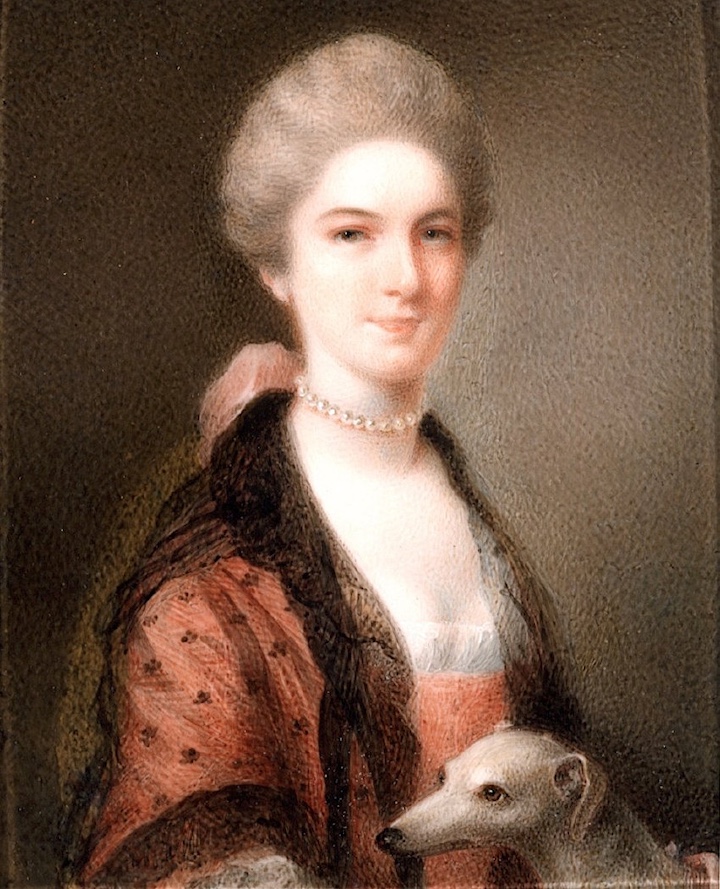
We have to use our imaginations to reconstruct most of the whirlwind courtship between Lord William Campbell and Sarah Izard in the early spring of 1763, but extant records reveal the seriousness of their matrimonial negations. As with many other wealthy families of that era, Sarah’s legal guardians required her intended spouse to sign a premarital contract or “settlement,” to protect her inherited assets from the potential spoilage of a profligate husband. After Campbell assented to this legal custom, Sarah’s guardians—Henry Middleton, Benjamin Smith, and her uncle Daniel Blake—retained lawyers to draft the necessary articles while Sarah’s family prepared for the wedding. The trio of guardians, who also managed numerous Izard plantations worked by scores of enslaved men, women, and children, calculated that Sarah’s minor share of her father’s estate amounted to £50,000 South Carolina currency (more than £7,000 sterling at that time). According to the British doctrine of coverture, that property would transfer to her husband’s possession at the moment of their legal union. To prevent the loss of Sarah’s fortune to a potentially capricious spouse, her guardians established a legal trust to manage the land and enslaved people apportioned to her and to invest the profits generated thereby. The trust blocking Campbell’s access to Sarah’s money did not concern the affluent officer. On Saturday, April 16th, Lord William signed both the settlement and a bond in the sum of £100,000 currency, pledging with his own fortune to honor the legal sanctity of their marriage settlement.[18]
On Sunday, 17 April 1763, the Reverend Robert Smith married Lord William Campbell and Sarah Izard at St. Philip’s Church in Charleston. The local newspaper, using the typical patriarchal language of that era, described the bride as “a young lady esteemed one of the most considerable fortunes in the province.” Details of the ceremony and the couple’s itinerary in the succeeding days are long lost, but Sarah’s family must have helped her pack clothes and mementos for a new life across the ocean, while Lord William fraternized with his new family and friends in the Carolina capital.[19]
Captain Campbell resumed his naval duties after a brief matrimonial diversion, and engaged a local pilot to move the Nightingale from Rebellion Road to an anchorage beyond the bar of Charleston Harbor. The warship set sail at dawn on April 26th and traversed the circuitous route in less than three hours, anchoring offshore to the southeast of Sullivan’s Island. Meanwhile, back in town, Campbell assigned power of attorney to local merchant John Forbes and a young lawyer named James Moultrie, who would manage the captain’s private accounts in South Carolina during the coming years.[20]
Lord and Lady William bid farewell to friends and family in Charleston the following morning and then stepped aboard the captain’s pinnace, which then traversed the harbor to the resting warship. Surviving records from the Nightingale’s brief Carolina visit do not mention any other passengers, but one or more servants, likely enslaved women of African descent, might have accompanied Sarah to her new home abroad. Immediately after Lord and Lady William ascended the ship’s ladder and greeted the waiting crew, the Nightingale set sail across the North Atlantic for England.[21]
Six weeks later, on the eighth of June, Captain Campbell’s crew and passengers sighted the south coast of Cornwall on the eastern horizon. Strong winds and persistent leaks obliged the Nightingale to shelter within Carrick Roads, near Falmouth, for several days, but the returning frigate reached Spithead by the 20th. The following day, Lord William wrote a brief letter to inform the Secretary to the Lords of the Admiralty that he had completed the assigned mission to Charleston, South Carolina. Campbell also apologized for the tardiness of his return, acknowledging that he “should have sailed from that port for England the 1st of April, the time their Lordships appointed, but [I] was detain’d by contrary winds ’til the 27th.”[22]
Campbell’s “contrary wind” named Sarah accompanied her husband and the crew of the Nightingale to a berth at Woolwich Dockyard in the River Thames, where a naval commissioner paid off the ship’s crew on the morning of July 19th. At noon, the captain hauled down the long, swallow-tailed pendant (or pennant) from the peak of the main topgallant mast, signaling the conclusion of the ship’s recent commission. Lord and Lady William thereafter commenced their private lives ashore in Britain, but did not forget their Carolina connections. In fact, they conspired to return to Charleston and expand their colonial investments. We’ll continue that narrative thread in the next episode, following the couple back and forth across the Atlantic in the years before the American Revolution.
[1] William Campbell, son of “the Honble: Collonel [sic] John Campbell and Mrs. Mary his wife deceas’d,” was baptized on 10 January 1736/7 (on the Julian Calendar, or 21 January 1737 on the Gregorian Calendar) at St. Mary's Church, Sundridge, Kent; see Kent Baptisms, 1710–1754, P357/1/A/3, Kent History & Library Centre; accessed via findmypast.com on 5 February 2026. William's mother, Mary, died in childbirth; no record of her burial has yet been found, but it probably occurred shortly before William's baptism. The Campbells long maintained a residence at Combe Bank, one mile north of St. Mary's Church.
[2] Campbell’s early service in the Royal Navy is summarized in his lieutenant’s passing certificate, dated 3 December 1760, which described him as being “more than 23 years of age”; it indicates that he served as a midshipman in the Tyger and then Yarmouth during the late 1750s, both of which were active in Indian waters; see ADM 107/5/310, held with other Admiralty records (ADM) at the National Archive, Kew, England. Campbell mentioned his service at the 1761 capture of Belle Île in his 1778 claim for wartime losses in Charleston, T 1/541, folios 395–410, at the National Archives.
[3] Campbell’s commission, dated 28 January 1762, is found in ADM 6/19/383, at the National Archives, Kew. According to Rif Winfield, British Warships in the Age of Sail, 1714–1792: Design, Construction, Careers and Fates (Seaforth, 2007), page 534 of e-book edition, the Carcass was built in 1759 as a three-masted sloop-of-war, carrying approximately 309 tons burthen, and was converted into a bomb vessel at Portsmouth in the spring of 1762 under Lord William Campbell.
[4] A brief summary of the Nightingale appears in Winfield, British Warships in the Age of Sail, 1714–1792, pages 405–6 of the e-book edition. This and subsequent descriptions of Campbell’s maritime activities and sailing itinerary in this essay derive from the Captain’s logbook, Nightingale, 1762–63, ADM 51/4273, held with other Admiralty records (ADM) at the National Archive, Kew, England.
[5] Admiralty orders to Lord William Campbell, 10 September 1762, in Admiralty Orders, 1762–63, ADM 2/89, pages 69–70.
[6] Lord William Campbell, aboard the Nightingale at Long Reach, to the Secretary of the Admiralty, John Cleveland, 30 October 1762, ADM 1/1608.
[7] Captain’s log, Nightingale, 1762–63, ADM 51/4273; Master’s log, Nightingale, 1762–73, ADM 52/1385; South Carolina Gazette (hereafter SCG), 5–12 February 1763, No. 1491, page 2, see “Charles Town, February 12,” and “Marine Intelligence.”
[8] For an overview of the political tensions of Governor Boone’s administration, see Eugene M. Sirmans, Colonial South Carolina: A Political History, 1663–1763 (Chapel Hill: University of North Carolina Press, for the Institute of Early American History and Culture, Williamsburg, Va., 1966), 346–57.
[9] SCG, 29 January–5 February 1763, page 7; SCG, 5–12 February 1763, page 1.
[10] Captain Campbell’s logbook (ADM 51/4273) noted the anchorage of the Mercury and Success on the morning of 23 February 1763, but the “Marine Intelligence” published in SCG, 19–26 February 1763, page 2, placed their arrival on the 22nd.
[11] South Carolina Department of Archives and History (hereafter SCDAH), Journal of His Majesty’s Council for South Carolina, No. 29, page 19 (28 February 1763); SCG, 26 February–5 March 1763, page 4.
[12] SCG, 25 December 1762–1 January 1763, page 1; SCG, 29 January–5 February 1763, page 7.
[13] SCG, 12–19 March 1763 (Saturday), No. 1496, page 3.
[14] SCG, 5–12 February 1763, page 2.
[15] SCG, 16–23 April 1763 (Saturday), No. 1501, page 4: “----- Mulier cupido quod dicit amanti ¶ In vento, & rapida scribere oportet aqua. Catul[lus, No. 70][translation: what a woman says to her passionate lover, she ought to write on the wind and swift-flowing water]. ¶ With simple Sylvia, false, capricious fair, ¶ Each vow is nonsense, ev’ry promise air: ¶ Engaged to two, what signifies her word? ¶ A stranger broke the first, her next a L---. ¶ Light as the vane, that plac’d upon the mast ¶ Turns with each wind, and yields to ev’ry blast, ¶ Still wilt thou be—Thy L--- shall wish too late ¶ His ship, more constant, was his only mate; ¶ For sure experience must have prov’d already, ¶ He ne’er shall keep thee ‘steady, girl, steady.’”
[16] SCG, 26 March–2 April 1763, page 2.
[17] Charlestonians received news of the ratification of the definitive treaty, signed at Paris on 10 February 1763, one month after the departure of the Nightingale, and its full text appears in SCG, 21–28 May 1763, pages 1 and 4.
[18] The full text of the Izard-Campbell marriage settlement of 16 April 1763, witnessed by John Forbes, Rev. Robert Smith, and William Græme, is found in SCDAH, Miscellaneous Records (Main Series), volume MM, pages 24–27.
[19] D. E. Huger Smith and A. S. Salley Jr., eds. Register of St. Philip’s Parish, Charles Town, or Charleston, S.C. (Columbia: University of South Carolina Press, 1971), 171; SCG, 16–23 April 1763, page 4; SCG, 23–30 April 1763, No. 1502, page 3.
[20] Lord William Campbell to John Forbes and James Moultrie, power of attorney, 26 April 1763, SCDAH, Miscellaneous Records (Main Series), volume MM, pages 77–78.
[21] SCG, 23–30 April 1763, page 3.
[22] Campbell to Admiralty Secretary John Cleveland, 21 June 1763, ADM 1/1608; I have added punctuation to clarify the syntax.
NEXT: Lord William Campbell, Sarah Izard, and their Carolina Connection, Part 2
PREVIOUSLY: The 1775 Debut of the South Carolina Flag
See more from Charleston Time Machine